Introduction
12th Arts ke baad Christ University ko consider karne wale students ke liye sabse pehla sawaal usually course se zyada fit ka hota hai: kya chosen programme unke interest, academic background aur future plan ke saath match karta hai? Christ University me Psychology, Journalism and Media, Economics, English, Political Science, Sociology aur related disciplines ke options students ko alag directions explore karne dete hain. Lekin admission decision sirf university ke naam ya kisi ek course ki popularity dekhkar lena practical nahi hai. Student ko eligibility, admission selection process, total education cost, campus preference, hostel requirement aur graduation ke baad ka intended path ek saath compare karna chahiye. For example, Psychology choose karne wale student ko higher study requirements ko pehle samajhna chahiye, jabki Journalism me portfolio, writing aur media-production skills ka importance graduation ke saath badh jata hai. Isi tarah Economics ya Political Science lene wale students higher studies, competitive examinations aur analytical roles ki direction me apni preparation plan kar sakte hain. Is guide ka purpose Christ University ko blindly recommend karna nahi, balki Arts students ko course selection se lekar admission preparation aur post-graduation career planning tak practical decision points samjhana hai.
About Christ University
Christ University Bangalore me established ek private deemed-to-be university hai jahan undergraduate level par Arts, Commerce, Management, Science, Law aur other disciplines ke programmes available hain. Arts students ke perspective se university ko evaluate karte waqt sirf overall reputation dekhna enough nahi hai; selected programme, campus location, academic structure, student activities aur graduation ke baad ke intended career path ko bhi compare karna chahiye. Psychology, Journalism and Media, Economics, English, Political Science aur Sociology jaise subjects alag academic interests ko support karte hain, lekin har course ka workload aur future pathway different ho sakta hai.
Christ University ke Bangalore campuses ka environment bhi student ke decision ko affect kar sakta hai. Central Campus ke alawa Kengeri, Bannerghatta Road aur Yeshwanthpur jaise locations par programmes available ho sakte hain, isliye application submit karne se pehle selected course kis campus me offered hai, daily commute practical hai ya hostel ki zarurat padegi, aur available facilities kya hain, in points ko verify karna useful hai. Bahar se aane wale student ke liye campus location ka direct connection accommodation aur monthly living budget se bhi hota hai.
Christ University ka student environment kaafi varied hai, isliye Arts student ko college choose karte waqt sirf course list nahi dekhni chahiye. Different academic backgrounds se aane wale students ke saath interaction, presentations, clubs, discussions aur campus activities ka experience classroom learning ko broader bana sakta hai. Is environment ka actual benefit tab milta hai jab student academics ke saath co-curricular activities, internships aur skill-building opportunities me bhi actively participate kare. Isliye university ka overall environment useful ho sakta hai, lekin final decision selected programme aur student ki own priorities ko dhyan me rakhkar hi lena better hai.
Campus selection ko admission formality samajhne ke bajay student ko ise daily academic routine ke part ke roop me dekhna chahiye. Ek hi university ke different campuses me programme availability, travel time, residential options aur student activities alag ho sakti hain. Agar student Bangalore ke bahar se aa raha hai, toh campus decide karne ke saath accommodation, food aur local transport ka monthly estimate bhi banana sensible rahega. Course same hone par bhi location se overall student experience aur budget dono affect ho sakte hain.
Best Courses After 12th Arts at Christ University
Christ University me Arts students ke liye course selection karte waqt sirf naam ya popularity ko priority dena useful nahi hai. Har programme ka academic focus aur आगे ka career route alag ho sakta hai, isliye apni Class 12 subjects, interest aur graduation ke baad ke plan ko saamne rakhkar option compare karna better approach hai. Psychology human behaviour aur research-oriented learning me interest rakhne walon ke liye relevant ho sakti hai, Journalism and Media communication aur content production ki direction deta hai, Economics analytical and quantitative thinking develop karne walon ke liye suitable ho sakta hai, jabki English, Political Science aur Sociology students ko literature, governance, society aur research-oriented pathways explore karne ka scope dete hain.
BA Psychology (Honours)
Psychology choose karne wale students ko human behaviour, cognition, development, personality aur research methods jaise areas ke saath deal karna padta hai. Is option ko choose karne se pehle yeh samajhna important hai ki graduation ke baad counselling, research, HR ya mental-wellness related entry-level directions explore ki ja sakti hain, lekin specialised professional roles ke liye further education aur applicable professional requirements ko alag se check karna zaruri hota hai. Agar aapko people-oriented work ke saath academic research bhi interesting lagta hai, toh Psychology ek logical option ho sakta hai.
BA Journalism & Mass Communication
Journalism and Media un students ke liye practical choice ho sakta hai jinko writing, reporting, video production, digital publishing ya public communication me interest hai. Graduation ke dauran sirf theory par depend karne ke bajay reporting assignments, writing samples, video work aur internships ka portfolio banana useful rahega. Degree ke baad newsroom, digital media, public relations, content, communication aur related roles ke liye different pathways open ho sakte hain.
BA Economics
Economics un students ke liye better fit ho sakta hai jo markets, public policy, statistics aur data-based reasoning ko samajhna chahte hain. Course choose karne se pehle students ko mathematics aur quantitative work ke comfort level ko honestly assess karna chahiye, kyunki economic analysis me numerical interpretation important ho sakti hai. Graduation ke baad banking, research, finance-related entry roles, policy studies aur competitive examinations jaise directions consider kiye ja sakte hain.
BA English Honours
English Honours literature, language, interpretation aur structured writing par strong academic base develop kar sakta hai. Yeh option un students ke liye useful ho sakta hai jinko reading, writing, teaching, publishing, communication ya humanities-based higher studies me genuine interest hai. Graduation ke saath editing, content writing, public speaking aur research-writing jaise practical skills develop karne se degree ka career value aur clear ho sakta hai.
BA Political Science
Political Science me government, political institutions, public policy, political theory aur international affairs jaise areas study kiye jate hain. Students is background ko civil services preparation, policy research, journalism, social-sector work ya further academic study ke saath connect kar sakte hain. Agar aap current affairs ko regularly follow karte hain aur governance-related questions me genuine interest hai, toh yeh course long-term preparation ke liye meaningful foundation de sakta hai.
BA Sociology
Sociology society ke structure, institutions, communities, social change aur human relationships ko systematic way me samajhne par focus karta hai. Students research methods aur social issues ke analysis ke through NGO work, development sector, social research, public policy aur higher studies ki directions explore kar sakte hain. Is course ko choose karte waqt reading, observation aur research-oriented assignments ke liye apni interest ko bhi consider karna chahiye.
Course select karte waqt ek useful test yeh hai ki student khud se pooche: kya main is subject ko sirf admission ke liye nahi, balki agle teen saal interest ke saath padh paunga? Iske baad syllabus, assignments ka nature, higher-study options aur possible career directions compare karna chahiye. Salary ko final deciding factor banane ke bajay student ko apni strengths aur skill-building capacity bhi consider karni chahiye. Agar kisi subject me genuine interest hai aur student uske saath practical skills develop karne ke liye ready hai, toh wahi choice long term me zyada sustainable ho sakti hai.
Christ University Admission Process 2027
Christ University ka undergraduate admission process programme ke according multiple stages me ho sakta hai, isliye students ko sirf Class 12 marks ke basis par preparation complete nahi samajhni chahiye. Application submit karne ke baad selected programme ke according entrance assessment, skill assessment, Micro Presentation, Personal Interview ya other selection stages apply ho sakte hain. Practical approach yeh hai ki student pehle apne exact programme ki eligibility aur selection requirements identify kare, phir documents, test preparation aur interview practice ko deadline se pehle complete kare. 2027 cycle ki final dates aur applicable stages programme-specific official notification se verify karna zaruri hai.
Step 1: Online Registration & Application
Admission application fill karte waqt students ko sirf form complete karne par focus nahi karna chahiye, balki har entered detail ko submit karne se pehle carefully verify karna chahiye. Name, date of birth, academic marks, contact details aur uploaded documents me spelling ya information mismatch baad me correction ki requirement create kar sakta hai. Application process complete hone ke baad confirmation page, application number aur login details ko safe location par save karke rakhna bhi useful hai, kyunki aage ke admission updates aur selection stages ke liye in details ki zarurat pad sakti hai.
- Valid email ID aur mobile number se registration
- 10th aur 12th academic details fill karna
- Passport size photo aur scanned signature upload
- Identity proof (Aadhaar/other ID) submit karna
- Application fee online payment
Form submit karne ke baad students ko application confirmation aur login credentials milte hain jisse further process track kiya jata hai.
Step 2: Entrance Test (CUET – Christ Internal Exam)
Jin undergraduate programmes me entrance assessment applicable hota hai, unke applicants ko written test ke format aur programme-specific requirements ko pehle samajhna chahiye. Preparation ka focus sirf difficult questions solve karne par nahi hona chahiye; reading speed, basic reasoning, accuracy aur time management bhi equally important ho sakte hain. Arts background se aane wale students ko quantitative topics unfamiliar lag sakte hain, isliye basic concepts ko gradually revise karke timed practice karna exam ke pressure ko handle karne me zyada practical rahega.
- English Language & Grammar
- Logical Reasoning
- Quantitative Aptitude (basic level)
- General Knowledge & Current Affairs
- Basic comprehension skills
Entrance assessment ki preparation me students ko sirf syllabus complete karne ke bajay question-solving approach par bhi kaam karna chahiye. Kuch questions familiar topics se aa sakte hain, jabki kuch questions limited time me information interpret karne ki ability test kar sakte hain. Isliye preparation ke final weeks me timed practice, error analysis aur weak topics ki revision ko routine ka part banana useful rahega. Exact sections aur assessment format programme ke according change ho sakte hain, isliye preparation ko latest programme-specific instructions ke saath align karna important hai.
Step 3: Skill Assessment / Micro Presentation (MP)
Micro Presentation me student ko limited preparation time ke andar kisi given topic par apni baat structured way me rakhni pad sakti hai. Is round ke liye har possible topic ka answer yaad karna realistic nahi hai; better strategy yeh hai ki introduction, two or three supporting points aur short conclusion ke format me bolne ki practice ki jaye. Student ko difficult vocabulary use karne ke bajay clear language, relevant examples aur steady delivery par attention dena chahiye, kyunki natural explanation memorised speech se zyada convincing lag sakti hai.
- Communication clarity check ki jati hai
- Confidence aur body language evaluate hoti hai
- Thought process aur subject understanding dekhi jati hai
- Spontaneous speaking ability important hoti hai
Micro Presentation ke liye student ko apni baat ko short time me organise karna seekhna chahiye. Practice ke dauran ek topic choose karke bina notes padhe opening point, supporting example aur closing thought explain karne ki habit develop karein. Isse student ko unfamiliar topic par bhi structured response dene ki practice milti hai. Delivery me clarity aur relevance ko priority dena better hai; unnecessarily complex words ya memorised lines presentation ko artificial bana sakti hain.
Step 4: Personal Interview (PI)
Personal Interview me panel student ke academic background ke saath uske course interest, motivation aur communication style ko samajhne ki koshish kar sakta hai. Questions school subjects, chosen programme, hobbies, current events ya future plans se related ho sakte hain. Isliye interview ke liye ready-made answers ratne ke bajay apne actual experiences aur course choose karne ki genuine reason ko clearly explain karne ki practice karna better hai. Agar kisi question ka answer nahi pata ho, toh unnecessarily guess karne ke bajay honestly respond karna safer approach hoti hai.
- Self-introduction aur background discussion
- Course interest aur career goals
- Current affairs awareness
- Basic subject knowledge (course related)
- Confidence aur communication style
Interview se pehle student ko apne application form me di gayi information ko dobara read kar lena chahiye, kyunki discussion wahi details se naturally connect ho sakti hai. Chosen course kyon pasand hai, school me kaunse subjects interesting lage, kisi activity me kya seekha aur graduation ke baad kya explore karna hai—inke short but genuine answers ready rakhna useful hai. Answer perfect hone se zyada important hai ki student question ko samajhkar calmly respond kare aur apni baat ko unnecessary exaggeration ke bina explain kare.
Step 5: Final Selection & Admission Confirmation
Admission process ke individual stages complete karne ke baad students ko selected programme ki offer details, payment deadline aur document requirements carefully check karni chahiye. Selection mil jana final planning ka end nahi hota; admission confirmation ke liye required payment, original documents aur university ke instructions time par complete karna equally important hai. Students ko application login, confirmation emails aur admission updates safely save karke rakhne chahiye taaki kisi deadline ya document requirement ko miss na karein.
- Selection email / offer letter issue hota hai
- Admission fee deposit karni hoti hai
- Document verification complete hota hai
- Course enrollment confirm hota hai
Important Admission Timeline (Expected 2027)
Admission planning ke liye students ko apne programme ki application window, assessment stage aur final confirmation deadline ko ek personal calendar me note kar lena chahiye. Isse preparation aur documentation last moment par dependent nahi rahenge. Dates ko expected timeline ke basis par plan kiya ja sakta hai, lekin application submit karte waqt latest programme-specific schedule ko final maana jana chahiye. Agar university kisi stage ki date revise karti hai, toh student ko apne preparation plan ko bhi uske according adjust karna chahiye.
- Application Period: Applications generally December se January ke aas-paas start ho sakte hain, lekin exact opening date programme ke according verify karein.
- Entrance Test & Selection: Eligible programmes ke liye entrance test, skill assessment, micro presentation ya interview jaise selection stages March se May ke period me ho sakte hain.
- Result & Admission Confirmation: Selection process complete hone ke baad results aur admission confirmation generally May se June ke beech expected ho sakte hain.
- Academic Session: Selected students ke liye classes aur orientation activities June se July ke aas-paas begin ho sakti hain, depending on the programme and campus.
Student Action: Application submit karne se pehle programme-specific eligibility, application deadline, selection stages aur required documents ko official Christ University admission information se cross-check karein. Expected timeline ko sirf preparation planning ke liye use karein; final dates university ki official notification ke basis par hi consider karein.
Admission process har year slightly change ho sakta hai, isliye students ko official university updates regularly check karne chahiye. Process ka main focus academic marks ke saath communication skills aur overall personality evaluation hota hai.
Entrance Exam Syllabus (Christ University)
Entrance preparation start karne se pehle student ko apne selected programme ke assessment requirements clear kar lene chahiye. Uske baad English comprehension, reasoning, general awareness aur applicable quantitative topics ko alag study blocks me divide kiya ja sakta hai. Har topic ko equal time dena zaruri nahi hai; jis area me mistakes ya slow solving zyada ho, us par additional practice rakhna more practical approach hota hai. Is tarah preparation syllabus complete karne ke bajay actual performance improve karne par focused rehti hai.
1. English Language & Communication Skills
English section ke liye preparation ka matlab sirf grammar rules ya vocabulary lists yaad karna nahi hai. Students ko short passages padhkar main idea identify karne, unfamiliar words ka context samajhne aur sentence structure ko quickly recognise karne ki practice bhi karni chahiye. Daily reading habit se comprehension improve ho sakti hai, jabki timed exercises exam ke dauran questions ko unnecessarily zyada time dene se bachane me help karte hain.
- Grammar (Tenses, Articles, Prepositions)
- Vocabulary (Synonyms & Antonyms)
- Reading Comprehension Passages
- Sentence Correction & Error Detection
- Para Jumbles / Sentence Arrangement
- Basic Writing & Interpretation Skills
English preparation ko daily reading aur question practice ke combination ke roop me rakhna useful rahega. Student short editorial, feature article ya quality news report padhkar unfamiliar words ka meaning context se identify kar sakta hai, phir usi din comprehension ya grammar questions solve kar sakta hai. Week ke end me galat questions review karne se pata chalega ki difficulty vocabulary, sentence structure ya reading speed me hai. Yeh approach random vocabulary memorisation ke comparison me zyada targeted preparation provide kar sakti hai.
2. Logical Reasoning & Analytical Ability
Logical reasoning questions me student ko information ke beech relationship identify karke given conditions ke basis par correct conclusion tak pahunchna hota hai. Isliye preparation ke dauran answer dekhkar pattern samajhne ke bajay khud problem solve karne ki habit develop karna useful hai. Series, coding, directions, syllogism aur arrangements jaise topics ko regular practice dene se unfamiliar questions ko approach karne ka confidence gradually improve ho sakta hai.
- Number & Letter Series
- Coding-Decoding
- Blood Relations
- Syllogism
- Direction Sense Test
- Analytical Puzzles
- Seating Arrangement (basic level)
Reasoning practice me sirf questions ki quantity badhana useful nahi hota; mistakes ka reason samajhna bhi important hai. Agar student kisi arrangement, series ya coding question me baar-baar same type ki error karta hai, toh us pattern ke kuch additional questions solve karke concept ko reinforce karna chahiye. Practice sessions me easy aur moderate questions ko mix karna bhi useful hai, kyunki exam ke dauran har question equally familiar nahi hoga. Gradually time limit add karne se solving speed ko accuracy ke saath balance karna easier ho sakta hai.
3. General Knowledge & Current Affairs
General awareness prepare karte waqt students ko news ko sirf headlines ke form me remember karne ke bajay important event ka basic context bhi samajhna chahiye. National developments, international events, government initiatives, economy, sports aur major social issues ko regularly revise kiya ja sakta hai. Static GK ke liye short topic-wise notes banana aur current affairs ke liye weekly revision rakhna information ko scattered hone se bachata hai.
- National Current Affairs
- International News
- Sports Updates
- Government Schemes
- Economy & Budget Highlights
- Important Days & Events
- Basic History & Geography Awareness
Current affairs ko prepare karte waqt student ko har news ko yaad karne ki zarurat nahi hoti. Major national decisions, important international developments, economy, education, science, sports aur significant social issues jaise areas se relevant events select karke short notes banana zyada manageable rahega. Har week ke notes ko weekend par revise karne se old information gradually connect hoti rahegi. Interview ke liye kisi major event par basic facts ke saath balanced understanding develop karna memorised one-line answers se zyada useful ho sakta hai.
4. Quantitative Aptitude (Basic Maths)
Quantitative practice me student ko pehle yeh identify karna chahiye ki difficulty calculation me hai ya concept ko question par apply karne me. Ek small error notebook maintain karke repeatedly wrong formulas, calculation mistakes aur confusing question types record kiye ja sakte hain. Week me ek timed practice session rakhne se student ko apni actual solving speed ka idea milega. Jahan calculation slow ho, wahan basic arithmetic aur percentage-fraction conversions ki practice bhi entrance preparation ko smoother bana sakti hai.
- Percentage
- Ratio & Proportion
- Average
- Profit & Loss
- Simple Interest & Compound Interest
- Time, Speed & Distance
- Basic Data Interpretation (charts/graphs)
Quantitative aptitude me basic concepts clear hone ke baad speed improve karna comparatively easier hota hai. Students percentage, ratio, average, profit and loss aur simple data interpretation jaise topics ko pehle accuracy ke saath solve karein aur uske baad timer use karke practice karein. Agar kisi calculation type me baar-baar mistake ho rahi hai, toh naye questions start karne ke bajay us particular concept ko revise karke targeted practice karna better rahega.
Exam Pattern Highlights (Expected 2027)
Christ University ke entrance-based programmes me selection pattern programme ke according different ho sakta hai. Isliye students ko ek fixed exam format assume karne ke bajay apne selected course ki latest admission notification check karni chahiye. Preparation ke perspective se English comprehension, logical reasoning, general awareness aur basic aptitude jaise areas par practice karna useful rahega, especially un programmes ke liye jahan written assessment ya entrance test selection process ka part ho.
| Preparation Area | What Students Should Practise |
|---|---|
| English | Reading comprehension, vocabulary, grammar and clear written communication. |
| Reasoning | Logical patterns, analytical questions and time-bound problem solving. |
| General Awareness | Important national and international developments, basic current affairs and general knowledge. |
| Aptitude | Basic numerical and analytical questions where applicable to the selected programme. |
Important: Exam pattern ko final preparation ka fixed template na banayein. Student ko selected programme ke latest assessment instructions ke according sections, duration aur applicable selection stages confirm karne chahiye. Agar pattern me change aaye, toh preparation resources ko bhi update karna sensible rahega. Is approach se student outdated sample papers ya assumptions par unnecessary preparation time spend karne se bach sakta hai.
Eligibility Criteria
Christ University ke undergraduate programmes ke liye eligibility course ke according different ho sakti hai. Generally, applicant ko recognised board se Class 12 ya equivalent qualification complete karni hoti hai, lekin required subjects, minimum marks aur additional conditions selected programme par depend kar sakti hain. Isliye Psychology, Economics, Journalism, English ya kisi other Arts-related programme ke liye apply karne se pehle us particular course ki eligibility ko separately check karna important hai.
What Students Should Check Before Applying
- Class 12 Qualification: Apni 12th qualification aur board recognition ko programme ki stated eligibility ke saath match karein.
- Subject Requirements: Kuch programmes me specific Class 12 subjects ya subject combinations ki condition ho sakti hai, isliye apne academic subjects ko carefully compare karein.
- Minimum Marks: Required percentage programme-specific ho sakti hai. Kisi ek fixed percentage ko sabhi courses ke liye applicable na samjhein.
- Selection Requirements: Jahan applicable ho, entrance test, skill assessment, micro presentation, personal interview ya other selection stages ke liye bhi prepare karein.
Practical Tip: Agar student multiple programmes ke liye apply kar raha hai, toh har option ke liye qualification, required subjects, minimum marks aur selection stages ko ek comparison list me note karna useful rahega. Isse ek course ki eligibility ko doosre course par accidentally apply karne ka risk kam hota hai. Documents bhi application se pehle organise kar lene chahiye, especially academic records aur identification details. Final submission se pehle programme-specific conditions ko ek baar line-by-line check karna simple step hai, lekin admission-related mistakes avoid karne me kaafi helpful ho sakta hai.
Christ University Fees Structure 2027 (Detailed Overview)
Christ University ek private deemed-to-be university hai, isliye yahan ki fee structure government colleges ke comparison me higher side par hota hai. Fees ka variation mainly course, specialization, campus (Central Campus ya off-campus), aur academic facilities par depend karta hai.
Fee compare karte waqt campus ke naam ko automatically higher ya lower cost ka indicator nahi samajhna chahiye. Actual amount selected programme, applicable fee components aur admission year par depend kar sakta hai. Student ko jis course me admission lena hai uski current fee details ko directly check karke academic charges aur residential expenses ko alag calculate karna chahiye. Isse university-level general estimates ke bajay apne actual course ke closer budget ka idea milta hai.
Bangalore me rehne wale student ka monthly budget accommodation ke type aur daily routine ke hisaab se noticeably change ho sakta hai. Hostel, PG ya shared accommodation me rehne par rent ke alawa food, local travel, mobile expenses, study material aur occasional personal spending ko bhi include karna padta hai. Isliye admission affordability decide karte waqt family ko sirf annual college fee nahi, balki realistic monthly living budget ke saath total course cost estimate karna chahiye.
1. Fee Structure Breakdown: What You Actually Pay
Christ University ka total education cost sirf tuition fee tak limited nahi hota. Course select karte waqt students ko academic fee ke saath admission-related charges, examination expenses aur, agar campus par rehna hai, toh hostel aur food costs ko bhi overall budget mein include karna chahiye. Exact charges programme, campus aur admission cycle ke according change ho sakte hain, isliye final payment se pehle latest fee details verify karna important hai.
| Expense | What It May Include | When to Consider It |
|---|---|---|
| Academic Fee | Main programme or tuition-related charges. | Primary cost to compare between courses. |
| Admission-Related Charges | Applicable registration, admission or confirmation charges. | Check these before confirming admission. |
| Examination & Academic Charges | Applicable examination or programme-related academic expenses. | Include them when estimating yearly expenses. |
| Hostel & Accommodation | Room and applicable residential charges for students choosing campus accommodation. | Add this separately if you will not live at home. |
| Food & Daily Living | Mess or food expenses along with local travel and personal requirements. | Important for calculating the realistic monthly budget. |
| Other Expenses | Books, stationery, student activities and other course or campus-related requirements where applicable. | Keep a small additional budget for variable expenses. |
Budget Tip: Course fee compare karte waqt sirf yearly tuition amount ko final cost na samjhein. Agar student hostel me rahega, toh accommodation, food, travel, study material aur personal expenses ko add karke three-year graduation budget estimate karna zyada practical approach hai. Exact amount ke liye selected programme aur campus ki latest official fee information ko final reference maana chahiye.
2. Approx Annual Fees (Course-wise Detailed Table)
| Course | Annual Tuition Fees (Approx) | Duration | Career Direction |
|---|---|---|---|
| BA Psychology (Hons) | ₹1.4 – ₹2.2 lakh | 3 Years | Counseling, HR, Mental Health, Research |
| BA Journalism & Mass Communication | ₹1.5 – ₹2.5 lakh | 3 Years | Media, Digital Marketing, Reporting, PR |
| BA Economics | ₹1.2 – ₹2 lakh | 3 Years | Banking, Finance, Data Analysis, UPSC |
| BA English (Hons) | ₹1.2 – ₹1.8 lakh | 3 Years | Writing, Teaching, Publishing, Civil Services |
| BA Political Science | ₹1.2 – ₹1.7 lakh | 3 Years | UPSC, State Exams, Policy Research |
| BA Sociology | ₹1.1 – ₹1.6 lakh | 3 Years | NGO Sector, Social Work, Development Studies |
3. Hostel & Living Cost (Important Reality)
Bangalore me students ke liye hostel aur living expenses bhi major cost factor hota hai. Christ University ke hostel facilities structured aur disciplined hoti hain lekin cost relatively higher side par hoti hai.
- Hostel Fees: ₹70,000 – ₹1.5 lakh per year (approx)
- Mess Charges: ₹3,000 – ₹6,000 per month
- PG/Outside Living: ₹8,000 – ₹15,000 per month (area wise vary)
- Transport & Misc: ₹2,000 – ₹5,000 per month
4. Scholarships & Fee Support (Detailed Overview 2027)
Scholarship ke liye apply karne se pehle student ko apne academic records aur applicable supporting documents organised rakhne chahiye. Selection ke exact factors har scheme me same nahi hote, isliye marks, financial circumstances, achievements ya other criteria ko universal rule ke roop me assume karna theek nahi hoga. Student ko application form me information accurately provide karni chahiye aur scholarship ke continuation ke liye agar academic conditions di gayi hain, toh unhe admission ke time hi understand kar lena better hai.
1. Merit-Based Scholarships
- 12th class me high percentage (generally top performers) ko preference milti hai
- Entrance exam aur interview performance bhi consider hoti hai
- Limited seats hoti hain, isliye competition high hota hai
- Renewal ke liye academic performance maintain karna zaruri hota hai
Merit-based scholarship ka practical benefit un students ke liye hota hai jinka academic record strong hai aur jo university ki stated scholarship conditions meet karte hain. Sirf 12th ke high marks ko sufficient maan lena safe nahi hai, kyunki scholarship availability, eligibility, selection method aur renewal conditions programme ya academic cycle ke according change ho sakti hain. Agar aap scholarship ko apne education budget ka important part maan rahe hain, toh admission confirm karne se pehle eligibility, application process aur renewal requirements ko official information se verify karna chahiye.
2. Need-Based Financial Assistance
- Financially weaker background wale students ke liye available
- Family income proof aur documents verify kiye jate hain
- Partial fee waiver ya reduction mil sakta hai
- Academic performance maintain karna compulsory hota hai
Need-based assistance ka purpose financial circumstances ki wajah se higher education continue karne wale eligible students ko support provide karna hota hai. Is type ki assistance ke liye academic documents ke saath income-related proof ya other supporting documents bhi maange ja sakte hain, isliye applicants ko paperwork pehle se organise rakhna chahiye. Financial support ko guaranteed amount samajhne ke bajay students ko apna admission budget aise prepare karna chahiye ki fee assistance na milne ki situation me bhi basic education expenses manageable rahen.
3. Sports & Extracurricular Quota Benefits
- State, national ya recognized sports achievements wale students eligible ho sakte hain
- Cultural activities, debates aur competitions me achievements bhi consider ho sakte hain
- Selection university committee ke evaluation par depend karta hai
- Seats limited hoti hain aur verification strict hota hai
Sports, cultural activities ya other extracurricular achievements scholarship consideration me relevant ho sakte hain, lekin student ko sirf participation certificate ke basis par financial benefit assume nahi karna chahiye. Recognised achievements, supporting records, selection criteria aur available seats jaise factors matter kar sakte hain. Agar aapke paas state, national, inter-university ya recognised competition ka achievement hai, toh certificates aur supporting documents ko application ke time organised format me rakhna useful rahega.
Important Note (Reality Check)
Scholarship ko admission budget ka guaranteed source samajhna practical nahi hoga. Financial support ki availability aur selection conditions academic performance, category, documentation, available funds aur university ke applicable rules ke according vary kar sakti hain. Isliye student ko admission planning aise budget ke saath karni chahiye jisme regular tuition aur living expenses scholarship ke bina bhi manageable hon. Scholarship approve hone par usse additional financial relief ke roop me consider karna safer planning approach hai.
Scholarship ke liye apply karna useful hai, lekin admission decision ko sirf expected financial assistance par depend karna risky ho sakta hai. Student ko tuition fee ke saath hostel, food, transport, books aur personal expenses ka separate estimate banana chahiye aur minimum budget bhi calculate karna chahiye. Agar scholarship milti hai toh usse overall financial pressure reduce ho sakta hai; agar nahi milti, toh family ko pehle se pata hona chahiye ki complete course ka approximate cost kaise manage kiya jayega.
5. Important Fee Reality Check
Students ko admission se pehle total yearly budget properly plan karna chahiye. Sirf tuition fee dekhkar decision lena practical nahi hota kyunki Bangalore me living cost add hone ke baad total expense significantly increase ho jata hai.
Internship ya part-time work se student ko practical exposure ke saath limited additional income ka opportunity mil sakta hai, lekin ise regular college expenses cover karne ka guaranteed method nahi maana chahiye. Class schedule, attendance requirements aur academic workload ko pehle priority deni chahiye. Agar student work experience lena chahta hai, toh aisi opportunity choose karna better rahega jahan working hours manageable hon aur experience uske future career direction se bhi connected ho.
Hostel Fees and Living Expenses
Agar aap Bangalore ke bahar se admission le rahe hain, toh hostel aur living cost bhi important factor hota hai. Christ University hostels disciplined environment provide karte hain lekin unki fees room type aur facilities ke according differ karti hai.
- Hostel Fees: Approx ₹70,000 – ₹1.5 lakh yearly
- Food/Mess Charges: ₹3,000 – ₹5,000 monthly
- Books & Study Material: ₹8,000 – ₹15,000 yearly
- Personal Expenses & Travel: ₹2,000 – ₹6,000 monthly
Bangalore me living cost student ke accommodation area, lifestyle aur daily travel par kaafi depend karta hai. Campus ke paas rehne wale student ka rent ya PG cost ek outer area me rehne wale student se alag ho sakta hai, jabki hostel choose karne par accommodation aur food ka budget comparatively predictable ho sakta hai. Isliye admission budget banate waqt sirf tuition aur hostel fee ko add karna enough nahi hai; local transport, study material, personal expenses aur occasional travel ke liye bhi monthly amount reserve karna practical rahega. Final decision se pehle apne preferred campus ke aas-paas accommodation options aur university ki latest residential charges compare karna better approach hai.
Additional Charges Students Should Know
Course ki advertised tuition fee ko final education cost samajhna students ke liye misleading ho sakta hai, kyunki admission aur academic year ke dauran programme-specific charges alag se apply ho sakte hain. Examination, practical work, library-related requirements, student activities ya other institutional charges course ke nature ke according vary kar sakte hain. Isliye payment karne se pehle latest fee document me recurring aur one-time charges ko alag mark karke apna yearly budget calculate karna useful rahega. Agar student hostel me rehne wala hai, toh in academic expenses ko accommodation aur daily living budget ke saath combine karke total estimate banana chahiye.
- Admission Registration Fee
- Examination Fee
- Lab/Practical Charges (selected courses)
- Library Deposit
- Uniform/Departmental Activity Charges (some programs)
- ID Card & University Charges
Scholarships and Financial Support
Christ University kuch students ko merit-based scholarships aur fee concessions bhi provide karti hai. Generally high academic performance aur financial background ke basis par scholarship consideration hoti hai.
Scholarship ke liye apply karne wale students ko application deadline ke saath eligibility conditions, required documents aur renewal rules bhi check karne chahiye. Sirf previous year ke criteria ko reference bana kar current application complete karna risky ho sakta hai, kyunki categories, documentation ya available support me changes aa sakte hain. Isliye jis academic session ke liye admission liya ja raha hai, usi session ki official scholarship information ko final reference maana better rahega.
Is Christ University Worth the Fees?
Christ University ki fee worth it hai ya nahi, iska answer student ke chosen programme aur opportunities ko kitna effectively use karta hai us par depend karega. Agar student ko course structure, campus environment, internships, student activities aur future study plans apne goals ke saath aligned milte hain, toh higher education cost ka value better justify ho sakta hai. Lekin agar student kisi programme ko sirf university reputation ki wajah se choose karta hai aur uske subject me interest nahi hai, toh expensive admission automatically better career outcome nahi deta.
Residential aur other non-tuition expenses ko final budget me separate line items ke roop me rakhein. University fees academic session ke saath revise ho sakti hain, isliye old estimates ko planning reference ke roop me use karein aur payment se pehle current programme-specific charges verify karein.
Placement and Career Opportunities After Christ University
Arts graduate ke liye first job tak pahunchne ka route course ke saath built skills par bhi depend karta hai. Communication, writing, basic digital tools, teamwork aur internship experience jaise factors entry-level applications me practical difference create kar sakte hain. Isliye placement ko sirf final-year recruitment event ke roop me dekhne ke bajay students ko graduation ke early semesters se apni employability profile build karni chahiye.
Placement opportunities ko samajhne ke liye student ko recruitment process se pehle apne target roles identify karne chahiye. HR, media, marketing, research ya communication roles ke liye required skills ek jaise nahi hote, isliye resume, internships aur interview preparation bhi role ke according customise karna useful hota hai. University ke placement-related support ka benefit tab zyada meaningful hota hai jab student pehle se apni preferred career direction aur basic job skills par kaam kar raha ho.
Arts degree ke baad career options ko ek single job category tak restrict karna zaruri nahi hai. Psychology, media, communication, HR, research, education, public-sector examinations aur management jaise routes alag interests ke students ko different directions provide kar sakte hain. Lekin har route ke liye additional skills, examinations ya higher qualifications ki requirement ho sakti hai. Isliye student ko “scope” dekhne ke saath yeh bhi identify karna chahiye ki selected field me entry ke liye exactly kya prepare karna padega.
1. Placement Structure (Step-by-Step Process)
Christ University mein placement process generally ek planned sequence mein hota hai, jahan students ko registration se lekar final selection tak alag-alag stages complete karni pad sakti hain. Process course, recruiting company aur hiring requirements ke according thoda different ho sakta hai.
- Pre-Placement Training: Resume writing, communication skills aur aptitude training di jati hai.
- Skill Assessment Tests: Logical reasoning, English aur domain knowledge check ki jati hai.
- Group Discussion (GD): Team discussion me communication aur leadership skills evaluate hoti hain.
- Technical / HR Interview: Personal skills, confidence aur subject understanding check hoti hai.
- Final Selection: Company offer letter provide karti hai based on overall performance.
2. Corporate Sector Opportunities (Detailed View)
Corporate roles me Arts graduates ko communication, coordination, client interaction, recruitment, marketing support aur operations jaise functions me entry mil sakti hai. Fresh graduate ke liye role choose karte waqt job description ko dhyan se padhna useful hai, kyunki same designation different companies me completely different responsibilities ke saath aa sakta hai. Graduation ke saath spreadsheet skills, professional communication, presentation ability aur basic workplace tools par practice karna entry-level transition ko easier bana sakta hai.
- HR Executive (Recruitment, Employee Management)
- Business Development Executive (Client Handling & Sales Growth)
- Marketing Associate (Brand Promotion & Campaigns)
- Operations Analyst (Process Management & Reporting)
- Customer Success Executive (Client Support Roles)
- Corporate Communication Executive (Internal Communication)
- Sales & Branding Associate (Product Marketing)
Entry-level corporate salary ko ek fixed figure ke roop me predict karna difficult hai. Offer role, employer, location, candidate ke skills, internship experience aur selection performance ke according change ho sakta hai. Student ko salary range dekhte waqt job responsibilities, learning opportunities aur future progression bhi compare karna chahiye. Published salary figures ko indicative information samajhna better hai, kyunki individual offer us range se lower ya higher ho sakta hai.
3. Media and Digital Industry Growth
Aaj media industry ka scope sirf newspapers tak limited nahi hai. Digital platforms, OTT channels, YouTube, Instagram aur online news portals ne is field ko kaafi expand kar diya hai.
- Content Writer & Copywriter
- Social Media Manager
- Digital Marketing Executive
- News Reporter & Anchor
- Video Content Creator
- SEO Content Strategist
- Public Relations Executive
- Brand Communication Specialist
Media-related roles me growth ka pace employer aur role ke saath kaafi vary kar sakta hai. Students ke liye early stage par writing quality, editing, research, basic design or video tools aur audience understanding jaise skills develop karna useful rahega. Freelancing possible hai, lekin independent work me client communication, deadlines, revisions aur payment management bhi handle karna padta hai. Isliye freelance opportunity ko guaranteed income ke bajay additional career route ke roop me dekhna more realistic hai.
4. Psychology Career Expansion
Psychology me graduation students ko human behaviour aur research ki foundation provide kar sakti hai, lekin career direction degree ke baad ke qualification plan par bhi depend karti hai. Students counselling-related work, research assistance, HR, social-sector roles aur further academic study jaise areas explore kar sakte hain. Agar target specialised psychology practice hai, toh undergraduate degree ko final qualification samajhne ke bajay relevant postgraduate education aur applicable professional requirements ko pehle se understand karna important hai.
- Counseling Psychologist
- School Counselor
- HR Psychologist
- Behavioral Analyst
- Mental Health Associate
- NGO & Social Sector Professional
Psychology choose karne wale students ko graduation ke first year se hi decide karna zaruri nahi hai ki unhe exactly kaunsi specialisation leni hai, lekin higher-study possibilities ko ignore bhi nahi karna chahiye. MA ya related postgraduate study, research experience aur specialised training future roles ke according important ho sakte hain. Student ko apne preferred career direction ke basis par qualification requirements check karni chahiye, especially agar long-term goal specialised or professional psychology work hai.
5. Internship and Real Industry Exposure
Graduation ke dauran internship ka experience student ko classroom concepts ko real assignments ke saath connect karne ka chance de sakta hai. Lekin internship ka value organisation ke naam se zyada student ke actual responsibilities par depend karta hai. Application karte waqt role description dekhna, mentor ya reporting structure samajhna aur internship ke end me apne completed work ko document karna useful rahega. Isse future interviews me student apne experience ko specific examples ke saath explain kar sakta hai.
- Media Houses & News Channels
- Digital Marketing Agencies
- Corporate HR Departments
- NGOs & Social Projects
- Research Organizations
- Startups & Branding Firms
Internship ka strongest benefit tab hota hai jab student us experience se kuch demonstrable output lekar nikle. Published article, research summary, campaign report, recruitment task, presentation, survey analysis ya content project jaise examples resume ko specific banate hain. Interview me bhi student apni responsibility, problem aur outcome explain kar sakta hai. Sirf internship certificate add karne ke comparison me actual work ko clearly document karna profile ko zyada meaningful banata hai.
6. Emerging Career Fields (2027 Trend)
Current time me kuch naye career fields fast grow kar rahe hain jahan Arts students easily enter kar sakte hain.
- Digital Content Creation (YouTube, Instagram)
- UI/UX Writing & Content Strategy
- Data Communication Roles
- Brand Strategy & Influencer Marketing
- AI-based Content & Marketing Jobs
- Podcast & Audio Content Industry
7. Salary Overview (Reality Based)
Graduation ke baad starting salary ko course ka automatic outcome samajhna sahi nahi hoga. Employer kis role ke liye hiring kar raha hai, candidate ke practical skills kya hain, internship experience kitna relevant hai aur job kis location par hai—ye sab initial offer ko affect kar sakte hain. Isliye salary estimate ko planning reference ki tarah use karein, aur career decision lete waqt learning potential aur role quality ko bhi saath me evaluate karein.
- Corporate Jobs: ₹3 – ₹6 LPA
- Digital Marketing: ₹3 – ₹7 LPA
- Media Industry: ₹2.5 – ₹5 LPA
- HR Roles: ₹3 – ₹5 LPA
- Content Writing: ₹2.5 – ₹5 LPA
Final Reality Check
Arts graduate ke first job options course ke subject ke saath-saath student ke practical profile par depend karte hain. Psychology graduate HR ya research-oriented roles explore kar sakta hai, Journalism student content or communication positions target kar sakta hai, aur Economics background wala student analytical or finance-related entry roles consider kar sakta hai. Isliye salary ko course-wise fixed number ke roop me dekhne ke bajay role-wise comparison karna zyada useful hai.
Career growth ko sirf university brand ya first placement package se judge karna practical nahi hai. Graduation ke dauran student ne kaunse projects complete kiye, kitni relevant internships ki, communication aur technical skills ko kitna improve kiya aur apne target field me kitna genuine experience build kiya—ye factors long-term opportunities ko influence karte hain. Isliye first year se ek realistic skill plan banana aur har semester me usme measurable improvement add karna degree complete hone ke time stronger profile create kar sakta hai.
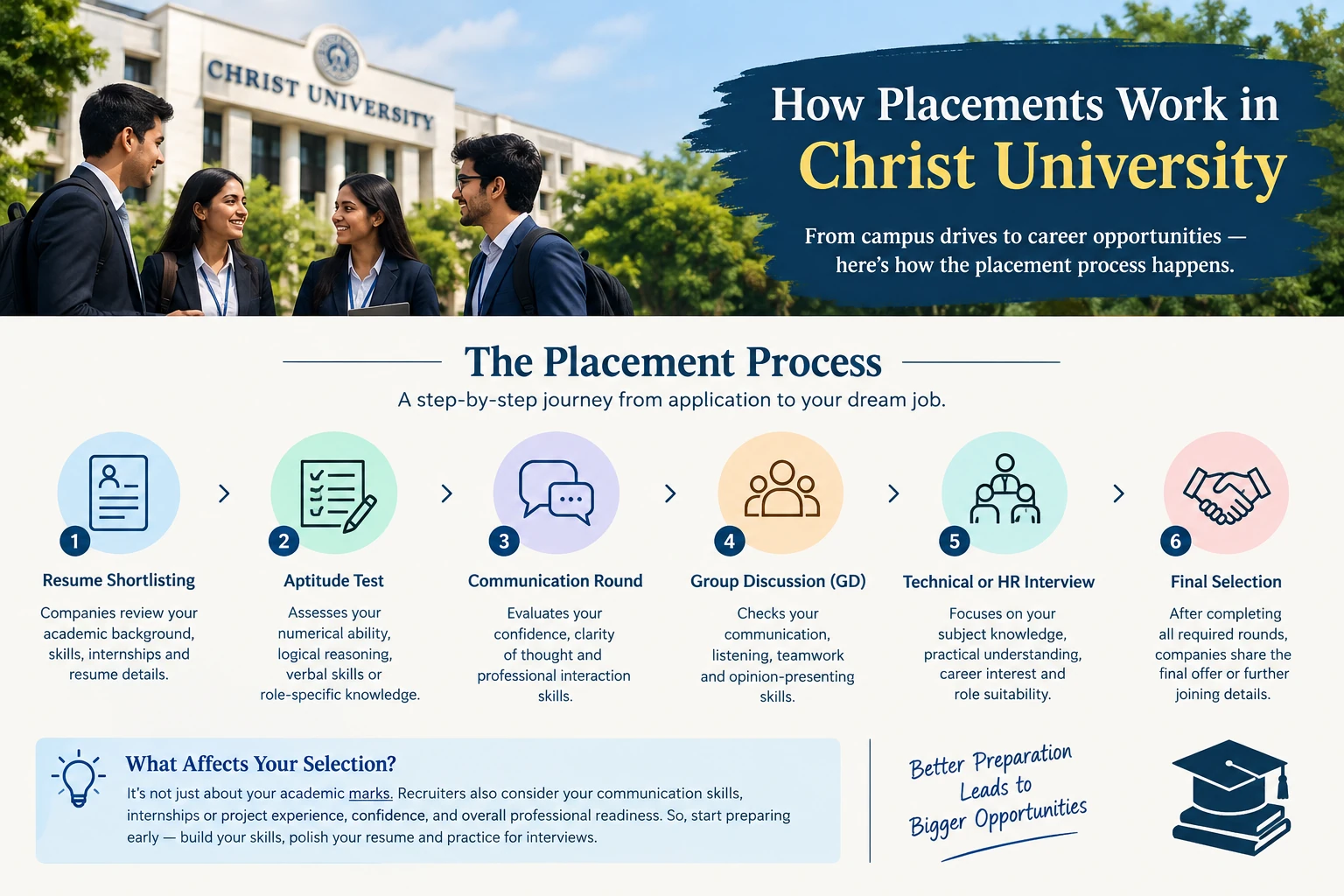
How Placements Work in Christ University
Christ University mein placement activities generally students ke final year ke aas-paas active hoti hain, although the exact timeline course aur recruitment schedule ke according change ho sakta hai. Eligible students ko placement registration ke baad participating companies ki job profiles aur eligibility requirements ke baare mein information milti hai. Jo students criteria meet karte hain, woh respective recruitment process mein participate kar sakte hain.
Placement Process Normally Includes:
- Resume Shortlisting: Company students ke academic background, skills, internships aur resume details ke basis par eligible candidates ko shortlist kar sakti hai.
- Aptitude Test: Kuch recruiters numerical ability, logical reasoning, verbal ability ya role-specific aptitude assess karne ke liye online ya written test conduct karte hain.
- Communication Round: Selected roles mein communication ability, clarity of thought aur basic professional interaction ko evaluate kiya ja sakta hai.
- Group Discussion (GD): Agar company ke selection process mein GD included hai, to students ke communication, listening, teamwork aur opinion-presenting skills dekhe ja sakte hain.
- Technical or HR Interview: Interview round mein candidate ke subject knowledge, practical understanding, career interest aur role ke liye suitability par questions ho sakte hain.
- Final Selection: Recruitment ke required rounds complete hone ke baad company selected candidates ko final offer ya further joining-related information provide karti hai.
Placement selection sirf academic marks par depend nahi karta. Recruiters role ke according communication, relevant skills, internship or project experience, interview performance aur overall professional readiness ko bhi consider kar sakte hain. Isliye students ke liye final year se pehle resume, communication skills aur interview preparation par kaam karna useful rahta hai.
Corporate Sector Career Opportunities
Corporate sector me Arts graduates ko HR support, customer relations, sales, marketing, operations aur communication jaise entry-level functions me opportunities mil sakti hain. Degree ke saath professional email writing, presentations, spreadsheet basics, teamwork aur client interaction jaise skills develop karne se transition easier ho sakta hai. Student ko job role choose karte waqt sirf starting salary nahi, balki learning opportunity, responsibilities aur future growth path ko bhi compare karna chahiye.
Regular presentations, group assignments aur structured academic activities students ko deadlines meet karne, ideas clearly present karne aur team ke saath work karne ki practice de sakti hain. Yeh habits professional environment me useful ho sakti hain, lekin actual corporate readiness ke liye students ko internships, practical projects aur role-specific skills bhi independently develop karni chahiye.
Popular Corporate Job Roles
- HR Executive
- Talent Acquisition Associate
- Business Development Associate
- Client Relationship Executive
- Marketing Coordinator
- Operations Associate
- Customer Success Executive
- Content and Communication Executive
- Sales and Branding Associate
Freshers ke salary packages ko ek fixed range me dekhna misleading ho sakta hai, kyunki employer, role, location, candidate skills aur previous internship experience ke according starting offer change ho sakta hai. Isliye student ko placement decision lete waqt package ke saath job responsibilities, learning opportunities, work location aur growth potential ko bhi evaluate karna chahiye. Salary figures ko indicative information samjhein, guaranteed outcome nahi.
Certifications ka benefit tab zyada meaningful hota hai jab student unhe practical work ke saath connect karta hai. For example, digital marketing certification ke saath ek small campaign project, HR course ke saath recruitment-related assignment ya analytics learning ke saath sample dashboard portfolio ko stronger evidence de sakta hai. Internship aur certification dono collect karne ke bajay student ko aise experiences choose karne chahiye jo uske intended job role ke skills ko genuinely demonstrate karein.
Digital Marketing and Content Careers
Digital marketing me Arts graduates ke liye opportunities content, social media, SEO, brand communication aur campaign support jaise areas me mil sakti hain. Is field me interest rakhne wale students ko degree ke saath actual projects par kaam karna chahiye, jaise ek sample content calendar, SEO article, social-media campaign ya basic analytics report. Creativity useful hai, lekin client communication, data interpretation aur platform-specific skills develop karna bhi long-term employability ke liye important hai.
Popular Digital Career Roles
- SEO Content Writer
- Social Media Strategist
- Influencer Marketing Executive
- Email Marketing Associate
- Brand Communication Executive
- YouTube Content Strategist
- Copywriter
- Digital Campaign Executive
Digital marketing me career banane ke liye degree ke saath practical proof of work bhi important hota hai. Student SEO articles, social media campaigns, email copies, basic analytics reports ya sample content calendars jaise small projects bana kar apna portfolio develop kar sakta hai. Freelancing ya remote opportunities possible hain, lekin unke liye communication, client handling, deadlines aur measurable work results samajhna bhi zaruri hai; sirf ek certification complete kar lena job ya freelance income ki guarantee nahi deta.
Higher Studies After Graduation
Graduation ke baad higher studies choose karne ka decision tab useful hota hai jab student ko kisi specific field me deeper qualification ki requirement ya clear career objective nazar aa raha ho. Psychology student MA Psychology, media student postgraduate communication studies aur management-oriented graduate MBA jaise routes consider kar sakta hai, lekin har option ki eligibility aur entrance requirements alag hoti hain. Isliye final year ke wait karne ke bajay second ya third year me hi entrance exams, course prerequisites, fees aur career outcomes compare karna practical rahega.
Popular Higher Study Options
- MBA (Marketing, HR, Finance)
- MA Psychology
- MA Journalism & Communication
- Master in Economics
- MSW (Master of Social Work)
- LLB
- UPSC Preparation
- Foreign Universities for Masters
Economics aur Political Science background wale students graduation ke baad policy research, public administration, civil services aur related academic areas ko explore kar sakte hain. In fields me interest hone par graduation ke subjects ko current affairs, research skills aur writing practice ke saath connect karna useful rahega. Career direction finalise karne se pehle student ko higher-study requirements aur relevant examination pattern ko separately understand karna chahiye.
Government Job Opportunities After Christ University
Arts graduates government-sector careers ko different examination routes ke through target kar sakte hain. UPSC aur State PSC administrative services ke liye known routes hain, jabki SSC, banking, railway aur other recruitment examinations alag types ke posts provide kar sakte hain. Har examination ki qualification, age limit, syllabus aur selection stages alag ho sakti hain. Isliye student ko “government job” ko ek single career category samajhne ke bajay apni qualification aur preferred work profile ke according examination shortlist karna chahiye.
College ke academic work se reading, writing, presentation aur analytical thinking jaise transferable skills develop ho sakte hain, jo competitive-exam preparation me indirectly useful ho sakte hain. Lekin university ka course kisi government examination me selection guarantee nahi karta. Candidate ko selected exam ka complete syllabus, previous papers, mock tests aur current affairs preparation independently follow karni hoti hai. Graduation ke saath preparation karne wale students ke liye workload ko realistic rakhna especially important hai.
1. UPSC Civil Services (IAS/IPS/IFS)
- India ki most prestigious government job exam
- Graduation ke baad eligibility milti hai (any stream)
- Prelims, Mains aur Interview stages hoti hain
- Subjects like Political Science, Economics aur Sociology helpful hote hain
Arts students ke liye government exam ka selection graduation ke subject se automatically nahi hota; exam-specific eligibility, syllabus aur preparation strategy ko separately follow karna padta hai. Political Science, Sociology, Economics ya English jaise subjects kuch topics ko samajhne me background advantage de sakte hain, lekin reasoning, quantitative aptitude, English aur current affairs jaise areas ke liye dedicated preparation phir bhi required hoti hai. Agar student graduation ke saath competitive exam prepare karna chahta hai, toh first year se daily study habit develop karke college assignments, current affairs notes aur mock-test practice ko manageable weekly schedule me divide karna zyada realistic approach rahega.
2. SSC Exams (CGL & CHSL)
- SSC CGL: Group B & C level government jobs
- SSC CHSL: Clerk, DEO aur assistant level posts
- Exam me reasoning, maths, English aur GK hota hai
- All India posting opportunities milti hain
SSC exams Arts graduates ke liye practical government-job route ho sakte hain, lekin CGL aur CHSL ko ek hi qualification level ka exam nahi samajhna chahiye. Graduation ke baad CGL jaise graduate-level opportunities ko target kiya ja sakta hai, jabki CHSL 12th-level recruitment route hai. Preparation start karne se pehle student ko selected examination ki current eligibility, subjects, age conditions aur post preferences verify karke uske according study plan banana chahiye.
3. Banking Sector Jobs
- IBPS PO, Clerk, SBI PO jaise exams
- Written exam + interview process hota hai
- Post aur recruitment notification ke according role, eligibility aur service conditions check karni hoti hain
- Customer handling aur finance roles milte hain
Banking exams me English comprehension aur communication useful skills hain, lekin Arts background apne aap selection advantage create nahi karta. Candidate ko reasoning, quantitative aptitude, English, general awareness aur exam-specific sections ki balanced preparation karni padti hai. Economics padhne wale students ko banking aur economy-related concepts familiar lag sakte hain, lekin actual performance regular mock tests, calculation speed aur accuracy par depend karegi.
4. Railway Recruitment (RRB NTPC & Group D)
- Indian Railways me large-scale recruitment hota hai
- NTPC posts me clerical aur operational jobs milti hain
- Group D me support level jobs include hoti hain
- Selection stages aur skill requirements post-specific notification par depend karte hain
Railway recruitment ko choose karne wale students ko post-wise eligibility aur selection stages pehle compare karne chahiye, kyunki NTPC aur other railway recruitments me qualifications, responsibilities aur examination requirements alag ho sakti hain. Job stability attractive factor ho sakta hai, lekin salary, posting location, work profile aur current service benefits ko recruitment notification ke basis par evaluate karna better hai. Purani recruitment information ya general salary figures ko current notification ka substitute nahi maana chahiye.
5. State PCS Exams
- State Public Service Commission exams (UPPCS, BPSC etc.)
- State administrative services ke liye recruitment hota hai
- Prelims + Mains + Interview process hota hai
- State governance aur policy roles milte hain
Political Science aur Sociology jaise subjects State PCS preparation me kuch syllabus areas ko understand karne ke liye useful background de sakte hain, lekin selection ke liye complete examination syllabus cover karna zaruri hota hai. State-specific history, geography, governance, current affairs aur language requirements bhi important ho sakti hain. Isliye student ko apne state ki latest PSC notification dekhkar preparation topics aur eligibility conditions finalise karni chahiye.
6. Insurance & PSU Exams
- LIC AAO, NIACL, GIC Assistant jaise exams
- Public Sector Undertakings me stable jobs milti hain
- Written exam + interview process hota hai
- Salary + benefits structured hote hain
7. Teaching & Research Sector
- School, college aur research careers ke qualification rules alag ho sakte hain
- Postgraduate qualification kai academic pathways me important hoti hai
- Teacher eligibility tests selected school-teaching routes me applicable ho sakte hain
- Research-oriented careers me postgraduate study aur further research training relevant ho sakti hai
Teaching aur research ko career option banane wale Arts graduates ko graduation ke baad required qualification ka clear roadmap banana chahiye. School teaching, college-level teaching aur academic research ke entry requirements ek jaise nahi hote, isliye student ko apne target role ke according postgraduate degree, eligibility test, teacher-training qualification ya research pathway check karna chahiye. Graduation ke subject ko long-term teaching career ke saath connect karne se pehle applicable rules ko current official notification se verify karna safest approach rahega.
Internship Opportunities During Graduation
Graduation ke dauran internship ka real benefit tab milta hai jab student sirf certificate collect karne ke bajay kisi relevant project ya work assignment me actively participate kare. Journalism student reporting ya content production ka portfolio bana sakta hai, Psychology student research assistance ya social-sector exposure explore kar sakta hai, aur corporate-oriented student HR, marketing, operations ya communication roles me practical experience le sakta hai. Internship ke baad apne projects, responsibilities aur measurable work ko resume me properly document karna future applications aur interviews ke liye generic “internship completed” line se zyada useful hota hai.
Internship Areas
- Media Houses
- Digital Marketing Agencies
- Corporate HR Departments
- Research Organizations
- NGOs
- Startups
- Content and Branding Agencies
Internship ka value tab zyada hota hai jab student us experience ko resume me specific work ke form me explain kar sake. For example, ek media intern apne published articles ya video projects mention kar sakta hai, HR intern recruitment tasks ka experience explain kar sakta hai aur research intern data collection ya report preparation ka contribution show kar sakta hai. Aise concrete examples interview me student ko sirf “internship ki hai” kehne ke comparison me apni practical ability clearly demonstrate karne me help karte hain.
Average Salary Expectations
Salary kisi bhi student ke liye fixed nahi hoti. Yeh mainly skills, internships, communication ability, certifications aur company profile par depend karti hai. Same course ke students ko bhi different salary mil sakti hai kyunki performance aur exposure ka direct impact hota hai.
- Corporate Sector (HR, Sales, Operations): ₹3 – ₹6 LPA (starting level roles)
- Digital Marketing / Social Media: ₹3 – ₹7 LPA (skills aur portfolio par depend)
- Media & Journalism Industry: ₹2.5 – ₹5 LPA (freshers level)
- Content Writing / Copywriting: ₹2.5 – ₹5 LPA (experience ke saath growth fast hoti hai)
- HR & Administration Roles: ₹3 – ₹5 LPA (entry-level packages)
Experience badhne ke saath salary improve ho sakti hai, lekin growth ka pace har career path me same nahi hota. Role change, specialised skills, stronger responsibilities, measurable work results aur relevant industry experience earning progression ko influence kar sakte hain. Isliye student ko graduation ke baad sirf years of experience count karne ke bajay har stage par apni skills aur responsibilities ko stronger banane par focus karna chahiye.
Job applications ko stronger banane ke liye student ko apne resume me specific evidence dikhana chahiye. Ek well-written project, internship assignment, published work, campaign result ya research task candidate ki capability ko general skill-list se better demonstrate kar sakta hai. Professional profile maintain karna useful hai, lekin profile ke saath actual work samples aur clearly explained responsibilities hone se recruiter ko candidate ka skill level samajhne me zyada context milta hai.
Preparation Strategy for Christ University Admission
Admission preparation ko manageable banane ke liye student ko pehle assessment ke required components identify karne chahiye aur unhe weekly targets me divide karna chahiye. English aur reasoning ke liye regular question practice ke saath current affairs reading aur speaking practice ko routine me include kiya ja sakta hai. Har week ke end par wrong answers aur weak areas review karne se next week ka study plan more focused banega. Interview ke liye preparation ka aim memorised responses nahi, balki apne academic background aur course choice ko naturally explain karna hona chahiye.
| Area | What to Practise | Student Action |
|---|---|---|
| English | Grammar, vocabulary, comprehension | Daily reading + weekly practice set |
| Reasoning | Logical questions and analytical patterns | Timed question practice |
| Current Affairs | Recent national and international events | Weekly notes and revision |
| Interview | Course choice, introduction and personal questions | Speak answers aloud instead of memorising scripts |
Recommended Preparation Books
Government Job Opportunities After Christ University
Management and MBA Path
Graduation ke baad MBA choose karne wale Arts students ko entrance preparation ke saath apne preferred management area ko bhi identify karna chahiye. CAT, XAT ya CMAT jaise exams ke preparation pattern me aptitude, reasoning, English aur data interpretation jaise areas aa sakte hain, jabki MBA ke baad Marketing, HR, Finance, Operations, Business Analytics ya related specialisations me direction choose ki ja sakti hai. Agar management career target hai, toh graduation ke second year se aptitude practice, communication improvement aur internships ko parallel develop karna last-minute entrance preparation se zyada sustainable approach ho sakta hai.
Popular MBA Specializations
- Marketing
- Human Resource Management
- Business Analytics
- Finance
- Operations Management
- Digital Marketing
MBA admission ke liye graduation ke academic experience ko apne future management goal se connect karke explain karna useful hota hai. Presentations aur group activities se communication practice mil sakti hai, lekin MBA entrance aur interview ke liye candidate ko separately aptitude, business awareness aur personal motivation par prepare karna padta hai. Interview me student ko yeh clearly explain kar pana chahiye ki management degree uske existing skills aur future career plan me kya role play karegi.
2. SSC CHSL
SSC CHSL 12th-level recruitment route hai, isliye Arts students ise graduation se pehle bhi target kar sakte hain, subject to the applicable recruitment conditions. Graduation ke saath preparation continue karne se student ko study routine maintain karne aur competitive-exam practice develop karne ka additional time mil sakta hai, lekin qualification aur age requirements ko har recruitment cycle ki official notification se verify karna zaruri hai.
- Posts: Clerk, DEO, LDC
- Good option for early government job seekers
- English aur typing skills helpful hoti hain
3. Banking Exams (IBPS PO / Clerk / SBI)
Economics ya English padhne ka background banking examination ke kuch topics ko samajhne me helpful ho sakta hai, lekin selection kisi particular Arts subject ki wajah se automatic nahi hota. Candidate ko reasoning, quantitative aptitude, English aur general awareness jaise areas par balanced preparation karni hoti hai. Regular mock tests ke through speed, accuracy aur time allocation ko improve karna actual examination performance ke liye zyada important role play karta hai.
- PO and Clerk level jobs
- Reasoning and aptitude important subjects hote hain
- Starting salary ₹30,000+ tak ho sakti hai
4. Railway NTPC
Railway recruitment me NTPC category ke under different types ke non-technical posts aa sakte hain, aur unki eligibility aur selection requirements post ke according change ho sakti hain. Arts graduates ko application se pehle qualification, age limit, examination stages aur available post details carefully check karni chahiye. Railway job ko sirf stability ke basis par choose karne ke bajay work profile, posting possibilities aur long-term career preference ko bhi decision me include karna sensible rahega.
- Station Master
- Goods Guard
- Junior Clerk
- Commercial Apprentice
5. State Government Exams
State Public Service Commission examinations state-level administrative aur other government positions ke liye recruitment ka important route ho sakte hain. Arts graduates ko apne state ke examination pattern, qualification rules, language requirements aur syllabus ko separately understand karna chahiye, kyunki ek state ki recruitment conditions doosre state se different ho sakti hain. Preparation me state-specific history, geography, governance aur current affairs ko national-level subjects ke saath balance karna useful rahega.
- State PCS Exams
- Police Sub Inspector
- Patwari
- Administrative Posts
6. UPSC Civil Services
UPSC preparation ko long-term project ki tarah approach karna zyada realistic hota hai, kyunki syllabus ke saath reading, answer writing, revision aur current affairs par sustained work chahiye hota hai. Graduation ke first year se basic foundation banana possible hai, lekin college academics ko ignore karke sirf competitive exam par depend karna zaruri nahi. Student apne degree subjects aur UPSC preparation ke overlapping areas ko identify karke gradually workload build kar sakta hai.
- IAS
- IPS
- IFS
- IRS
Which Arts Subjects Help Most in Government Exams?
Kuch subjects directly competitive exam preparation me useful maane jate hain:
- Political Science: Indian Polity aur Governance understanding improve karta hai
- Economics: Banking aur economy-related topics me help karta hai
- English: Communication aur comprehension strong karta hai
- Sociology: Society aur social issues understanding improve karta hai
- History: UPSC aur SSC GK section me useful hota hai
How Christ University Students Prepare Along With Graduation
Graduation ke saath government-exam preparation manage karne ke liye student ko realistic weekly schedule banana chahiye, jisme college classes, assignments, revision aur competitive-exam practice ke liye separate time ho. Busy academic periods me preparation hours naturally reduce ho sakte hain, isliye daily target ko unnecessarily large rakhne ke bajay consistent routine maintain karna better hai. College ke reading, presentations aur academic work ko bhi communication, writing aur analytical skills develop karne ke opportunities ke roop me use kiya ja sakta hai.
- Daily newspaper reading habit develop hoti hai
- Presentation aur communication skills improve hote hain
- Current affairs awareness strong hoti hai
- English fluency exams aur interviews me helpful hoti hai
Graduation aur competitive-exam preparation ko saath chalane ke liye consistency ke saath priorities set karna zaruri hai. Student ko har subject ko daily cover karne ki koshish karne ke bajay weekly targets divide karne chahiye aur college exams ke time competitive preparation ko temporarily adjust karna chahiye. Is tarah preparation routine pressure create karne ke bajay graduation ke overall schedule ke andar manageable reh sakta hai.
Preparation Strategy for Admission
Daily Study Routine
- Roz minimum 2 hours English practice karein
- Current affairs newspaper ya apps se padhein
- Reasoning questions regularly solve karein
- Weekly mock tests attempt karein
- Interview speaking practice mirror ke saamne karein
Interview Preparation Tips
- Simple aur clear communication use karein
- Fake confidence show na karein
- Apne hobbies aur interests honestly batayein
- Current affairs aur personal introduction prepare rakhein
Interview preparation ka best approach scripted answers ratna nahi, balki apne background aur course choice ko clearly explain karna seekhna hai. Student ko apne Class 12 subjects, chosen programme, hobbies, strengths aur future career plan ke basic questions ke natural answers practice karne chahiye. Agar interviewer kisi current issue ya unexpected topic par opinion pooche, toh answer dene se pehle point ko samajhna aur reason ke saath response dena memorised lines repeat karne se zyada effective hota hai.
Useful Books for Preparation
Agar aap entrance exam aur interview preparation seriously karna chahte hain, toh basic English, reasoning aur current affairs books helpful ho sakti hain.
- English Grammar and Writing Practice Book
- Logical Reasoning Preparation Guide
- General Knowledge and Current Affairs Book
Online Skill Development Course
College admission ke saath practical skills develop karna bhi important hota hai. Communication, personality development aur career planning courses future growth me kaafi useful hote hain.
Join Career Growth Course for Arts StudentsFinal Thoughts
Christ University ko 12th Arts ke baad shortlist karne ka decision tab zyada meaningful hoga jab student university ke overall reputation ke bajay apne selected course aur personal priorities ko compare kare. Admission se pehle programme eligibility, selection stages, expected expenses, campus requirements aur graduation ke baad ke next step ko written checklist me compare karna practical rahega. Agar budget limited hai, toh tuition ke saath hostel, food, travel aur other academic expenses ko bhi total calculation me include karein. Agar career goal Psychology, Media, Economics, Civil Services ya Corporate roles me se kisi specific direction me hai, toh graduation ke first year se related skills aur internships plan karna degree ke end tak wait karne se zyada useful approach ho sakta hai. University opportunities provide kar sakti hai, lekin un opportunities ka actual benefit student ki participation, skill-building aur consistent preparation par depend karega.