Introduction
12th ke baad career choose karna har student ke liye ek important turning point hota hai. Is stage par liya gaya decision aapki aane wali 5–10 saal ki growth ko directly impact karta hai. India me pichhle kuch saalon me ek major shift dekhne ko mila hai — log ab traditional job mindset se digital economy ki taraf move kar rahe hain.
Is digital shift ka ek important part digital marketing hai, kyunki businesses ko sirf online presence banana hi nahi, balki us presence ko relevant customers tak pahunchana bhi hota hai. Aaj ek local business Google Search, social media, WhatsApp ya apni website ke through customers se connect kar sakta hai, jabki larger companies multiple digital channels ko ek coordinated strategy ke saath use karti hain. Isi environment me SEO, content, social media, paid advertising, analytics aur email marketing jaise areas ke liye trained professionals ki zarurat develop hoti hai. Student ke liye iska practical meaning ye hai ki digital marketing ko sirf “online promotion” samajhne ke bajay ek business skill ke roop me dekhna chahiye, jisme audience understanding, communication, data aur execution sab important hote hain.
Digital marketing ki entry relatively accessible hai, lekin iska matlab ye nahi ki bina practice ke career banana easy hai. Student ko pehle basic concepts samajhne ke baad kisi ek area, jaise SEO, content, social media ya paid advertising, par practical work karna chahiye. Portfolio, communication aur measurable work samples banne ke baad internship, junior job ya freelance project ke liye apply karna zyada practical approach hoti hai
What is Digital Marketing?
Digital marketing ka simple meaning sirf itna nahi hai ki internet par ads chalana ya social media par post karna. Asal me ye ek complete system hai jisme businesses apne products aur services ko sahi logon tak pahunchate hain, unka interest build karte hain aur unhe paying customer me convert karte hain.
Simple language me digital marketing ka kaam kisi business ke message ko un logon tak pahunchana hai jinke liye product ya service relevant ho sakti hai. Ye process search engines, websites, social platforms, video platforms aur email jaise different channels par alag tarike se execute hota hai. For example, Google Search par user ki existing need ko target kiya ja sakta hai, Instagram par awareness create ki ja sakti hai aur email ke through pehle se interested audience ke saath follow-up maintain kiya ja sakta hai. Isliye channel choose karna business goal aur audience behaviour dono par depend karta hai.
Lekin real-world perspective me digital marketing sirf promotion tak limited nahi hai. Ye ek deep strategy-based system hai jisme psychology (log kya sochte hain), data analysis (kya kaam kar raha hai), creativity (content kaise attractive ho) aur technology (tools & platforms) sab ek saath kaam karte hain.
Simple Real Example (Easy Understanding)
Maan lijiye aap ek online shoe store launch karte ho. Website par products upload karna sirf starting point hai; actual marketing tab shuru hoti hai jab aap ye samajhne ki koshish karte ho ki potential buyer kya search karta hai, kis type ke content par response deta hai aur purchase se pehle kaunse questions uske mind me aate hain. Isi information ke basis par marketer ko content, advertising message, product page aur customer journey ko plan karna padta hai.
- Log Google par “best running shoes” kab search karte hain
- Kaun se ads unhe attract karte hain
- Kaun sa design unka attention capture karta hai
- Aur kaun si website unhe trust feel karwati hai
Jab search intent, advertisement, product page aur checkout experience ek doosre se properly connected hote hain, tab visitor ke customer banne ki possibility improve hoti hai. Marketer is journey ko numbers ke through evaluate karta hai—for example, kitne users ne page dekha, kitne log product par gaye aur kitne users ne purchase ya enquiry complete ki. Isi practical measurement ki wajah se digital marketing ko sirf posting ka kaam samajhna incomplete hai.
Digital Marketing ka Hidden Concept
Digital marketing ko sirf regular posting ya advertisements chalane tak limit karna field ki actual working ko bahut narrow bana deta hai. Marketer ko ye samajhna padta hai ki audience kisi message ko notice kyun karti hai, kis information ke baad trust develop hota hai aur kis point par user action lene ke liye ready hota hai. Isi liye campaign planning me audience research, message testing, content quality aur performance data ko ek saath dekha jata hai. Har view ya click purchase me convert nahi hota, isliye marketer ka kaam user journey ke different stages ko samajhkar improvement opportunities identify karna hota hai.
- Awareness: Logon ko product ke baare me batana
- Interest: Unka curiosity create karna
- Decision: Compare aur trust build karna
- Action: Purchase ya signup karwana
Is journey ko commonly marketing funnel ke framework se samjha ja sakta hai. Awareness mein user brand ko notice karta hai, consideration stage mein information compare karta hai aur conversion stage mein purchase, registration ya enquiry jaisa action leta hai. Har business mein funnel ka design alag ho sakta hai, kyunki product, audience aur buying decision ka time ek jaisa nahi hota.
Why Digital Marketing is Powerful Today?
- 1. Almost har insan internet use karta hai
- 2. Businesses offline se online shift ho rahe hain
- 3. Advertising cost control me rehta hai
- 4. Results track karna possible hota hai
- 5. Small business bhi global audience tak pahunch sakta hai
Final Simple Understanding
Practical level par digital marketing ko ek connected process ke roop me samjha ja sakta hai: pehle audience aur uski need ko identify karna, phir suitable channel par useful message pahunchana, us response ko measure karna aur results ke basis par strategy ko improve karna. Isi process ki wajah se digital marketing me creativity ke saath analytics aur business understanding bhi important ho jati hai.
Real Working Flow (Simple Diagram + Deep Understanding)
Digital marketing ki working ko ek customer journey ke through samajhna beginner ke liye sabse practical approach hai. Har visitor immediately customer nahi banta; pehle usse brand ya information ke baare me awareness milti hai, phir interest develop hota hai, website ya offer ko evaluate karta hai aur suitable lagne par enquiry, signup ya purchase jaisa action leta hai. Marketer ka kaam in stages ko connect karna aur har stage par unnecessary friction ko identify karna hota hai.
Student ke liye is flow ko samajhne ka fayda ye hai ki woh digital marketing ko individual tools ki list ke bajay ek connected process ke roop mein dekh pata hai. Agar traffic aa raha hai lekin enquiry nahi ho rahi, to problem advertisement ke bajay landing page, offer ya trust signals mein bhi ho sakti hai. Isi tarah analysis karna practical marketer ki important responsibility hoti hai.
User Search / Social Media Scroll
            ↓
   Ad / Content Exposure (Awareness Stage)
            ↓
   Interest Build / Click (Engagement Stage)
            ↓
   Website / Landing Page Visit (Trust Stage)
            ↓
   Action (Buy / Signup / Inquiry) (Conversion Stage)
            ↓
   Retargeting Ads + Email Follow-up
            ↓
   Repeat Purchase / Loyal Customer
Step-by-Step Real Explanation
1. User Search / Scroll:
Customer journey aksar user ke search behaviour ya content browsing se start hoti hai. Google par search karne wala person usually kisi specific information ya solution ki need express kar raha hota hai, jabki Instagram ya YouTube par user discovery mode me ho sakta hai aur kisi topic ya product ko pehli baar notice kare. Marketer ko dono situations ke difference ko samajhna padta hai, kyunki search-based audience aur discovery-based audience ke liye message aur content format alag ho sakte hain.
2. Ad / Content Exposure:
Is stage par brand ka content user ke saamne aata hai, jo video, image, article, search result, social post ya paid advertisement ke form me ho sakta hai. First impression yahin develop hota hai, isliye message ko audience ke context se relevant rakhna important hai. Agar content user ki need se match nahi karta, to high reach ke bawajood meaningful engagement milna difficult ho sakta hai.
3. Interest / Click:
3. Interest / Click:** Is stage par user decide karta hai ki saamne dikh raha content uski actual need se related hai ya nahi. Headline, thumbnail, offer, search result ya short-form video ka opening part attention lene mein role play kar sakta hai. Click milna sirf first step hai; uske baad page par relevant information milna bhi equally important hota hai.
4. Website / Landing Page Visit:
User ke click karne ke baad website ya landing page uske decision process ka important part ban jata hai. Page par information clear hai ya nahi, mobile par properly open ho raha hai ya nahi, offer samajh aa raha hai ya nahi aur business ke trust signals visible hain ya nahi—ye factors user ke next action ko influence kar sakte hain. Isi stage par marketer ko traffic ke saath page experience ko bhi evaluate karna chahiye.
5. Action (Conversion):
Conversion tab hota hai jab visitor business ke desired action ko complete karta hai, jaise order place karna, form submit karna, appointment book karna ya enquiry bhejna. Har campaign ka conversion goal alag ho sakta hai. Isliye marketer ko sirf clicks count karne ke bajay final business outcome ko bhi track karna padta hai.
6. Retargeting & Repeat Sales:
Har visitor first interaction me purchase ya enquiry complete nahi karta, isliye suitable campaigns me follow-up communication ka role aa sakta hai. Retargeting advertisements, email reminders ya useful follow-up content ke through interested users ko dobara relevant information di ja sakti hai. However, frequency aur relevance ka dhyan rakhna zaroori hai, kyunki repeated communication tabhi useful hoti hai jab user ke previous behaviour ke context me meaningful ho.
7. Loyal Customer:
First purchase ke baad customer experience digital marketing journey ka final point nahi hota. Delivery, support, product quality, follow-up communication aur relevant offers customer ko dobara business ke saath engage karne mein influence kar sakte hain. Isi wajah se existing customers ko retain karna bhi marketing strategy ka practical part hai.
Why This Flow is Important?
- A. Har step par user psychology ka use hota hai
- B. Conversion rate improve hota hai
- C. Marketing budget waste nahi hota
- D. Business ko scalable growth milti hai
Is poore flow ko improve karne ke liye marketer data ko stage-by-stage dekhta hai. Agar impressions high hain lekin clicks low hain, to creative ya message ko test kiya ja sakta hai; agar clicks aa rahe hain lekin enquiries nahi, to landing page aur offer ko review karna logical hota hai. Is tarah optimization guesswork ke bajay evidence par based hota hai.
Types of Digital Marketing (Practical Understanding)
Digital marketing ke different channels ko samajhna beginner ke liye useful hai, kyunki har channel ka objective aur measurement method alag hota hai. SEO organic search visibility par focus karta hai, paid advertising faster traffic la sakti hai, social media audience engagement build karta hai aur email marketing existing users ke saath communication maintain kar sakta hai. Career choose karte waqt student ko in differences ko apni interest aur working style ke saath compare karna chahiye.
| Type | Simple Meaning | Real Purpose | Example |
|---|---|---|---|
| SEO (Search Engine Optimization) | Website ko Google me rank karwana | Free organic traffic generate karna | “Best shoes in India” search par website top aana |
| Social Media Marketing (SMM) | Instagram, Facebook, etc. par marketing | Brand awareness + audience engagement | Instagram reels se product viral karna |
| PPC Advertising | Paid ads (Google/Facebook ads) | Instant traffic aur leads lana | Google ads par “buy shoes online” ad dikhna |
| Content Marketing | Useful content create karna | Audience ko attract aur educate karna | Blog, YouTube video, Instagram post |
| Email Marketing | Email ke through marketing | Customers ko retain karna aur repeat sales lana | Discount offers emails send karna |
| Affiliate Marketing | Product promote karke commission kamana | Passive income generate karna | Amazon product link share karke earning |
| YouTube Marketing | Video content ke through promotion | Long-term audience aur trust build karna | Tech review videos se product promote karna |
Real Insight (Important Understanding)
Har digital marketing channel ka objective aur working style alag hota hai, isliye har business ko automatically sabhi channels par active rehne ki zarurat nahi hoti. SEO un users tak pahunchne me useful ho sakta hai jo already information search kar rahe hain, paid advertising specific campaigns ko faster reach de sakti hai aur social media regular audience engagement ke liye suitable ho sakta hai. Student ko channels ko “best” ya “worst” ke basis par choose karne ke bajay business goal, audience aur available resources ke according evaluate karna chahiye.
Step-by-Step Roadmap (Beginner to Pro Journey)
Digital marketing ek aisa skill hai jisme koi fixed shortcut nahi hota, lekin agar aap ek structured roadmap follow karte ho to aap 6–12 months me strong practical level tak pahunch sakte ho. Yaha sabse important cheez consistency aur real practice hoti hai, sirf theory nahi.
Learning roadmap ka practical purpose ye hai ki beginner ek saath bahut saare tools seekhne ke pressure mein na aaye. Pehle basic marketing concepts samajhna, phir ek small project par implementation karna aur uske baad results ko document karna zyada useful sequence hai. Jaise experience badhta hai, student apni chosen specialization mein advanced tools aur strategies add kar sakta hai.
Complete Visual Roadmap (Beginner → Pro Level)
START
  │
  ▼
 Month 1: Foundation Building
   - Digital Marketing basics samajhna
   - SEO kya hota hai (Google ranking system)
   - Social Media platforms ka deep understanding
   - Basic marketing psychology

  │
  ▼
 Month 2: Skill Development Phase
   - Content Writing practice (blogs, captions)
   - Canva design basics (posts, creatives)
   - Google tools introduction (Analytics + Search Console)
   - Keyword research basics

  │
  ▼
 Month 3: Practical Exposure
   - Apna blog ya Instagram page start karna
   - Regular content posting schedule banana
   - Audience understanding develop karna
   - Basic branding start karna

  │
  ▼
 Month 4: Real Market Entry
   - Freelancing platforms explore karna
   - Small clients ke liye work start karna
   - Portfolio banana (real work samples)
   - Case studies create karna

  │
  ▼
 Month 5–6: Income Generation Stage
   - Paid projects handle karna
   - Client communication improve karna
   - Results-based work deliver karna
   - Monthly consistent income build karna

  │
  ▼
 6+ Months: Specialization & Growth
   - SEO / Paid Ads / Content Strategy me specialization
   - High-paying clients target karna
   - Personal brand build karna
   - Long-term freelancing or job growth
Real Understanding (Har Stage ka Purpose)
Is roadmap ka main purpose sirf tools seekhna nahi hai, balki ek complete marketing mindset develop karna hai. Beginner stage me aap basics samajhte ho, intermediate me practice karte ho, aur advanced stage me aap actual business growth handle karna seekhte ho.
- A. Month 1–2: “What is digital marketing?” samajh aata hai
- B. Month 3–4: Real content aur audience handle karna aata hai
- C. Month 5–6: Paise kamane ki journey start hoti hai
- D. 6+ months: Skill ek career me convert ho jati hai
Important Reality Check
Online tutorials aur courses concepts samajhne ke liye useful starting point ho sakte hain, lekin sirf videos complete kar lene se practical readiness automatically prove nahi hoti. Student ko seekhe hue concepts ko kisi real ya self-created project par apply karna chahiye, jaise keyword research, content calendar, basic SEO audit, social campaign plan ya sample landing page analysis. Jab learner apne decisions ko explain kar sakta hai aur unke results ko document kar sakta hai, tab portfolio aur interview discussions dono zyada meaningful ban jate hain.
Pro Tip (Industry Secret)
Beginner ke liye digital marketing ke har area ko ek saath master karne ki koshish karna unnecessary pressure create kar sakta hai. Better approach ye hai ki pehle ek primary area choose kiya jaye—jaise SEO, content, social media ya paid advertising—and uske around related supporting skills develop ki jayein. For example, SEO learner ko content research aur analytics bhi samajhna chahiye, jabki paid advertising learner ko conversion tracking aur landing-page basics ki knowledge useful lagegi. Is tarah specialization ke saath practical understanding bhi gradually build hoti hai.
- 1. Theory se zyada practical work important hai
- 2. Ek skill ko deeply master karna better hai
- 3. Real projects se experience build hota hai
- 4. Portfolio ke bina freelancing difficult hoti hai
Career Opportunities (Industry Roles)
Digital marketing ko ek single job samajhna galat hoga. Ye ek complete industry ecosystem hai jisme alag-alag skills ke basis par multiple career paths bante hain. Har role ka kaam alag hota hai aur earning potential bhi experience ke saath continuously grow karta hai.
Is industry me career direction choose karne ke liye student apni natural strengths ko starting point bana sakta hai. Jise writing aur ideas pasand hain woh content ya social media side explore kar sakta hai, analytical thinking strong hai to SEO, analytics ya performance marketing suitable ho sakta hai, aur business strategy me interest rakhne wala learner growth-oriented roles ki taraf move kar sakta hai. Career ke saath specialization change ya expand bhi ki ja sakti hai, isliye first role ko lifetime career decision samajhna zaroori nahi hai.
1. SEO Specialist (Search Engine Expert)
SEO specialist ka practical role website ki search visibility improve karna hota hai. Isme keyword research ke saath search intent samajhna, useful page content prepare karna, internal linking improve karna, technical problems identify karna aur website performance monitor karna shamil ho sakta hai. Search ranking kisi ek trick se permanently control nahi hoti, isliye SEO work mein regular analysis aur updates ki zarurat padti hai.
SEO ka business value tab clearly samajh aata hai jab relevant users search ke through website tak pahunchte hain. Ek SEO professional ko sirf traffic badhane ke bajay ye bhi dekhna padta hai ki visitors relevant pages tak ja rahe hain ya nahi aur unka behaviour business objective ke saath match karta hai ya nahi. Isi wajah se keyword selection aur content quality dono important hote hain.
SEO mein opportunities agencies, in-house marketing teams, publishers, e-commerce businesses aur independent projects mein mil sakti hain. Beginner ke liye ek small website ka technical audit, keyword mapping ya content optimization project portfolio ka useful sample ban sakta hai. Experience ke saath role strategy, technical SEO ya specialised industry work ki taraf move kar sakta hai.
2. Social Media Manager
Social media manager brand ke selected platforms par content planning, publishing, audience interaction aur performance tracking sambhal sakta hai. Sirf posts upload karna iska complete role nahi hota; professional ko ye samajhna padta hai ki kaunsa format kis audience ke liye suitable hai aur campaign ke results ko kaise measure kiya jaye. Is role mein writing, visual thinking aur communication tino useful skills hain.
Is role ka creative part content ideas, short videos, captions, visual formats aur campaign themes develop karne mein dikhta hai. Saath hi, social media manager ko comments, audience feedback aur post-performance data bhi dekhna padta hai. Isliye creativity ke saath basic analytics samajhna bhi career growth ke liye helpful hota hai.
Influencer collaborations ne social media teams ke work ko bhi broader bana diya hai, kyunki brands ko creator selection, campaign briefing, content approval aur performance reporting jaise tasks manage karne pad sakte hain. Student is area ko samajhne ke liye kisi small brand ke liye sample campaign plan bana kar portfolio mein add kar sakta hai.
3. Content Writer / Content Strategist
Content writer different digital formats ke liye information ko clear aur audience-friendly language me present karta hai, jisme blogs, website pages, product descriptions, captions aur video scripts shamil ho sakte hain. Content strategist ka role broader hota hai, kyunki usse ye decide karna padta hai ki audience ke current questions aur business objective ke according kaunsa topic, format aur distribution channel useful rahega. Isliye strong content career ke liye writing ability ke saath research aur audience understanding bhi important hoti hai.
Digital campaign mein content ka role isliye important hai kyunki audience ko message, information aur offer isi medium ke through samajh aata hai. Ek blog search traffic ke liye useful ho sakta hai, short video awareness ke liye aur email existing customers ko update karne ke liye. Isliye effective content ka format campaign ke objective aur audience ke behaviour par depend karta hai.
Content writing mein experience build karne ke baad writer website articles, product descriptions, newsletters, scripts ya specialised industry content par focus kar sakta hai. Freelancing mein portfolio quality, niche knowledge, deadlines aur client communication ka direct effect project opportunities par padta hai. International work possible hai, lekin uske liye strong samples aur professional communication zaroori hote hain.
4. Performance Marketing Expert (Ads Specialist)
Performance marketing professionals paid campaigns ko business objectives ke according plan aur monitor karte hain. Unka kaam audience selection, campaign setup, creative testing, budget allocation aur conversion data analyse karna ho sakta hai. Is role mein “kam budget mein maximum result” ko guaranteed outcome nahi samajhna chahiye; actual performance product, audience, competition, offer aur campaign execution par depend karti hai.
Performance marketing mein numbers ko samajhna particularly useful hota hai, kyunki marketer ko spend aur outcome ke relationship ko monitor karna padta hai. Click-through rate, cost per lead, conversion rate aur return on ad spend jaise metrics campaign evaluation mein use kiye ja sakte hain. Beginner ko pehle metrics ka meaning samajhna chahiye, uske baad live campaigns par optimization seekhna better rahega.
Performance marketing ki requirement un businesses mein zyada relevant ho sakti hai jahan paid campaigns ke results ko closely track kiya jata hai, including e-commerce, lead-generation businesses aur startups. Student portfolio ke liye ek hypothetical campaign bana sakta hai jisme audience, budget, creative idea, conversion goal aur measurement metrics clearly explain kiye gaye hon.
5. Affiliate Marketer
Affiliate marketing mein creator ya publisher kisi third-party product ya service ko promote karta hai aur eligible conversion par commission receive kar sakta hai. Is model mein product ownership ki zarurat nahi hoti, lekin audience ka trust important hota hai. Kisi bhi affiliate recommendation mein product ke features, limitations aur relevant disclosure ko clearly present karna responsible approach hai.
Affiliate content kabhi-kabhi long period tak traffic generate kar sakta hai, lekin isse automatic income ki guarantee nahi hoti. Search rankings, audience interest, product availability, commission structure aur conversions time ke saath change ho sakte hain. Isliye beginners ko affiliate marketing ko quick-income shortcut ke bajay content, audience building aur ethical recommendations ke combination ke roop mein dekhna chahiye.
Affiliate earnings audience size ke saath-saath traffic quality, conversion rate, commission structure aur niche par depend karti hain. Large audience hone ke baad bhi income predictable nahi hoti, jabki focused audience wala creator relevant products ke through better conversions generate kar sakta hai. Beginners ko pehle useful content aur audience trust build karne par focus karna chahiye.
6. Freelancer / Digital Marketing Consultant
Digital marketing freelancer generally project ya retainer basis par clients ke saath kaam karta hai, isliye uska workload ek single employer ke fixed responsibilities tak limited nahi hota. Consultant ka role usually strategy-oriented hota hai, jahan business ki current marketing position ko understand karke priorities, channel selection, campaign direction aur improvement areas suggest kiye ja sakte hain. Beginner ko consultant title target karne se pehle execution skills aur client-facing experience develop karna zyada practical rahega.
Freelancing ka flexible part students ko different clients aur projects ke saath experience lene ka opportunity de sakta hai, lekin flexibility ke saath responsibility bhi aati hai. Client communication, deadlines, invoices, revisions aur project scope ko manage karna padta hai. Remote work possible hone ke bawajood professional communication aur reliable delivery ko ignore nahi kiya ja sakta.
Experienced freelancers ki monthly income fixed salary ki tarah predictable nahi hoti. Earnings client count, project value, specialization, repeat work, market demand aur freelancer ke results par depend kar sakti hain. Isliye ₹1 lakh+ jaise figures ko normal starting expectation nahi maana chahiye; beginner ke liye portfolio aur reliable client work build karna pehla practical target hona chahiye.
7. Growth Hacker (Startup Role)
Growth-focused marketer ka kaam alag-alag experiments ke through business growth ke opportunities identify karna ho sakta hai. Isme landing-page testing, acquisition experiments, user behaviour analysis, retention ideas aur automation jaise areas aa sakte hain. Is role ke liye marketing knowledge ke saath data interpretation aur experiment design samajhna bhi useful hota hai.
Growth-oriented roles startups aur rapidly changing businesses mein particularly relevant ho sakte hain, jahan teams ko limited resources ke saath acquisition, retention ya conversion improve karne ke experiments karne padte hain. Is career path mein salary ko sirf job title se judge karna useful nahi hai; experience, analytical ability, business understanding, experimentation skills aur actual results compensation ko influence karte hain.
Final Insight (Real Industry Truth)
Digital marketing me success kisi ek role par depend nahi karta, balki aapke skill combination aur practical experience par depend karta hai. Jo log ek skill ko deep level tak master kar lete hain, wo long-term me highest earning level tak pahunch jate hain.
Salary & Income in Digital Marketing
Salary Note: The figures below are broad estimates intended to explain how earnings can differ by experience and work arrangement. Actual compensation varies by role, company, city, specialization, portfolio, performance and whether the person is working in a salaried position or as a freelancer. Students should treat these numbers as indicative rather than guaranteed income.
| Level | Experience | Monthly Income | Reality Check |
|---|---|---|---|
| Beginner | 0–1 Year | ₹15,000 – ₹40,000 | Internships + Entry Jobs |
| Intermediate | 1–3 Years | ₹40,000 – ₹1,00,000 | Freelance + Job Mix |
| Senior | 3–5 Years | ₹1L – ₹2.5L | Specialized roles demand high pay |
| Expert | 5+ Years | ₹2L – ₹5L+ (role, company, specialization and location dependent) | Agency or global clients |
| Freelancer | Skill Based | ₹20K – ₹3L+ | Depends on clients + results |
Comparison: Digital Marketing vs Traditional Jobs
12th ke baad career decide karte waqt students aksar digital marketing ko conventional degree-based careers aur traditional employment options ke saath compare karte hain. Practical difference sirf salary ka nahi hota; qualification requirements, learning pattern, work environment, income predictability, flexibility aur skill-updating ki responsibility bhi alag hoti hai. Isliye kisi ek option ko universally better kehne ke bajay student ko apni priorities ke according comparison karna chahiye.
Traditional employment me role, working hours aur compensation structure comparatively defined ho sakte hain, jabki digital marketing me responsibilities role aur work arrangement ke according kaafi vary kar sakti hain. Kuch professionals in-house teams me kaam karte hain, kuch agencies join karte hain aur kuch freelancing ya independent projects choose karte hain. Neeche comparison ka purpose kisi option ko promote karna nahi, balki student ko entry requirement, work style, risk aur growth factors ko ek saath evaluate karne me help karna hai.
| Factor | Digital Marketing | Traditional Jobs | Real Insight |
|---|---|---|---|
| Entry Requirement | Skill-based (practical knowledge + portfolio) | Degree mandatory + competitive exams | Digital marketing me aap bina degree ke bhi start kar sakte ho, jabki traditional jobs me qualification fixed hoti hai. |
| Learning Curve | Continuous learning (fast-changing industry) | Fixed syllabus + slow updates | Digital marketing me har 3–6 months me tools aur strategies change hoti rehti hain. |
| Growth Speed | Fast (1–3 years me strong income possible) | Slow (5–10 years me promotion) | Skill agar strong ho to digital marketing me growth exponential hoti hai. |
| Work Style | Remote / Freelance / Flexible timing | Fixed office hours (9 to 5 jobs) | Digital marketing me aap ghar se ya global clients ke saath kaam kar sakte ho. |
| Income Structure | Unlimited (skill + clients par depend) | Fixed salary + annual increment | Digital marketing me earning limit nahi hoti, traditional jobs me salary cap hoti hai. |
| Job Security | Skill dependent (high demand but performance based) | Relatively stable (government/private sector) | Digital marketing me performance sabse important hota hai, job se zyada freelancing security hoti hai. |
| Career Flexibility | High (multiple roles possible) | Limited (fixed designation) | Digital marketing me aap SEO, Ads, Content ya Freelancing sab try kar sakte ho. |
| Global Opportunities | High (international clients possible) | Limited (location-based jobs) | Digital marketing me US, UK, UAE clients ke saath bhi kaam possible hai. |
| Risk Factor | Medium (depends on skills & consistency) | Low (fixed salary system) | Digital marketing me risk tab hota hai jab skills update nahi ki jati. |
Final Real-World Insight
Agar simple language me samjha jaye to traditional jobs stability deti hain, jabki digital marketing growth aur freedom deta hai. Dono me se best option aapke mindset par depend karta hai — agar aap secure life chahte ho to traditional job, aur agar aap growth + flexibility chahte ho to digital marketing better option hai.
Future Scope in India (View – Deep Analysis)
India ka digital ecosystem duniya ke fastest growing digital markets me se ek mana jata hai. Internet adoption, smartphone usage aur online services ke badhte use ne digital marketing ki demand ko significantly increase kiya hai.
Sabse important change ye hua hai ki ab marketing sirf big companies tak limited nahi rahi. Chhote shops, local businesses, coaches, creators aur startups sab apni online identity build kar rahe hain. Is wajah se digital marketing ek “support skill” nahi, balki “core business necessity” ban chuki hai.
Aane wale years me AI-assisted content creation, automation, analytics aur personalization jaise areas marketing workflows ko influence kar sakte hain. Is change ka practical effect ye hoga ki marketers ko sirf individual tools chalana hi nahi, balki outputs ko evaluate karna, audience context samajhna aur business objective ke according decisions lena bhi aana chahiye. Students ke liye iska matlab hai ki basic digital marketing skills ke saath data interpretation, communication aur technology ke responsible use par bhi gradually focus karna useful rahega.
- A) India ka digital economy continuously double-digit growth par hai
- B) Tier-2 aur Tier-3 cities me internet adoption fast grow kar raha hai
- C) E-commerce, D2C brands aur online services ka boom chal raha hai
- D) Remote work aur freelancing mainstream career option ban raha hai
- E) AI tools aur automation platforms marketing workflows ko faster aur more efficient bana rahe hain
- F) Global companies Indian digital talent ko actively hire kar rahi hain
- G) Performance marketing aur influencer economy rapidly grow ho rahi hai
Aaj ke time me digital marketing ka scope sirf job tak limited nahi hai. Ye ek multi-income career path hai jisme aap freelancing, agency, personal brand, affiliate income aur even startup growth sab ek saath build kar sakte ho.
Real-Life Example (Deep Practical Understanding)
Maan lijiye ek local clothing shop ka business mainly nearby customers aur walk-in traffic par depend karta hai. Shop ke existing customers regular ho sakte hain, lekin naye buyers tak pahunchne ke liye business ko apne local area ke bahar discovery opportunities create karni padti hain. Digital marketing yahan sirf advertisement ka kaam nahi karegi; business ko apne products, location, offers, customer questions aur ordering process ko online audience ke liye clearly present karna hoga. , Ab jab usne digital marketing adopt ki, to usne apni complete strategy change ki:
- Instagram aur Facebook par brand page create kiya
- Regular reels aur product videos upload karna start kiya
- Targeted Instagram + Facebook ads run kiye
- Google Business Profile optimize kiya local search ke liye
- WhatsApp catalog setup kiya direct ordering ke liye
- Local influencers ke saath collaborations kiye
- Festive season campaigns aur discount ads run kiye
Agar shop ki digital strategy properly execute ho aur online enquiries ya orders ko track kiya jaye, to business ko apne existing local customer base ke beyond naye audiences tak pahunchne ke additional opportunities mil sakti hain. Actual result campaign budget, product demand, location, pricing, content quality aur customer response par depend karega. Isliye digital marketing ka impact measure karne ke liye reach ke saath enquiries, website visits, calls, orders aur repeat customers jaise relevant indicators ko track karna better approach hai, Ye example clearly show karta hai ki digital marketing sirf promotion nahi hai — ye ek complete business growth engine hai jo kisi bhi small business ko scalable bana sakta hai.
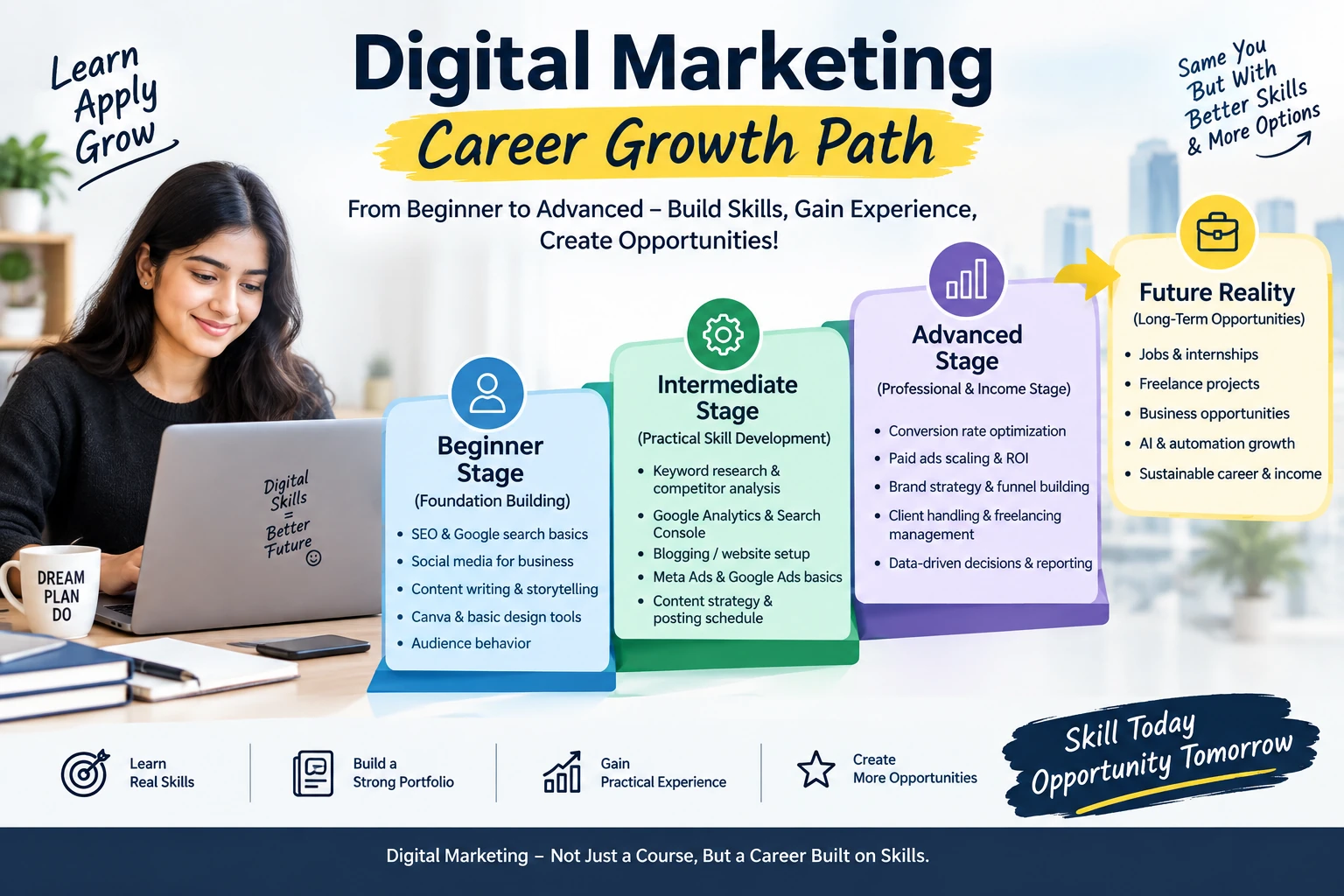
Skills Breakdown (Beginner → Advanced Career Growth Path)
Digital marketing me skills ek saath develop nahi hoti hain. Beginner ko pehle basic concepts aur audience understanding clear karni hoti hai, uske baad content, SEO, social media aur analytics jaise areas par practical work karte hue apni working ability improve karni padti hai. Jaise-jaise experience badhta hai, learner individual tasks complete karne se aage badhkar campaigns, performance data aur business objectives ko ek saath samajhna seekhta hai. Isliye skills development ko sirf tools ki list ya certificates collect karne ke bajay ek gradual process ke roop me dekhna zyada practical hai.
Beginner Stage (Foundation Building)
- Basic understanding of SEO aur Google search system
- Social media platforms ka proper business use
- Content writing aur storytelling basics
- Canva aur basic design tools ka use
- Audience behavior samajhna (log kya pasand karte hain)
Beginner stage ka focus immediately earning start karne ke bajay marketing fundamentals ko independently use karna seekhne par hona chahiye. Student ek small website, sample social media page ya practice campaign ko learning project ke roop me use kar sakta hai. For example, kisi topic ke liye keyword research karna, audience ke according content idea prepare karna, ek simple social post design karna aur uske possible performance factors ko analyse karna beginner ko real working process samajhne me help karta hai. Is practical exposure se learner sirf terminology ya tutorials yaad karne ke bajay marketing decisions lene ki habit develop karta hai.
Intermediate Stage (Practical Skill Development)
- Keyword research aur search competition ko samajhna
- Google Analytics aur Search Console se basic performance data read karna
- Blog ya simple website par content publish aur optimize karna
- Meta Ads aur Google Ads ke basic campaign structure ko samajhna
- Content calendar aur channel-wise publishing plan banana
Intermediate level par learner ka focus alag-alag skills ko actual marketing tasks me use karne par hota hai. Is stage par sirf ye jaan lena enough nahi hota ki keyword research, analytics ya advertising tools kaise kaam karte hain; learner ko ye bhi samajhna padta hai ki available information ke basis par kya decision lena hai. For example, search data dekhkar kisi topic ko prioritize karna, website content me relevant improvements identify karna ya campaign ke basic performance numbers ko compare karna practical understanding develop karta hai. Apne projects me kiye gaye changes aur unke results ko properly record karna bhi useful habit hai, kyunki baad me isi material ko portfolio me work evidence ke roop me present kiya ja sakta hai.
Advanced Stage (Professional & Business-Focused Skills)
- Conversion rate optimization aur user journey improvement
- Paid advertising campaigns ko scale karna aur performance evaluate karna
- Brand positioning, campaign strategy aur funnel planning
- Client requirements, project scope aur marketing deliverables manage karna
- Performance data ke basis par reporting aur strategic decision making
Advanced stage par marketer ka role individual tasks complete karne se badhkar business objectives ko samajhne aur unke according priorities set karne ka ho jata hai. Traffic, leads, conversions, customer behaviour aur campaign spending ko ek saath analyse karke ye identify karna pad sakta hai ki improvement ki sabse zyada zarurat kis area me hai. Is level par professional ki value sirf kisi platform ya software ko operate karne se nahi banti; important ye hota hai ki woh data ko context ke saath interpret kare, practical recommendations de aur clearly explain kar sake ki proposed change business ke result ko kis tarah influence kar sakta hai.
Daily Routine (Real Industry Workflow)
- Morning: Website traffic aur ad performance analysis
- Mid-day: Content creation (blogs, reels, creatives)
- Afternoon: Campaign optimization aur testing
- Evening: Client communication aur reporting
- Night: New trends, AI tools aur market updates learning
Digital marketing workflow me consistency ka matlab har din identical tasks repeat karna nahi hai. Kabhi marketer content plan karega, kabhi campaign data analyse karega aur kabhi website ya landing page me improvement identify karega. Important point ye hai ki decisions ko available data aur previous results ke saath connect kiya jaye. Regular review se professional ko ye samajhne me help milti hai ki kaunse activities continue karni hain, kya test karna hai aur kis area me resources waste ho rahe hain.
Tools Used in Industry (Professional Ecosystem)
- Google Analytics: User behavior aur traffic analysis
- Google Search Console: SEO ranking aur indexing monitor karna
- Canva: Creative posts aur marketing design banana
- SEMrush / Ahrefs: Keyword research aur competitor analysis
- Meta Ads Manager: Facebook aur Instagram advertising campaigns
- Email Marketing Tools: Customer retention aur automation workflows
- AI Tools: Content creation aur marketing automation support
Modern digital marketing me tools execution aur measurement ko easier banate hain, lekin tools khud strategy ka replacement nahi hote. Analytics platforms se traffic aur user behaviour samjha ja sakta hai, SEO tools research ko organize kar sakte hain aur advertising platforms campaign performance report kar sakte hain. Beginner ke liye pehle ye samajhna zyada important hai ki kisi tool ka data kis question ka answer de raha hai; uske baad advanced features seekhna comparatively easy ho jata hai.
Freelancing Reality (Ground Level Truth)
Freelancing ke starting phase me student ko income se pehle market-ready work aur client trust build karne par focus karna chahiye. Initial projects generally small tasks se start ho sakte hain, jahan client ko basic execution, communication aur timely delivery ki zarurat hoti hai. Neeche diye examples ko fixed market rates nahi samajhna chahiye; actual project fee task ki complexity, freelancer ke experience aur client requirements ke according change ho sakti hai.
- ₹500–₹2000: Basic tasks (posts, captions, small SEO fixes)
- ₹5000–₹20000: Monthly clients aur regular projects
Experience badhne ke saath freelancer ke paas sirf completed tasks nahi, balki apne work ke measurable examples aur client outcomes bhi collect hone lagte hain. Ye case studies future clients ko freelancer ki working process samajhne me help kar sakti hain. Strong portfolio ke saath specialization, repeat clients aur better project selection gradually improve ho sakte hain, although income kisi fixed timeline ya amount ke according guaranteed nahi hoti.
- Experienced freelancers with strong portfolios and long-term clients may earn ₹50,000+ per month, although earnings vary significantly based on skills, niche and client acquisition.
- International clients ke through dollar earning bhi possible hai
- Long-term passive income streams create ho sakte hain
Frequently Asked Questions (FAQs)
1. Can I start Digital Marketing immediately after 12th?
Yes. Digital marketing is a skill-based field where practical knowledge is often more important than having a specific degree. Many students begin learning after Class 12 while continuing higher education. Building real projects and a portfolio is usually more valuable than completing only theoretical courses.
2. Which stream is best for Digital Marketing?
Students from Arts, Commerce and Science can all enter this field. There is no stream restriction. Communication skills, creativity, analytical thinking and continuous learning are more important than academic background.
3. Is a college degree compulsory for getting a digital marketing job?
Many companies prefer graduates, but employers also hire candidates who can demonstrate practical skills, certifications and successful projects. A strong portfolio often improves job opportunities.
4. How much can a beginner earn in Digital Marketing?
Entry-level salaries vary depending on the company, city, skills and experience. Freshers generally start with internships or junior roles and income usually increases after gaining practical experience and handling successful campaigns.
5. Can I earn through freelancing while studying?
Yes. Students who develop practical skills in SEO, content writing, social media management or paid advertising may take freelance projects. However, regular income depends on experience, communication skills and client satisfaction.
6. Which Digital Marketing skill has the highest future demand?
SEO, Performance Marketing, Content Strategy, Marketing Analytics, AI-assisted Marketing, Email Automation and Conversion Rate Optimization are expected to remain valuable as businesses continue expanding online.
7. Is Digital Marketing a good long-term career in India?
Digital marketing continues to grow because businesses of every size require online visibility. Students who regularly update their skills and adapt to changing technologies generally have better long-term career prospects.
8. How long does it take to become job-ready?
The timeline depends on learning speed and practical work. Students who consistently practice, create projects and understand real marketing tools generally become more employable than those who focus only on theory.
Final Conclusion (Future Reality)
Digital marketing un students ke liye ek practical career option ho sakta hai jo communication, creativity, technology aur data ke combination ke saath kaam karna pasand karte hain. Is field me progress sirf course complete karne ya certificate lene se decide nahi hoti; practical projects, portfolio, specialization aur real work experience ka role important hota hai. Student agar learning ke saath small SEO projects, content work, social media campaigns, analytics exercises ya advertising case studies create karta rahe, to uske paas future internships, jobs ya freelance opportunities ke liye dikhane ke liye genuine work samples bhi develop hote hain.
Long-term career growth individual skills, experience, communication ability, specialization aur changing market requirements par depend karegi. AI aur automation marketing ke kuch routine tasks ko faster bana sakte hain, lekin audience ko samajhna, information ko evaluate karna, creative decisions lena aur campaign results ko business goals ke saath connect karna ab bhi important capabilities hain. Isliye guaranteed income ya quick success ko target karne ke bajay gradually useful skills develop karna aur unhe real projects me apply karna zyada realistic approach hai. Agar aap degree ke saath ek practical skill bhi build karna chahte hain, to digital marketing ko apne career options me consider kiya ja sakta hai.