Mass Communication ek broad study and career area hai jisme journalism, advertising, public relations, digital publishing, broadcasting, content production aur corporate communication jaise different work areas include ho sakte hain. 12th Arts ke baad is field ko explore karne wale students ko course choose karte waqt apni interest, preferred work style, practical training, fees, admission route aur future specialization ko saath me evaluate karna chahiye.
Table of Contents
- What is Mass Communication?
- Mass Communication Courses After 12th Arts
- Future Trends in Mass Communication
- Career Scope
- Salary Scope
- Skills Required
- Top Colleges & Universities
- Frequently Asked Questions
What is Mass Communication?
Mass Communication ek aisa field hai jiska main purpose information, ideas, opinions aur entertainment ko ek bade audience tak pahunchana hota hai. Aaj ke digital era me communication sirf newspapers aur television tak simit nahi raha. Social media platforms, websites, podcasts, OTT platforms, YouTube channels aur mobile applications bhi mass communication ka important hissa ban chuke hain.
Jab koi news channel lakhon logon tak ek hi samay me news pahunchata hai, jab ek advertising campaign poore desh ke consumers ko influence karta hai, ya jab ek digital content creator apne videos ke through millions viewers tak apna message pahunchata hai, to ye sab Mass Communication ke examples hote hain.
Mass Communication ka field journalism, advertising, public relations (PR), broadcasting, film production, digital media, content creation aur corporate communication jaise kai sectors ko cover karta hai. Is field me students ko communication techniques, media ethics, reporting, content writing, video production, public relations strategies aur audience behavior ke baare me practical knowledge di jati hai.
Pichhle kuch saalon me internet aur smartphone users ki tezi se badhti sankhya ne media industry ko completely transform kar diya hai. Aaj traditional media ke saath-saath digital media companies, online news portals, influencer marketing agencies aur content production houses bhi large-scale employment opportunities provide kar rahe hain.
Best Courses After 12th Arts
12th Arts complete karne ke baad students ke paas Mass Communication field me enter karne ke liye kai undergraduate aur diploma courses available hote hain. Course ka selection student ke career goals, interest area aur future specialization par depend karta hai.
1. Bachelor of Journalism and Mass Communication (BJMC)
BJMC India ke sabse popular undergraduate media courses me se ek hai. Yeh generally 3 saal ka professional degree program hota hai jisme students ko journalism, reporting, news writing, video production, digital media, public relations aur advertising ke practical aspects sikhaye jate hain.
BJMC choose karne wale students ko course ko sirf ek general media degree ke roop me nahi dekhna chahiye. Is programme ka practical value is baat par depend karta hai ki college journalism, reporting, editing, video production, digital publishing aur internship jaise areas me kitna hands-on exposure deta hai. Agar aap journalism, news production, digital reporting, content production ya media-related roles explore karna chahte hain, to admission se pehle syllabus ke saath practical assignments, student publications, studio facilities, internship structure aur final-year projects ko bhi compare karein. Isse aapko ye samajhne me madad milegi ki course aapke intended career path ke liye actual preparation kis level tak provide karega.
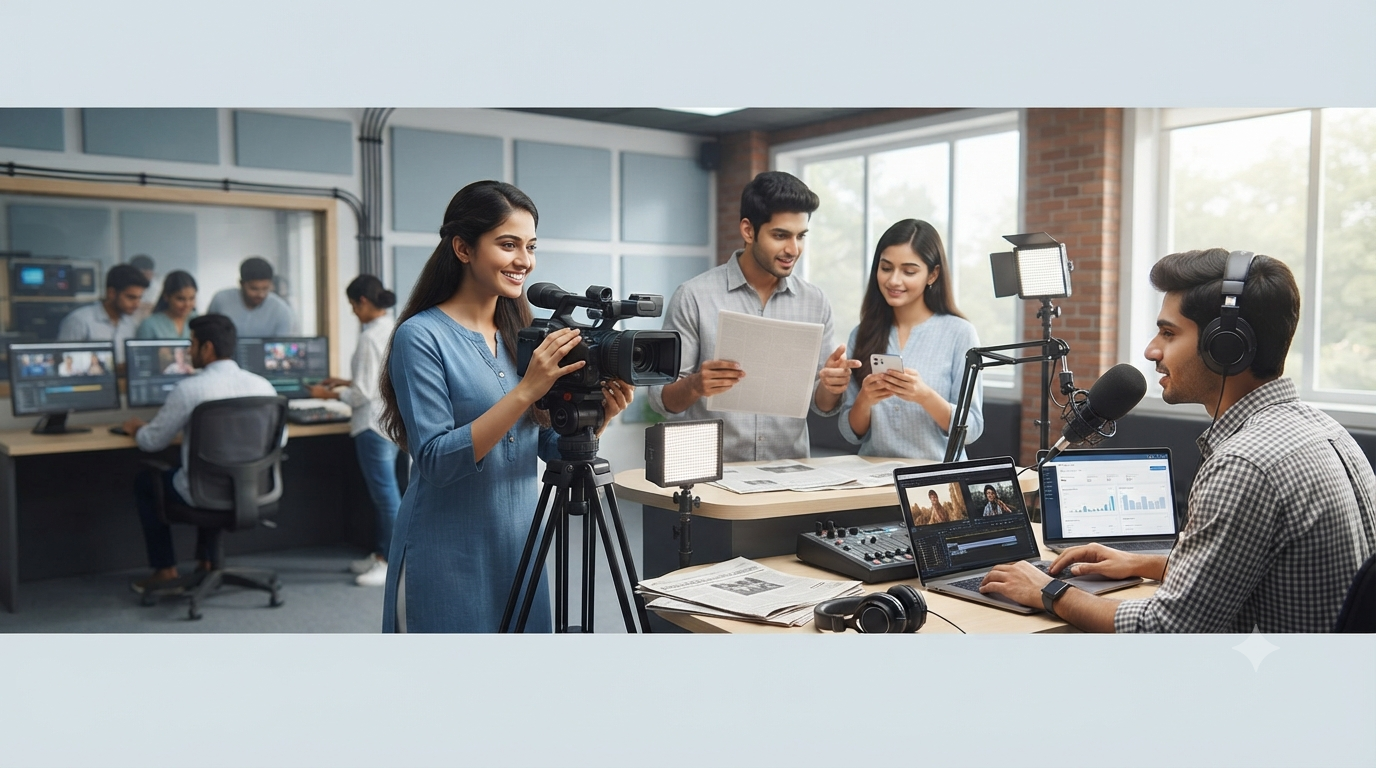
Mass Communication after 12th Arts covers areas such as journalism, digital media, broadcasting, advertising, public relations and content production.
2. BA in Mass Communication
BA in Mass Communication un students ke liye ek degree option hai jo media ko sirf news ya entertainment ke roop mein nahi, balki communication, society aur audience ke perspective se samajhna chahte hain. Course ke syllabus ke according students communication theories, media studies, journalism, media writing, audience behaviour aur digital communication jaise topics padh sakte hain. Kuch programmes mein practical assignments, reporting exercises, presentations aur media production activities bhi included hoti hain.
Is course ko choose karne se pehle university ka syllabus dekhein aur compare karein ki programme mein theory aur practical learning ka balance kaisa hai. Agar aap future mein journalism, content research, media studies ya higher education explore karna chahte hain, to course ke subjects aur available specialisations ko apne interests ke saath match karna useful rahega.
3. Diploma in Media Studies
Diploma programmes un students ke liye relevant ho sakte hain jo media ke kisi particular area ko relatively focused curriculum ke through seekhna chahte hain. Programme ke according topics mein reporting, video production, editing, media writing ya digital content creation shamil ho sakte hain. Har diploma ka syllabus ek jaisa nahi hota, aur duration bhi institute ke according vary karti hai.
Admission se pehle check karein ki diploma mein hands-on assignments, equipment access, practical projects aur assessment kaise conduct hote hain. Sirf course ka naam ya short duration dekhkar admission na lein. Institute ki recognition, certificate ki acceptance aur future degree admission ke liye us qualification ki suitability bhi verify karein.
4. Advertising and Public Relations Courses
Advertising aur Public Relations (PR) media aur communication ke aise areas hain jahan message ko plan karna, audience ko samajhna aur information ko suitable format mein present karna important hota hai. Advertising-related courses mein campaign planning, copywriting, branding aur consumer behaviour cover kiye ja sakte hain. PR programmes mein press releases, media relations, organisational communication, event communication aur public image se related topics padhne ko mil sakte hain.
Dono fields ka work nature alag ho sakta hai. Advertising mein campaign ke creative aur promotional elements par focus ho sakta hai, jabki PR mein organisations aur unke stakeholders ke beech communication manage karna important hota hai. Course choose karne se pehle sample assignments, practical projects aur internship components dekhein, taaki aapko samajh aaye ki programme mein kis tarah ka kaam karna padega.
5. Digital Media and Communication Courses
Digital media programmes online platforms par information create, publish aur present karne se related skills cover kar sakte hain. Course ke syllabus ke according students digital journalism, social media content, multimedia storytelling, online audience analysis, SEO fundamentals, content planning ya basic video production seekh sakte hain. Lekin har programme mein ye saare subjects available hon, zaroori nahi hai.
Is field ko explore karne ke liye students ek chhota practical project bana sakte hain, jaise kisi topic par researched article, short video script, sample social media content plan ya multimedia story. Isse unhe writing, research, visual presentation aur audience ke liye information organise karne ki practice milti hai. Course select karte waqt dekhein ki practical work ko feedback aur assessment ke through kaise evaluate kiya jata hai.
Eligibility and Admission Process for Mass Communication
Mass Communication mein admission ka ek common process sabhi colleges ke liye applicable nahi hota. Kuch institutions Class 12 ke marks ke basis par candidates ko consider karte hain, jabki kuch entrance examination, merit list, interview ya additional selection requirements use kar sakte hain. Eligibility mein minimum marks, required subjects aur other conditions bhi institution ke according different ho sakti hain.
Arts stream ke students ke saath Commerce aur Science background ke students bhi kai undergraduate media programmes ke liye eligible ho sakte hain. Lekin kisi particular course mein English subject, minimum aggregate marks ya other conditions required ho sakti hain. Isliye kisi general eligibility statement ko apni target university ke admission rules ka substitute na samjhein.
Minimum Eligibility: Apply Karne Se Pehle Kya Check Karein?
- Educational qualification: Check karein ki recognised board se Class 12 pass hona required hai ya appearing students bhi apply kar sakte hain.
- Minimum marks: University ki prescribed percentage aur applicable category-wise relaxation verify karein. Har institution ke liye 45% ya 60% ka ek fixed rule assume na karein.
- Stream and subject requirements: Confirm karein ki Arts, Commerce aur Science ke students eligible hain ya programme mein koi specific subject required hai.
- Entrance examination: Dekhein ki admission Class 12 merit, CUET-UG, university entrance test ya kisi other selection method par based hai.
- Documents: Mark sheets, identity documents, photographs aur category certificates, agar applicable hon, admission instructions ke according prepare karein.
Mass Communication Admission Ke Common Routes
Admission ka method samajhne ke liye apni shortlisted universities ki official admission websites compare karein. Neeche common routes diye gaye hain; ye har institution par apply nahi hote.
- Merit-based admission: Kuch colleges Class 12 ke marks aur apne published merit criteria ke basis par selection karte hain. Subject combination aur merit calculation ke rules bhi check karein.
- CUET-UG: Kuch participating universities CUET-UG scores ke through undergraduate admission deti hain. NTA ke official CUET-UG portal par examination information dekhein aur participating universities ki list se apni target institution verify karein. University ke programme-specific rules bhi check karna zaroori hai.
- University-level selection: Kuch institutions apna entrance test, interview, aptitude assessment ya other selection procedure rakh sakte hain. In requirements ko current admission notice se confirm karein.
CUET-UG 2026 ke official syllabus mein Mass Media / Mass Communication ek listed subject hai. Lekin sirf is subject ke syllabus mein hone se ye conclude nahi karna chahiye ki har Mass Communication course mein iska paper dena compulsory hai. Required CUET subjects aur selection criteria concerned university decide karti hai. Latest details ke liye CUET-UG 2026 syllabus aur relevant university ki admission notice ko saath mein check karein.
Mass Communication Courses Ki Duration
Course ki duration qualification aur institution par depend karti hai. Neeche common programme categories ka indicative overview diya gaya hai. Ye fixed national duration chart nahi hai; actual duration ko concerned institution ke current prospectus se verify karein.
| Course Type | Duration | What to Check |
|---|---|---|
| Certificate Course | Institute-specific; often a few months | Skills covered, practical work and certificate validity |
| Diploma in Media Studies | Varies by programme | Syllabus, training facilities and recognition |
| BA / BJMC / BA Journalism and Mass Communication | Commonly 3 or 4 years, depending on programme | Degree structure, curriculum and applicable exit options |
| MA / Master's in Journalism and Mass Communication | Programme-specific; commonly 2 years | Graduation eligibility, specialisation and admission method |
Undergraduate degree structures India mein institution aur applicable curriculum framework ke according differ kar sakte hain. UGC ke Curriculum and Credit Framework for Undergraduate Programmes mein flexible undergraduate pathways ka framework diya gaya hai. Iska matlab ye nahi ki har college mein har option available hai; apne programme ki actual duration aur degree requirements university se confirm karein.
Admission Se Pehle College Ko Kaise Evaluate Karein?
Course ka naam aur duration dekhne ke baad decision final na karein. Curriculum ko dhyan se padhein aur dekhein ki students ko reporting, writing, editing, photography, audio-video production ya digital media mein kitna practical exposure milta hai. Agar internship course ka part hai, to uski duration, evaluation method aur responsibilities samjhein. College se available equipment, media labs, faculty background aur student projects ke examples ke baare mein bhi information le sakte hain.
Fees compare karte waqt tuition ke alawa examination charges, equipment-related expenses, hostel ya travel costs aur other compulsory payments ko bhi consider karein. Placement support ko evaluate karne ke liye available placement reports, role descriptions aur disclosed data dekhein; sirf promotional statements ke basis par future salary ya job milne ki guarantee assume na karein.
Career Scope in Mass Communication
Mass Communication India ke fastest-growing career sectors me se ek mana jata hai. Pehle media careers ka matlab sirf newspaper journalism ya television reporting hota tha, lekin aaj industry ka scope kaafi expand ho chuka hai. Digital media, OTT platforms, corporate communication, advertising agencies, influencer marketing aur content creation jaise naye sectors ne employment opportunities ko kai guna badha diya hai.
Internet users aur smartphone consumption ke badhne ke saath companies ko skilled communication professionals ki zarurat lagatar badh rahi hai. Isi wajah se Mass Communication graduates ko private media houses ke saath-saath corporate organizations, government departments, startups aur international media networks me bhi opportunities mil rahi hain.
Career path choose karte waqt sirf job title dekhne ke bajay apne daily work preference ko samajhna zyada useful rahega. Agar aapko ground reporting, interviews aur current affairs pasand hain to journalism-related roles aapke interest se match kar sakte hain; agar writing ke saath visual content banana pasand hai to digital content, video production ya multimedia roles explore kiye ja sakte hain. Isi tarah brand communication aur client interaction me interest rakhne wale students advertising ya PR ko consider kar sakte hain. Graduation ke first year me different projects try karke apni preference identify karna specialization choose karne se pehle practical evidence de sakta hai.
Popular Career Options
- Journalist / Reporter: News collection, investigation, reporting aur public-interest stories cover karna.
- News Anchor: Television ya digital news platforms par news presentation aur live discussions conduct karna.
- Public Relations (PR) Officer: Organizations ki public image maintain karna aur media relations handle karna.
- Advertising Executive: Brand campaigns plan karna, consumer engagement strategies develop karna aur creative teams ke saath kaam karna.
- Content Creator: YouTube, blogs, podcasts aur social media platforms ke liye engaging content banana.
- Media Planner: Advertising campaigns ke liye suitable media channels select karna aur audience reach maximize karna.
- Social Media Manager: Brand presence manage karna, audience engagement increase karna aur digital marketing campaigns execute karna.
- Corporate Communication Specialist: Companies ke internal aur external communication systems ko manage karna.
- Radio Jockey (RJ): Radio broadcasting aur audience engagement activities perform karna.
- Digital Journalist: Online news portals, mobile platforms aur multimedia storytelling par focus karna.
Salary Scope in Mass Communication
Mass Communication me income ko ek fixed figure ke roop me samajhna practical nahi hai, kyunki same qualification ke baad bhi salary role, employer, location, experience, portfolio aur specialization ke according kaafi different ho sakti hai. Ek fresher reporter, content writer, PR executive ya production trainee ka starting package ek experienced editor, communication manager ya specialized media professional ke compensation se naturally alag hoga. Freelance aur creator-based work me income aur bhi variable ho sakti hai, kyunki payment project, client, audience, contract aur workload par depend karti hai. Isliye career planning karte waqt sirf expected salary ke bajay entry-level role, required skills aur experience ke saath possible progression ko bhi dekhna chahiye.
Location ka effect media careers me role aur employer ke according vary karta hai. Delhi-NCR, Mumbai, Bengaluru, Hyderabad aur Pune jaise major media and corporate hubs me media houses, agencies, production companies aur corporate communication teams ka concentration relatively zyada ho sakta hai, lekin iska matlab ye nahi ki har candidate ko automatically higher salary milegi. Salary compare karte waqt city ke saath employer type, role responsibilities, working hours, portfolio expectations, internship experience aur available learning opportunities ko bhi consider karna chahiye. Digital roles me bhi income ko guaranteed growth ke roop me nahi dekhna chahiye, kyunki freelance aur performance-linked work me earnings project aur client availability ke saath change ho sakti hain.
| Experience Level | Average Monthly Salary | Typical Roles |
|---|---|---|
| Fresher | ₹20,000 – ₹35,000 | Trainee Reporter, Content Writer, Assistant Producer |
| 1–3 Years | ₹35,000 – ₹60,000 | Reporter, PR Executive, Social Media Executive |
| 3–7 Years | ₹60,000 – ₹1,20,000 | Senior Journalist, Editor, Media Planner |
| 7+ Years | ₹1 Lakh – ₹3 Lakh+ | Media Manager, Senior Producer, Communication Head |
International employers ya multinational organizations ke compensation levels ko Indian entry-level salaries ke saath directly compare karna useful nahi hota, kyunki country, currency, taxation, living cost, role responsibilities aur professional experience sab alag hote hain. Isi tarah freelance journalism, consulting aur content creation me monthly income fixed salary ki tarah predictable nahi hoti; kisi month multiple projects mil sakte hain aur kisi period me workload comparatively kam ho sakta hai. Agar student independent work explore karna chahta hai, to portfolio, client communication, contracts, invoicing, revision handling aur consistent work pipeline ko earning expectations ke saath samajhna zaruri hai.
Skills Required for Success in Mass Communication
Mass Communication ki preparation classroom theory tak limited nahi rehni chahiye, kyunki media-related work me students ko information collect karne, sources verify karne, ideas ko clear language me present karne aur different formats me content produce karne ki practice karni padti hai. For example, ek journalism student reporting assignment ke through interview aur fact-checking practice kar sakta hai, jabki digital-media student article ke saath thumbnail, short video, social post ya basic analytics report prepare kar sakta hai. Isi tarah PR ya corporate communication me writing ke saath audience understanding, professional email communication aur message planning ka practical use hota hai.
Core Skills Every Student Should Develop
- Communication Skills: Clear aur effective communication media industry ki foundation hoti hai.
- Writing & Storytelling: News reports, articles, scripts aur digital content create karne ke liye strong writing ability zaruri hai.
- Public Speaking: Anchoring, presentations, interviews aur audience interaction ke liye confidence develop karna important hai.
- Research & Fact Verification: Accurate information collect karna aur facts verify karna professional credibility ke liye essential hai.
- Digital Media Knowledge: Social media platforms, content management systems aur digital publishing tools ki understanding honi chahiye.
- Video & Audio Production Basics: Modern media environment me multimedia skills ka importance lagatar badh raha hai.
- Creativity: Unique ideas aur engaging content audience attention attract karne me help karte hain.
- Critical Thinking: Complex situations ko objectively analyze karna aur balanced reporting karna professional responsibility ka hissa hai.
- Networking Skills: Industry professionals aur sources ke saath strong relationships career growth me help karte hain.
- Adaptability: Media industry rapidly change hoti rehti hai, isliye naye tools aur technologies ko quickly learn karna zaruri hai.
Agar student journalism ya media me career banana chahta hai, to traditional reporting ke saath digital formats ko samajhna practical advantage de sakta hai. For example, ek reporting assignment ko sirf written article tak limit karne ke bajay student usi topic ka short video, interview clip, social-media summary ya visual explainer bhi prepare kar sakta hai. Is practice se writing, research, editing aur audience-oriented presentation jaise skills ek hi project me develop hote hain. Graduation ke dauran aise multi-format projects ka portfolio banana internships ke liye apne actual work ko demonstrate karne ka useful tareeka ho sakta hai.
Major Industry Areas in Mass Communication
Mass Communication ko sirf journalism ke naam se samajhna incomplete hoga, kyunki media-related work ka actual structure kaafi wide hai. Ek student reporting aur news production me ja sakta hai, doosra advertising campaign ke creative ya media-planning side ko explore kar sakta hai, jabki koi digital publishing, podcast production, PR, corporate communication ya multimedia content par focus kar sakta hai. Har domain me daily work alag hota hai, isliye specialization choose karne se pehle student ko sample projects, internship descriptions aur entry-level job responsibilities dekhni chahiye. Is comparison se ye clear hota hai ki kisi field me actual kaam writing-heavy hai, camera-based hai, client-facing hai ya technical production se related hai.
Television & News Broadcasting
Television aur news broadcasting me work ek single role tak limited nahi hota. Reporter ko information collect karke sources se verification karni pad sakti hai, field journalist ko location se updates dene hote hain, producer ko programme flow aur newsroom coordination dekhna hota hai, jabki video editor available footage ko usable news package me convert karta hai. Anchoring ke liye presentation ke saath script understanding aur live situation handle karne ki ability bhi important hoti hai. Isliye is sector me interest rakhne wale students ko reporting, interview practice, script writing, basic video editing aur current-affairs research ko college projects ke through gradually develop karna chahiye.
Newspapers & Magazine Publishing
Newspapers aur magazines me kaam karne wale professionals ka role publication ke workflow par depend karta hai. Reporter information gather aur verify karta hai, feature writer kisi topic ko detailed narrative me develop kar sakta hai, copy editor language aur structure ko refine karta hai, aur digital team isi story ko website ya social platform ke format me adapt kar sakti hai. Isliye print-media me interest rakhne wale students ko reporting ke saath headline writing, editing, research aur digital publishing ka basic workflow bhi samajhna chahiye. College magazine, student newspaper ya independently researched articles ka portfolio is practice ko demonstrate karne ka practical medium ho sakta hai.
Advertising Industry
Advertising me communication ko ek defined audience aur business objective ke according shape kiya jata hai. Copywriter words aur campaign message develop kar sakta hai, creative team visual concept par kaam karti hai, media planner suitable channels select karta hai aur account or campaign team client requirements ko coordinate karti hai. Student is field ko samajhne ke liye kisi imaginary product ke liye complete campaign exercise bana sakta hai jisme target audience, message, headline, social-media post, short-video concept aur basic media plan include ho. Aise projects se creativity ke saath strategic thinking ko bhi practice kiya ja sakta hai.
Public Relations (PR)
Public Relations ka kaam sirf kisi organization ki positive image banane tak limited nahi hota. PR professionals press releases prepare kar sakte hain, journalists ke saath communication coordinate kar sakte hain, media queries ka response organize kar sakte hain aur events ya announcements ke communication plan me contribute kar sakte hain. Crisis situation me information ko clear aur consistent language me communicate karna bhi important ho sakta hai. Is field me interest rakhne wale students ke liye press-release writing, professional email drafting, media-list research aur mock press-conference exercises useful practice ho sakti hain.
Digital Media & Online Publishing
Digital media me content ek hi format me publish nahi hota, isliye professionals ko written, visual, audio aur short-form formats ke basic workflow ko samajhna useful hota hai. Ek digital journalist ko article ke saath headline, image selection, social-media version aur kabhi-kabhi short video bhi prepare karna pad sakta hai, jabki content team audience response ko analytics ke through review kar sakti hai. Student is area me apna small portfolio website, blog, podcast episode ya short-video series bana kar research, scripting, editing aur publishing ka complete process practice kar sakta hai. Is approach se “digital media” ko sirf ek job title ke bajay actual work process ke roop me samajhna easier hota hai.
Corporate Communication
Corporate communication me organization ke andar aur bahar dono taraf information ko appropriate audience tak pahunchana hota hai. Internal communication me employee announcements, newsletters, leadership messages aur organizational updates aa sakte hain, jabki external communication me media statements, corporate announcements, public-facing content aur brand communication include ho sakte hain. Is role ko explore karne wale students ko formal writing, presentation, research, professional email communication aur information summarization par practice karni chahiye, kyunki corporate environment me language ko clear, accurate aur context-appropriate rakhna important hota hai.
Step-by-Step Study Plan for Success in Mass Communication
Mass Communication me successful career banane ke liye sirf degree complete karna kaafi nahi hota. Students ko practical skills, industry exposure aur professional portfolio par bhi focus karna chahiye. Neeche diya gaya roadmap beginners ke liye helpful ho sakta hai.
Step 1: Communication Fundamentals Strong Karo
First year ke beginning me communication practice ko daily routine ka part banana useful rahega. Roz newspaper ya reliable news source se ek current-affairs topic choose karke uska short summary apni language me likhein, phir usi topic ko 1–2 minute me verbally explain karne ki practice karein. Is exercise se reading comprehension, information selection, vocabulary aur speaking clarity ek saath improve hoti hai. English ke saath Hindi ya regional-language communication bhi practice karein, especially agar aap multilingual media roles explore karna chahte hain.
Step 2: Writing & Reporting Skills Develop Karo
Writing skill develop karne ke liye sirf notes banana enough nahi hai; different formats me actual writing karna zyada useful practice deta hai. Har week ek news-style report, ek opinion-free information article aur ek feature-style piece likhne ki koshish karein. Har draft ke baad headline, opening paragraph, factual accuracy, sentence clarity aur unnecessary repetition ko review karein. Dheere-dheere apne selected pieces ko edit karke portfolio me rakhein, taaki graduation ke time aapke paas sirf certificate nahi balki demonstrable writing samples bhi hon.
Step 3: Digital Media Tools Seekho
Digital tools seekhte waqt ek saath bahut saare software collect karne ke bajay ek practical workflow complete karna better approach hai. Pehle basic image editing aur simple design se start karein, phir short-video editing, captions, thumbnails aur social-media publishing ka process practice karein. Agar blogging ya digital journalism me interest hai to kisi CMS par article publish karna bhi seekhein. Har tool ko tutorial dekhkar chhodne ke bajay ek real project me use karein, kyunki actual output banate waqt hi editing, formatting aur publishing ki common problems samajh aati hain.
Step 4: Portfolio Build Karna Start Karo
Digital tools seekhte waqt ek saath bahut saare software collect karne ke bajay ek practical workflow complete karna better approach hai. Pehle basic image editing aur simple design se start karein, phir short-video editing, captions, thumbnails aur social-media publishing ka process practice karein. Agar blogging ya digital journalism me interest hai to kisi CMS par article publish karna bhi seekhein. Har tool ko tutorial dekhkar chhodne ke bajay ek real project me use karein, kyunki actual output banate waqt hi editing, formatting aur publishing ki common problems samajh aati hain.
Step 5: Internships Complete Karo
Internship choose karte waqt sirf organization ke naam ko priority na dein; role me aapko actual work kya milega, ye check karna zyada useful hai. Internship description me writing, research, social-media handling, video editing, reporting, event support ya client communication jaise tasks mention hain to unhe note karein aur joining se pehle duration, working arrangement, mentor or reporting structure aur certificate policy clear kar lein. Internship ke dauran daily work samples aur learnings record karna future portfolio aur interview preparation dono me useful ho sakta hai.
Step 6: Specialization Choose Karo
Specialization choose karne se pehle kam se kam do ya teen domains ko projects ya short internships ke through test karna practical approach ho sakta hai. Journalism me reporting aur verification ka workflow alag hota hai, advertising me campaign thinking aur creative development ka role hota hai, PR me professional communication aur media coordination important ho sakte hain, jabki digital media me content production aur platform-specific publishing ka combination milta hai. Apne interest ke saath ye bhi dekhein ki kis type ka daily work aap consistently karna pasand karte hain, kyunki specialization ka decision sirf trend dekhkar lene se baad me mismatch ho sakta hai.
Step 7: Continuous Learning Maintain Karo
Media tools aur publishing formats change hote rehte hain, isliye graduation ke baad learning ko completely stop kar dena practical nahi hoga. Har few months apne field se related ek naya workflow choose karein, jaise short-form video editing, data-based storytelling, podcast production, content analytics ya AI-assisted research, aur us par ek small project complete karein. Saath hi ye check karein ki tool ka actual professional use kya hai aur uski limitations kya hain. Is tarah learning random tutorials collect karne ke bajay portfolio me visible output create karne wali activity ban sakti hai.
Job Opportunities After Mass Communication
Mass Communication ke baad employment ko ek single “media job” category ke roop me dekhna useful nahi hai. News organizations me reporting, editing aur production roles ho sakte hain; advertising agencies me copywriting, media planning aur campaign coordination; PR firms me media relations aur communication work; digital companies me content, social media aur publishing roles; aur corporate organizations me internal ya external communication positions mil sakti hain. Government sector me recruitment ka process alag rules aur notifications ke through hota hai, jabki freelance work me client aur project availability important factor ban jati hai. Isliye student ko apni specialization ke saath target role aur employer type clearly define karna chahiye.
Popular Employment Sectors
- News Channels: Reporters, Anchors, Producers, Video Journalists.
- Newspapers & Digital Publications: Content Writers, Editors, Feature Writers.
- Advertising Agencies: Campaign Managers, Copywriters, Media Planners.
- Public Relations Firms: PR Executives, Corporate Communication Specialists.
- Digital Media Companies: Social Media Managers, Content Strategists, SEO Writers.
- Corporate Organizations: Internal Communication Managers and Brand Communication Teams.
- Radio & Podcast Industry: Radio Jockeys, Audio Producers and Podcast Creators.
- Film & OTT Industry: Script Writers, Production Coordinators and Media Researchers.
Freelance & Independent Opportunities
Mass Communication graduates freelance journalism, blogging, YouTube content creation, podcasting, social media consulting aur content marketing ke through bhi income generate kar sakte hain. Aaj creator economy ke growth ke saath independent media careers bhi kaafi popular ho rahe hain.
Employers & Workplaces in Mass Communication
Mass Communication graduates ko traditional media ke alawa digital publishing, advertising, public relations, production, corporate communication aur content teams me bhi roles mil sakte hain. Employer ka type aur role ki responsibility organization ke according change hoti hai, isliye kisi company ka naam dekhkar job role assume nahi karna chahiye. Student ko vacancy description me qualification, experience, portfolio requirement, language requirement aur actual responsibilities check karni chahiye. Neeche diye gaye examples ko representative workplaces ke roop me dekhein, guaranteed recruiters ya placement list ke roop me nahi.
2027 ke liye digital tools ka basic knowledge useful ho sakta hai, lekin har employer ki requirements same nahi hoti. Kisi role me reporting aur writing primary requirement ho sakti hai, kisi me video production, social media management, audience research ya corporate communication. Isliye student ko apne target role ke recent job descriptions compare karke un skills ki list banani chahiye jo repeatedly mention ho rahi hain, aur phir college projects ya internships ke through un skills ke evidence create karne chahiye.
Television & News Networks
Television aur news networks me communication graduates ko reporting, news research, production, video journalism, assignment coordination aur content-production related work mil sakta hai. Exact role organization, vacancy aur candidate ke experience ke according vary karega. Student ko application se pehle role description me shift timing, field work, language requirement, writing test, video skills aur experience criteria check karna chahiye.
- NDTV
- Aaj Tak
- India Today Group
- Zee Media
- Network18
- ABP News
- Republic Media Network
- News18 India
Possible roles me Reporter, Anchor, Producer, Video Journalist, Assignment Editor aur Content Producer jaise positions include ho sakti hain. In roles ke daily tasks alag hote hain, isliye candidate ko job title ke saath actual responsibilities bhi padhni chahiye. For example, reporting role me source verification aur field work important ho sakta hai, jabki production role me planning, coordination aur deadline management ka weight zyada ho sakta hai.
Newspapers & Digital Publications
Print aur digital publications me writing ke saath editing, research aur content adaptation ka kaam bhi hota hai. Aaj ek story ko newspaper edition ke liye edit karne ke baad website, newsletter ya social platform ke format me adapt karna pad sakta hai, although exact workflow publication ke according different ho sakta hai. Isliye students ko writing ke saath headline writing, editing, fact-checking aur basic digital publishing practice karni chahiye.
- Times of India Group
- Hindustan Times
- The Indian Express
- The Hindu
- Dainik Bhaskar
- Jagran Group
- Amar Ujala
Content Writer, Reporter, Copy Editor, Feature Writer aur Digital Journalist jaise roles publication ke structure ke according available ho sakte hain. Application se pehle student ko published work ka nature, required language, working location, experience requirement aur portfolio expectations check karni chahiye, taaki course ke baad target role ko realistically samjha ja sake.
Digital Media & Online Platforms
Digital media me news portals, content companies, podcast teams, video studios aur social-media agencies jaise different workplace environments ho sakte hain. Yahan ka work article publishing se lekar short-video scripting, social-media content, audience research, basic SEO aur multimedia production tak extend ho sakta hai. Student ko apne interest ke according ek primary skill choose karke uske around portfolio projects banana chahiye.
- Online News Portals
- Content Media Companies
- Podcast Networks
- Video Content Studios
- Social Media Agencies
- Content Marketing Firms
Digital Journalist, SEO Content Writer, Social Media Manager, Content Strategist aur Multimedia Producer jaise roles ke responsibilities ek doosre se kaafi different ho sakti hain. Isliye “digital media job” ko single category samajhne ke bajay individual job descriptions compare karein aur dekhein ki role me writing, analytics, editing, client communication ya content planning me se kis skill ki actual requirement hai.
Advertising & Branding Agencies
Advertising agencies brands ke liye campaign concepts, communication messages, media plans aur creative executions develop kar sakti hain. Agency structure ke according client servicing, copywriting, creative development, media planning aur campaign coordination alag teams handle kar sakti hain. Student ko is field me interest ho to kisi imaginary brand ke liye complete campaign brief, headline options, social-media concepts aur basic media plan banana useful practice ho sakta hai.
- Advertising Agencies
- Creative Agencies
- Brand Communication Firms
- Media Planning Agencies
- Marketing Communication Companies
Copywriter, Media Planner, Campaign Executive aur Brand Communication Specialist jaise roles me daily work ka nature different hota hai. Copywriting writing-heavy ho sakti hai, media planning audience aur channel selection se related ho sakti hai, aur campaign roles me coordination aur deadline management ka role aa sakta hai. Is difference ko samajhkar specialization choose karna sirf job title dekhne se zyada practical rahega.
Public Relations & Corporate Communication
PR agencies aur corporate communication departments media relations, organizational announcements, public communication aur reputation-related activities handle kar sakte hain. Work me press-release drafting, media coordination, event communication, professional correspondence aur information management jaise tasks include ho sakte hain. Student ko is field me interest ho to sample press release, mock media statement aur formal communication drafts ke through apni writing practice develop karni chahiye.
- Public Relations Agencies
- Corporate Communication Departments
- Brand Reputation Firms
- Corporate Media Teams
PR Executive, Corporate Communication Officer aur Media Relations Manager jaise roles ke responsibilities employer ke according change hoti hain. Entry-level candidate ko job description me writing requirement, media coordination, client interaction, reporting responsibility aur required experience check karna chahiye. Isse student ko ye samajhne me madad milegi ki role purely writing-based hai ya communication ke saath coordination aur stakeholder handling bhi involved hai.
Government Recruitment Ko Kaise Track Karein
Government media aur communication roles ke liye recruitment ek single common process follow nahi karta. Vacancy ke according eligibility, educational qualification, experience, age limit, selection stages aur pay level change ho sakte hain. Isliye students ko kisi old vacancy, coaching article ya general salary table ko final eligibility proof nahi maanna chahiye. Vacancy notice me department name, post name, qualification, application deadline, examination pattern aur official recruitment authority ko directly verify karna better approach hai.
Mass Communication background wale students ko PIB, Prasar Bharati-related opportunities, Ministry or department recruitment, state information and public relations departments aur eligible PSU communication roles jaise areas ko separately track karna chahiye. Har organization me same designation ya same qualification requirement hona zaruri nahi hai. Official notification available hone par usme diye gaye exact educational qualification aur selection process ko priority dein.
1. Press Information Bureau (PIB)
Press Information Bureau (PIB) Government of India ke communication system ka ek important part hai, jahan government ministries aur departments se related information ko media ke liye organise aur communicate kiya jata hai. Mass Communication background wale students ke liye is type ke workplace ko samajhna useful hai kyunki yahan news writing, information verification, press communication aur public-facing content jaise skills ka practical use ho sakta hai. Daily work sirf press release likhne tak limited nahi hota; information ko clearly present karna, official material ko samajhna aur media communication ke context ko follow karna bhi important ho sakta hai.
Communication-related work me press releases, media-related material, briefings ke liye communication support, background information aur digital content preparation jaise tasks role ke according aa sakte hain. Kisi specific post ke liye exact responsibilities designation aur recruitment notification par depend karti hain, isliye students ko sirf job title dekhkar eligibility assume nahi karni chahiye. Agar aap government media communication me interest rakhte hain, to writing practice ke saath current affairs notes, factual reporting exercises aur Hindi-English communication samples banana useful preparation ho sakta hai.
Possible Work Areas:
- Information and Media Communication
- Press Release and Content Preparation
- Media Coordination
- Public Communication
- Research and Information Support
Is type ke work ke liye clear writing, information ko verify karke present karne ki ability, current affairs awareness aur language proficiency useful skills ho sakti hain. Students ko recruitment ke liye current official notification me required qualification, experience, age limit aur selection process separately verify karna chahiye, kyunki har position ke requirements same nahi hote.
2. Doordarshan
Doordarshan India ka public television broadcasting network hai jahan news, educational, cultural, public-interest aur entertainment-related programming produce aur broadcast ki jati hai. Mass Communication students ke liye is type ke organisation ko samajhna useful hai kyunki television production ek team-based workflow hota hai. Kisi programme ke final broadcast se pehle research, scripting, recording, editing, production coordination aur presentation jaise multiple stages handle kiye ja sakte hain.
Mass Communication graduates ke liye actual work role aur department ke according change ho sakta hai. News-related work me research aur script preparation important ho sakti hai, jabki programme production me coordination, recording, editing aur production planning jaise tasks involve ho sakte hain. Isliye student ko sirf television dekhne ya anchoring me interest hone ke basis par career decide karne ke bajay ek small production project karke dekhna chahiye, jaise short interview record karna, script prepare karna aur us footage ko basic editing ke saath complete programme format me organise karna.
Possible Work Areas:
- News and Current Affairs Production
- Programme Production
- Script and Content Research
- Video and Post-Production
- Broadcast Coordination
- Media and Programme Support
Television-related roles me script writing, research, interview preparation, camera and editing workflow ki basic understanding, clear communication aur deadline ke according team ke saath kaam karne ki ability useful ho sakti hai. Kisi specific recruitment ke liye educational qualification aur selection stages ko current official notification se verify karna zaruri hai, kyunki har post ke liye same eligibility apply nahi hoti.
3. All India Radio (AIR)
All India Radio (AIR) radio broadcasting ke through news, information, educational programmes, cultural content aur public-interest communication ko audiences tak pahunchata hai. Radio aur audio media me interest rakhne wale Mass Communication students ke liye iska workflow television se alag practical skills develop karne ka opportunity deta hai. Yahan visual presentation ke bajay voice, script, sound, timing aur information delivery par zyada focus hota hai, isliye audio storytelling ko samajhna useful preparation ho sakta hai.
Radio production me kisi programme ke liye research karna, script prepare karna, interviews ke questions develop karna, audio content ko organise karna aur programme flow maintain karna jaise tasks role ke according involve ho sakte hain. Students apni preparation ke liye short audio bulletin, interview recording ya five-minute podcast episode bana kar practice kar sakte hain. Is exercise se unhe script structure, pronunciation, questioning, voice delivery aur editing workflow ko practically samajhne ka chance milta hai.
Possible Work Areas:
- Radio Programme Production
- News and Audio Content
- Script and Research Work
- Programme Coordination
- Audio Production Support
- Broadcast Content Development
Radio-related work me language clarity, listening ability, script writing, research, voice presentation aur audio editing jaise skills useful ho sakte hain. Kisi particular AIR-related opportunity ko consider karte waqt students ko current recruitment notice me post-specific qualification, experience requirements, selection process aur application conditions check karni chahiye.
4. State Information & Public Relations Departments
State governments ke Information and Public Relations Departments government programmes, public information aur awareness-related communication ko citizens aur media tak pahunchane me role play karte hain. Communication work ka nature state aur department ke according change ho sakta hai, lekin is area me government information ko simple language me communicate karna, media-related material prepare karna, public awareness content support karna aur different communication channels ke saath coordinate karna jaise tasks relevant ho sakte hain.
Mass Communication students ke liye is field ko samajhne ka ek practical tareeka hai ki kisi government scheme ya public-awareness topic par ek sample communication package prepare kiya jaye. Isme short press note, newspaper-style information article, social-media post aur basic awareness script include ki ja sakti hai. Aise exercises se student ko ye samajhne me help milti hai ki public communication me information ko attractive banane ke saath accurate, clear aur responsible rakhna bhi important hota hai.
Possible Work Areas:
- Public Information and Communication
- Media Coordination
- Public Relations Support
- Government Content Preparation
- Public Awareness Communication
State-level recruitment ka process ek state se doosre state aur ek post se doosri post tak different ho sakta hai. Kuch positions ke liye competitive examination ho sakta hai, jabki kuch roles ke liye department-specific recruitment conditions apply ho sakti hain. Isliye students ko current state government notification me educational qualification, age criteria, experience, selection stages aur recruiting authority ko directly verify karna chahiye.
5. Ministry of Information and Broadcasting
Ministry of Information and Broadcasting (I&B) Government of India ke information, broadcasting aur related media matters se connected policy and administrative work ka part hai. Mass Communication students ke liye ministry-level environment ko samajhna useful ho sakta hai kyunki yahan media, public communication, broadcasting aur information management se related work ka institutional perspective milta hai. Lekin kisi ministry me Mass Communication degree hone ka matlab automatically kisi particular post ke liye eligibility hona nahi hai; recruitment post-specific requirements ke according hoti hai.
Communication aur information-related responsibilities me research, documentation, public communication material, media-related coordination ya content support jaise areas role ke according aa sakte hain. Students agar is sector ko explore karna chahte hain to unhe current affairs ke saath government communication ka formal writing style, factual information handling, report preparation aur basic media analysis par practice karni chahiye. Specific vacancy ke liye official notification me required qualification aur selection procedure ko final reference maana jana chahiye.
6. Public Sector Undertakings (PSUs)
Public Sector Undertakings aur other government-controlled organisations me Public Relations, Corporate Communication, employee communication aur media-related functions ke liye different types of communication work ho sakta hai. Har PSU ka organisational structure aur recruitment process alag ho sakta hai, isliye Mass Communication graduate ke liye available position ko general rule ke roop me nahi dekhna chahiye. Kuch organisations communication-related positions ke liye specific qualifications maang sakti hain, jabki kuch recruitment notices me different educational backgrounds ya experience requirements mention ho sakte hain.
Corporate communication environment me kaam karne wale professionals ko internal announcements, employee communication, media coordination, corporate information, public-facing content aur organisational messaging jaise areas handle karne pad sakte hain. Students is type ke work ko samajhne ke liye kisi imaginary company ke liye press release, internal newsletter, short corporate announcement aur media-response draft prepare karke practice kar sakte hain. Isse formal writing, concise communication aur organisation-specific tone ko samajhne me practical help milti hai.
Examples of Organisations to Track:
- ONGC
- NTPC
- SAIL
- BHEL
- GAIL
- Indian Oil
Possible Communication Work Areas:
- Corporate Communication
- Public Relations
- Media Relations
- Internal Communication
- Content and Information Support
Kisi vacancy ko shortlist karne se pehle students ko post name ke saath educational qualification, required experience, age limit, selection stages, job location, application dates aur role ki actual responsibilities check karni chahiye. IndianOil bhi apni career information me batata hai ki recruitment organisational requirement ke according hoti hai aur detailed advertisement me job description aur eligibility criteria diye jaate hain. Isliye kisi coaching website, old vacancy article ya general career list ko final eligibility source maanane ke bajay current official recruitment notification ko reference banana zyada accurate approach hai.
Preparation ke liye students apne Mass Communication coursework ke saath press release writing, corporate announcement, internal newsletter, media-response draft, research-based article aur basic digital content jaise practical samples prepare kar sakte hain. Ye exercises unhe corporate communication aur public relations ke actual writing requirements ko samajhne me help karengi. Jab koi relevant vacancy publish ho, tab student apne existing skills aur portfolio ko us post ki requirements ke saath compare karke decide kar sakta hai ki application uski qualification aur experience se match karti hai ya nahi.
Skills Required for Government Media Jobs
- Excellent communication skills
- Hindi and English proficiency
- Current affairs knowledge
- Content writing ability
- Public communication skills
- Media awareness
- Research skills
- Computer and digital communication knowledge
Salary in Government Communication Jobs
| Position | Approx Salary |
|---|---|
| Information Officer | ₹35,000 – ₹70,000 |
| Public Relations Officer | ₹40,000 – ₹80,000 |
| Program Executive | ₹35,000 – ₹75,000 |
| Communication Officer | ₹45,000 – ₹90,000 |
Government communication posts ki actual pay structure post, department, recruitment rules, pay level, allowances aur appointment conditions ke according change ho sakti hai. Isliye table ko indicative information ke roop me dekhein aur kisi specific vacancy ke liye official notification me diye gaye pay level aur allowances ko final reference maan kar hi salary expectation banayein.
Possible Government Media & Communication Roles
Government media aur communication work me designation organisation aur recruitment rules ke according change ho sakta hai. Isliye neeche diye gaye roles ko guaranteed vacancies ki list ke roop me nahi, balki un types of responsibilities ko samajhne ke liye dekhein jo different departments ya organisations me appear ho sakti hain.
- Public Relations Officer (PRO)
- Information Officer
- Media Officer
- Communication and Content Roles
- Broadcasting and Programme Roles
- Media and Information Support Roles
Kisi specific role ke liye Mass Communication qualification accepted hai ya nahi, ye current recruitment notification se verify karna chahiye. Students ko designation ke saath job description bhi read karni chahiye, kyunki similar-sounding posts me qualification, experience, selection stages aur daily responsibilities different ho sakti hain.
Skills Useful for Government Media & Communication Work
Government communication-related work me sirf degree knowledge sufficient nahi hoti; information ko accurate, clear aur audience ke according present karne ki ability bhi useful hoti hai. Students ko apni preparation ke dauran writing, research aur communication skills ko practical assignments ke through develop karna chahiye. For example, kisi public issue par short factual article likhna, ek government-style press note prepare karna ya kisi current-affairs topic ka concise briefing note banana useful practice ho sakti hai.
- Clear written and verbal communication
- Hindi and English language proficiency
- News and media writing
- Information research and fact checking
- Current affairs awareness
- Public communication and content development
- Basic digital media and multimedia skills
Skill development ko sirf certificates collect karne tak limited na rakhein. Students apne college projects, internships aur self-created assignments ko portfolio me organise kar sakte hain, jaise press release, interview script, news article, awareness campaign draft, short video script ya research-based communication piece. Aise samples se student ko apni strengths identify karne aur future role ki requirements ke saath apne skills compare karne me practical help mil sakti hai.
Government recruitment ko static career list ki tarah nahi dekhna chahiye, kyunki eligibility, educational qualification, age limit, experience requirement, selection stages, pay level aur application dates post aur recruiting organisation ke according change ho sakte hain. Students ko kisi old vacancy article, coaching material ya general career guide par final eligibility decide karne ke bajay current official recruitment notification ko primary reference banana chahiye. Vacancy milne par post name, required qualification, subject or degree requirement, experience, selection process aur application deadline ko ek saath check karna practical approach rahega.
Colleges & Universities Offering Mass Communication Programs
Mass Communication course choose karte waqt college ka naam akela decision factor nahi hona chahiye. Students ko programme level, current admission route, curriculum, practical facilities, internship structure, location, total fee aur official placement information ko separately verify karna chahiye. Neeche diye gaye institutions examples ke roop me listed hain; course availability, duration, fee aur admission process academic session ke according change ho sakte hain, isliye application se pehle institution ki current official information check karna zaruri hai.
| College | Admission | Duration | Fees | Syllabus Highlights |
|---|---|---|---|---|
| Indian Institute of Mass Communication (IIMC) | Entrance Exam | 1–2 Years | ₹80K – ₹2L | Journalism, PR, Radio, Digital Media |
| Jamia Millia Islamia | Entrance Test | 3 Years | ₹30K – ₹1L | TV Production, Media Law, Journalism |
| Delhi University (DU) | CUET | 3 Years | ₹15K – ₹60K | BJMC, Media Studies, Communication |
| Symbiosis Institute of Media & Communication | Entrance + Interview | 3 Years | ₹8L – ₹12L | Advertising, PR, Digital Media |
| Xavier Institute of Communications | Entrance + Portfolio | 1–2 Years | ₹2L – ₹5L | Journalism, Film, Advertising |
| Christ University | Entrance Test | 3 Years | ₹3L – ₹6L | Media Studies, Journalism, PR |
| Amity University | Direct + Entrance | 3 Years | ₹4L – ₹10L | Mass Comm, Film, Digital Media |
Deep Knowledge Articles (Clickable)
Journalism Deep Guide Public Relations Complete Guide Advertising Industry Full GuideFuture Trends in Mass Communication (2027 Update)
- OTT platforms (Netflix, Prime Video) documentary journalism growth
- AI tools for automated news writing
- Short-form content (Reels & Shorts) dominance
- Podcast & audio journalism boom
- Data journalism & fact-based reporting demand
- Social media based news consumption increase
Skills and Their Practical Use in Mass Communication
| Skill | Where It Is Used | How Students Can Practise |
|---|---|---|
| News Writing | News portals, publications, reporting teams | Weekly news reports and fact-checked articles |
| Video Editing | Digital media, social content, video production | Short interviews, explainers and edited news packages |
| Public Speaking | Anchoring, presentations, interviews, PR | Recorded presentations and mock interviews |
| SEO Writing | Web publishing, blogs and digital content | Search-focused articles with clear structure and factual sources |
| Social Media Management | Brands, media pages and communication teams | Content calendars, captions and basic performance review |
Career Growth Path in Mass Communication
- Intern / Trainee: Students generally begin by assisting with research, writing, production, social content or basic media tasks. Internship payment, where offered, depends on the organization and arrangement.
- Junior-Level Roles: After graduation, roles may include reporter, content writer, production assistant, PR executive, social media executive or junior digital-media positions. Starting compensation varies by employer, location, role and candidate skills.
- Mid-Level Roles: With relevant experience, professionals may move into senior reporting, editing, production, PR, content strategy or media-planning responsibilities. Compensation depends on role scope and organization.
- Senior Roles: Experienced professionals may take responsibility for teams, editorial planning, campaigns, production or communication strategy, depending on their specialization and employer.
- Independent Work: Freelancers and creators may work with multiple clients or platforms, so their monthly income can vary according to projects, audience, contracts and workload.
Factors That Affect Mass Communication Income
| Work Type | Main Income Factors | What Students Should Build |
|---|---|---|
| Full-Time Media Job | Role, employer, location, experience and responsibilities | Degree, portfolio, internship and role-specific skills |
| Corporate Communication | Organization, role level, experience and communication responsibilities | Writing, presentation, research and professional communication |
| Freelancing | Clients, projects, rates, workload and repeat assignments | Portfolio, niche expertise, client handling and proposals |
| Content Creation | Audience, platform, monetization model and consistency | Content quality, publishing discipline and audience understanding |
Freelancing & Online Income Opportunities
Mass Communication students graduation ke saath freelance work explore kar sakte hain, lekin ise guaranteed income source samajhna theek nahi hoga. Freelance content writing, video editing, social-media management, podcast production, copywriting ya research assistance jaise projects start karne ke liye student ko pehle ek specific service define karni chahiye aur us service ke 3–5 quality samples prepare karne chahiye. Uske baad portfolio, proposal writing, client communication, revision handling aur payment terms ko samajhna zaruri hai. Initial stage par learning aur reliable work process develop karna income expectation se zyada practical focus ho sakta hai.
- Freelance Content Writing
- YouTube Journalism
- Podcast Creation
- Blogging
- Social Media Management
- Copywriting
- Public Relations Consulting
Mass Communication students graduation ke saath freelance work explore kar sakte hain, lekin ise guaranteed income source samajhna theek nahi hoga. Freelance content writing, video editing, social-media management, podcast production, copywriting ya research assistance jaise projects start karne ke liye student ko pehle ek specific service define karni chahiye aur us service ke 3–5 quality samples prepare karne chahiye. Uske baad portfolio, proposal writing, client communication, revision handling aur payment terms ko samajhna zaruri hai. Initial stage par learning aur reliable work process develop karna income expectation se zyada practical focus ho sakta hai.
Additional Career Opportunities
Media skills ko independent projects me use karne ka ek aur tareeka educational blogging, niche content, newsletter production ya audience-focused digital publishing ho sakta hai. In activities ko start karte waqt student ko pehle content purpose, target audience aur publishing schedule define karna chahiye. Affiliate links use kiye ja rahe hain to commercial relationship ko clearly disclose karna bhi important hai, taaki reader ko content aur monetization ke beech ka connection samajh aaye.
Start Earning with EarnKaro Affiliate ProgramAbout the Author & Editorial Approach
This guide has been developed by the Career Guidance Team of After12thArtsCareer.com with a focus on the questions that usually arise when a student starts exploring Mass Communication after Class 12. Instead of looking at the field only through course names or job titles, the article connects academic choices with practical areas such as journalism, digital publishing, advertising, public relations, broadcasting, content production and communication work.
The purpose of the editorial approach is to help students understand what they are actually choosing before they apply for a programme. Course duration, syllabus, practical exposure, admission requirements, fees and career pathways can differ between institutions and roles, so these details should be considered separately rather than treated as the same for every college or employer. Information that can change with a new admission cycle or recruitment notice should be checked against the latest information issued by the relevant institution or organisation.
Mass Communication also involves skills that are developed through practice, not only classroom study. Writing a news report, preparing a script, editing a short video, creating a communication campaign or presenting information to an audience can give students a clearer understanding of the kind of work involved. For this reason, the guide includes practical considerations alongside academic information so that readers can relate the subject to actual media and communication tasks.
Important Information for Students
- Course structure and duration can vary between universities and institutions.
- Admission requirements should be checked from the current admission notice of the concerned institution.
- Job eligibility depends on the specific role, employer and recruitment notification.
- Salary and freelance earnings can vary according to role, experience, location, employer and type of work.
- Examples of career areas are intended to explain possible work directions, not to guarantee employment.
Last Updated: October 2026
Frequently Asked Questions (FAQs)
What can I do after Mass Communication?
Mass Communication ke baad career options specialization ke according change hote hain. Journalism me reporting, editing aur digital news roles explore kiye ja sakte hain, jabki advertising, PR, corporate communication, digital publishing, content production aur social-media related roles bhi available ho sakte hain. Student ko apni interest ke saath role ki daily responsibilities aur required skills compare karke direction choose karni chahiye.
What is the average salary after Mass Communication?
Mass Communication ki salary ko ek single fixed range se represent karna difficult hai. Starting pay role, employer, city, specialization, internship experience aur portfolio ke according vary kar sakti hai. Experience ke saath compensation change ho sakta hai, lekin exact figure ke liye specific job role aur employer ki current vacancy information ko check karna zyada reliable approach hai.
Which course is better: BJMC or BA Mass Communication?
BJMC aur BA Mass Communication ka actual structure university ke curriculum par depend karta hai, isliye sirf degree title ke basis par decision nahi lena chahiye. BJMC programme me journalism aur media-production related subjects ka focus ho sakta hai, jabki BA Mass Communication me communication theory aur broader media studies ka coverage mil sakta hai. Admission se pehle syllabus, practical components, internship structure, elective subjects aur assessment pattern compare karna zyada useful rahega.
Can I get government jobs after Mass Communication?
Mass Communication graduates kuch government media, broadcasting, information, public-relations aur communication-related recruitment opportunities ke liye eligible ho sakte hain, lekin eligibility har post ke official notification par depend karti hai. PIB, Prasar Bharati-related organisations, government information departments, state communication departments aur eligible public-sector roles ko alag-alag vacancy notifications ke through track karna chahiye. Educational qualification, age limit aur selection process ko application se pehle official notice se verify karein.
Do I need strong English skills?
Mass Communication me English useful skill ho sakti hai, especially agar aap English news writing, digital publishing, corporate communication, advertising ya kisi aise role me jana chahte hain jahan regular English content prepare karna padta hai. Lekin iska matlab ye nahi hai ki career banane ke liye sirf English language par strong command hona hi zaruri hai. Hindi aur regional-language media me bhi reporting, broadcasting, content production, public communication aur other media-related work ke opportunities ho sakte hain. Aapko apne preferred career area ke according language requirement samajhni chahiye aur jis language me kaam karna hai usme writing, speaking, listening aur information ko clearly explain karne ki practice develop karni chahiye.
Agar abhi English average hai, to is wajah se Mass Communication ko immediately reject karne ki zarurat nahi hai. Graduation ke saath daily newspaper reading, short article writing, vocabulary building, interview practice aur basic presentation exercises ke through language skills gradually improve ki ja sakti hain. Saath hi Hindi ya apni regional language me bhi professional writing aur communication ko seriously develop karein, kyunki media work me audience aur platform ke according language ka use change hota hai.
Recommended Books (Amazon)
Mass Communication Books (Beginner to Advanced) Journalism & Media Study BooksAffiliate Disclosure: Some links on this page are affiliate links. If you purchase through these links, we may earn a small commission at no extra cost to you.