Urdu Language Course After 12th (2027): Courses, Study Options, Skills & Career Guide
12th ke baad Urdu ko apne future study plan ka hissa banane wale students ke liye sabse pehla step ye samajhna hai ki language course ka decision sirf interest ke basis par nahi, balki aage ke academic aur professional plan ko dekhkar lena chahiye. Kuch students Urdu ko graduation me main subject ke roop me padhna chahte hain, kuch teaching ya higher studies ki taraf jaana chahte hain, jabki kuch students translation, writing, media, research ya digital language work me iska practical use explore karna chahte hain. In sabhi routes ki preparation aur qualification requirement ek jaisi nahi hoti. Isi wajah se course choose karne se pehle apna intended direction clear karna useful hai, taaki aap jis programme me admission le rahe hain uska syllabus, duration, eligibility aur future study requirements aapke actual goal ke saath match kar sake.
Urdu ko career perspective se samajhne ke liye ise sirf ek school subject ya literature-based study tak limit karna zaroori nahi hai. Urdu language ka academic use literature, education, research aur cultural studies me mil sakta hai, jabki practical language skills ka application translation, editing, journalism, publishing aur bilingual communication jaise areas me bhi ho sakta hai. Digital content ke environment me subtitles, transcription, proofreading, captions aur multilingual material preparation jaise tasks bhi relevant ho sakte hain. Lekin har work area me employer ya client ki requirement alag ho sakti hai, isliye sirf language seekhna sufficient nahi maana ja sakta; student ko apni direction ke according writing ability, translation practice, subject knowledge, digital tools ya communication skills bhi develop karni pad sakti hain.
Is guide me Urdu language study ko ek practical learning aur career-planning perspective se samjhaya gaya hai. Aap yahan course ke different formats, eligibility aur admission considerations ke saath ye bhi dekh sakte hain ki learning ke dauran kin skills par focus karna useful rahega aur alag-alag work areas ke liye kis tarah ki preparation ki ja sakti hai. Agar aap 12th ke baad Urdu ko degree, diploma, certificate, teaching, translation, content work ya further study ke liye consider kar rahe hain, to ye information aapko available routes ko compare karne aur apne liye realistic study plan banane me help karegi.
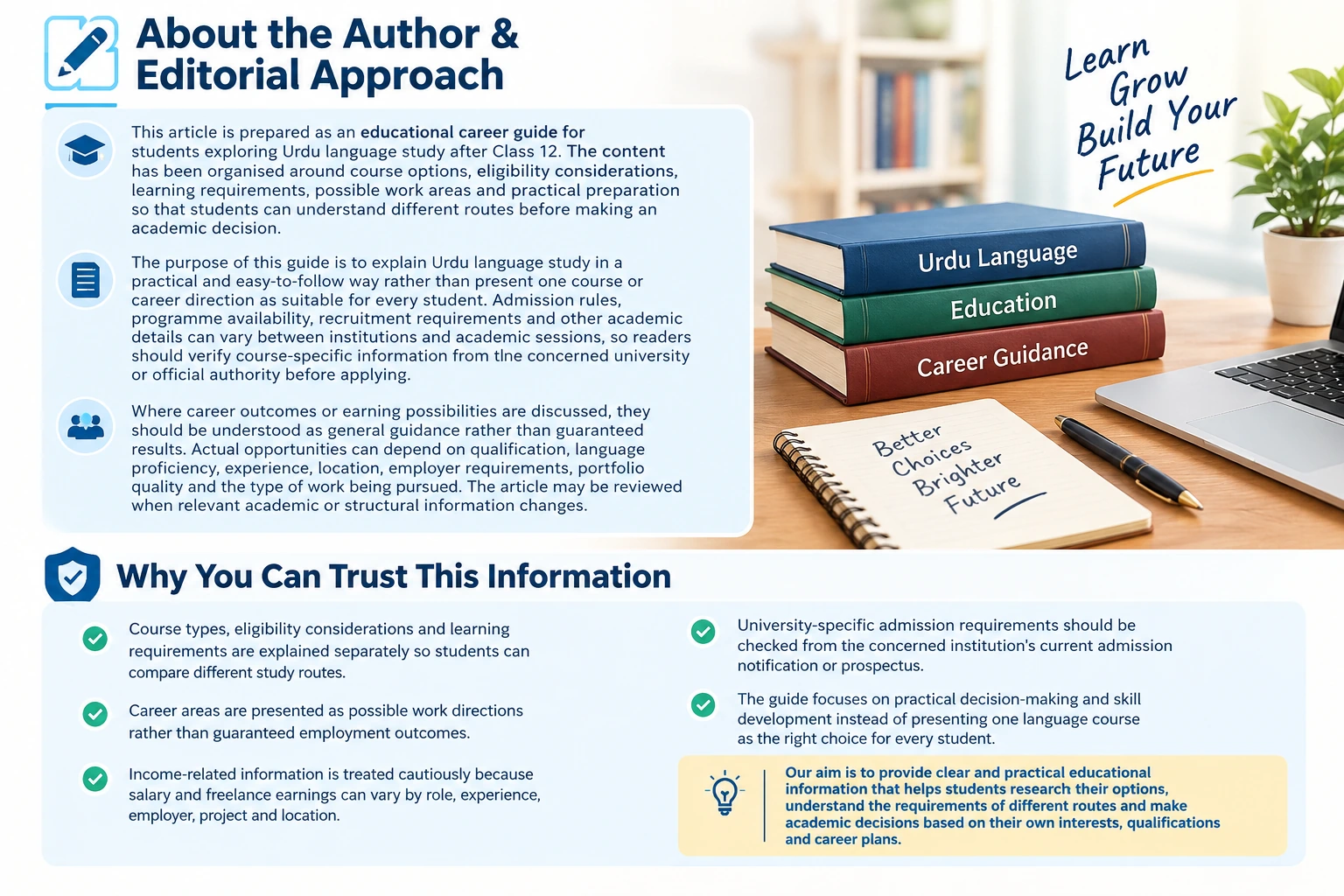
Table of Contents
- What is Urdu Language (Real Understanding)
- Why Urdu Language is Still Important in 2027
- Course Types & Duration Explained Simply
- Eligibility & Admission Process (Step-by-Step)
- Best Colleges & Universities in India
- Subjects & Syllabus Overview
- Career Scope & Real Job Opportunities
- Government & Private Sector Jobs
- Skills You Actually Develop
- Future Scope & Industry Demand (2027)
What is the Urdu Language? Understanding Its Language, Script and Practical Use
Urdu ek Indo-Aryan language hai jo South Asia ke linguistic aur cultural environment me develop hui aur time ke saath iski apni distinct literary tradition bani. Urdu ko samajhne ke liye sirf grammar, vocabulary ya script ko dekhna enough nahi hai, kyunki language ka actual learning experience reading, writing, pronunciation, sentence formation aur context ko samajhne se develop hota hai. Urdu literature me poetry, prose, storytelling aur everyday expression ke different forms milte hain, isliye students ke liye iska study ek language skill ke saath literary aur cultural understanding ko bhi develop kar sakta hai. Agar koi learner Urdu ko academic subject ke roop me choose karta hai, to uske liye language ke basic structure ke saath literature aur written expression ko gradually samajhna important hoga.
Aaj Urdu ka practical use traditional books aur classroom learning tak restricted nahi hai. Written Urdu ka use publications, journalism, educational material aur institutional communication jaise areas me ho sakta hai, jabki digital environment me subtitles, transcription, proofreading, captions aur multilingual content preparation jaise tasks bhi language skills se connected ho sakte hain. In activities ka nature ek doosre se kaafi different hota hai; example ke liye translation me meaning aur context ko accurately transfer karna important hota hai, jabki editing me grammar, sentence structure aur readability par zyada attention dena padta hai. Isliye Urdu seekhne wale student ko apne intended use ke according language practice ka focus decide karna chahiye.
Hindi background se aane wale kuch learners ko Urdu ke vocabulary aur sentence structure ke kuch aspects familiar lag sakte hain, kyunki Hindi aur Urdu ka linguistic relationship close hai. Lekin dono languages ko completely identical samajhna bhi sahi approach nahi hoga. Urdu ki Nastaliq-based writing tradition, spelling conventions, vocabulary choices aur formal expression ko independently practice karna padta hai. Beginner ke liye isliye reading aur writing practice ko gradually build karna useful hota hai, especially agar uska goal Urdu ko sirf bolne ke bajay properly read aur write karna bhi hai.
Urdu ko long-term skill ke roop me develop karne wale student ke liye reading, writing, translation aur communication ko alag-alag practice areas ki tarah dekhna useful rahega. Agar future direction teaching hai, to academic qualification aur subject knowledge ke saath explanation skills important hongi; translation ya editing me accuracy, vocabulary, grammar aur context understanding par zyada focus karna hoga; aur content-related work me clear writing aur practical samples ka role ho sakta hai. Isliye Urdu course choose karte waqt sirf language seekhne ka decision na lekar ye bhi sochna chahiye ki aap is skill ko kis type ke study, academic project ya professional work ke saath connect karna chahte hain.
Real Life Use of Urdu Language (Where It Actually Works in 2027)
Urdu language ka use sirf books ya classroom tak limited nahi hai. Aaj ke time me ye ek practical working language ban chuki hai jo media, government aur digital world me continuously use ho rahi hai. Agar aap Urdu seekhte hain, to aapko sirf grammar nahi, balki real-world communication aur career opportunities bhi milti hain.
- TV news channels me Urdu subtitles, reporting aur script translation
- Court cases aur legal documents ka translation (Hindi–Urdu–English)
- Bollywood aur OTT platforms par dialogue writing aur script adaptation
- Gulf countries (UAE, Saudi Arabia) me communication aur documentation support
- YouTube channels, reels aur social media content ka Urdu captioning
Digital media ne Urdu language work ke formats ko traditional books aur classroom teaching se aage badhaya hai. Ab language skills ka use subtitles, captions, transcription, translation, proofreading, article editing aur multilingual content preparation jaise tasks me bhi ho sakta hai. Lekin har organisation me Urdu-related work ki requirement same nahi hoti, isliye student ko kisi general “high demand” statement par depend karne ke bajay actual job descriptions, required language pair, writing standard aur portfolio expectations ko check karna chahiye. Is approach se course ke baad available work ko realistically samajhna easier hota hai.
Eligibility Criteria (Updated 2027 Real Admission Standards)
Urdu language courses ke liye eligibility ka structure kaafi simple hota hai, kyunki ye ek open-access humanities subject hai. Zyada tar universities me kisi bhi stream ke students apply kar sakte hain.
- 12th pass hona compulsory hai (Arts, Commerce ya Science – kisi bhi stream se)
- Minimum marks requirement usually 45%–50% hoti hai, lekin reputed universities me cutoff thoda higher ho sakta hai
- Language interest aur basic reading comprehension (Hindi/English) helpful hoti hai
- BA Urdu ke liye kuch universities entrance test ya merit dono consider karti hain
Admission ke waqt sabse important step ye hai ki student course ka naam dekhkar eligibility assume na kare. Ek university me BA Urdu ke liye 12th marks, subject combination aur admission route alag ho sakta hai, jabki kisi certificate ya diploma programme ke rules comparatively different ho sakte hain. Isliye application submit karne se pehle official admission notification me eligibility, required documents, application dates, entrance ya merit process aur fee details verify karna chahiye. Agar university ne current academic session ke liye separate prospectus release kiya hai, to wahi document final reference maana jana chahiye.
Admission Process (Step-by-Step 2027 Guide)
Urdu course ka admission process institution ke type aur programme ke according change ho sakta hai. Kuch programmes merit-based admission follow kar sakte hain, jabki kuch institutions entrance examination, counselling ya university-specific selection process rakh sakte hain. Student ko application bharne se pehle ye identify karna chahiye ki admission kis route se hoga aur selection ke liye kaunse documents ya academic requirements important hain. Iske baad application deadline, fee payment, document verification aur admission confirmation ke steps ko ek simple checklist me rakhna useful rahega, taaki deadline ya document submission me unnecessary mistake na ho.
- Step 1: Official university website par online application form fill karna
- Step 2: Required documents upload karna (10th/12th marksheet, ID proof, photo)
- Step 3: Entrance exam (agar applicable ho) appear karna ya merit list ka wait karna
- Step 4: Shortlisted candidates ke liye counselling ya interview process
- Step 5: Final admission confirmation aur fee payment
Where Can You Study Urdu Language? Universities and Learning Options
India me Urdu padhne ke liye students ko university-based degree programmes ke saath diploma, certificate aur distance-learning options bhi mil sakte hain. Programme availability institution aur academic session ke according change ho sakti hai, isliye kisi university ka naam dekhkar ye assume nahi karna chahiye ki har level par Urdu course same format me available hoga. Agar aap 12th ke baad Urdu ko graduation subject ke roop me lena chahte hain, to university ki current course list, eligibility, admission route, syllabus aur application dates ko pehle check karna useful rahega. Higher studies ya language-focused work ka plan hai to BA ke baad available postgraduate options aur related specialisations ko bhi comparison me include karein.
- University of Delhi (DU) – Urdu se related undergraduate aur postgraduate study options ke liye current programme details aur eligibility university ke official admission information se verify karein.
- Jamia Millia Islamia, New Delhi – Urdu language aur literature se related programmes available ho sakte hain; admission se pehle current prospectus me course structure aur eligibility check karein.
- Aligarh Muslim University (AMU) – Urdu language aur literature ke academic study ke liye university ke current department aur programme details ko refer karein.
- Osmania University, Hyderabad – Urdu-related academic programmes ke liye current course availability, admission criteria aur study structure verify karein.
- University of Lucknow – Urdu study options ke liye current undergraduate aur postgraduate programme information ko admission notification ke saath compare karein.
- Indira Gandhi National Open University (IGNOU) – Distance-learning route consider karne wale students ko current Urdu-related programmes, eligibility, study material aur admission schedule check karna chahiye.
University select karte waqt sirf institution ka naam ya course title dekhna sufficient nahi hai. Student ko syllabus me language learning ke saath literature, translation, writing ya related subjects ka balance dekhna chahiye aur ye bhi check karna chahiye ki programme regular hai ya distance mode me offered hai. Agar future plan teaching, research, translation ya content-related work ka hai, to course ke academic structure ke saath practical exposure aur higher-study pathway ko bhi compare karna useful rahega. Admission ke final decision se pehle concerned university ki latest official notification ko reference maana chahiye, kyunki eligibility, fees, programme availability aur application dates academic session ke saath change ho sakti hain.
Online learning resources ko formal university programme ka direct replacement samajhne ke bajay supplementary practice ke liye use kiya ja sakta hai. Beginner learner online lessons ke through Urdu script, pronunciation, vocabulary, reading aur basic sentence formation par additional practice kar sakta hai, jabki formal degree ya diploma programme structured syllabus, assessment aur broader academic study provide karta hai. Agar aap translation, editing ya digital language work explore karna chahte hain, to online learning ke saath translated passages, proofreading exercises, subtitles ya bilingual writing samples ka portfolio banana bhi useful rahega. Is tarah online resources ko apni formal study ya independent skill development ke saath practically connect kiya ja sakta hai.
Urdu Language Courses Types (Complete Career-Oriented Comparison 2027)
Urdu language me different level ke courses available hote hain, aur har course ka purpose alag hota hai. Kuch courses beginners ke liye hote hain, jabki kuch advanced level par aapko teaching, research ya professional translation jobs ke liye prepare karte hain.
12th ke baad Urdu choose karne wale students ke liye starting point unke existing language level aur career objective par depend karega. Agar kisi student ko Urdu script aur basic reading ka experience nahi hai, to certificate ya introductory programme se foundation build karna useful ho sakta hai. Dusri taraf, jo student Urdu ko graduation ke main subject ke roop me padhna chahta hai, wo BA Urdu jaise degree programme ko directly consider kar sakta hai. Is decision me course duration ke saath syllabus, admission eligibility, university recognition aur aage ki study requirement ko bhi compare karna chahiye.
| Course | Duration | Eligibility | What You Learn | Career Outcome (2027 Reality) |
|---|---|---|---|---|
| Certificate in Urdu | 6 Months – 1 Year | 10th / 12th Pass | Basic script, reading, daily vocabulary | Entry-level translator assistant, basic freelance work |
| Diploma in Urdu | 1 Year | 12th Pass | Grammar, sentence structure, communication | Junior translator, content support roles |
| Advanced Diploma in Urdu | 1–2 Years | 12th Pass | Literature, professional translation, writing | Media houses, publishing, govt translation units |
| BA Urdu | 3 Years | 12th Pass | Complete language + literature study | Teacher, lecturer eligibility, UPSC optional support |
| MA Urdu | 2 Years | Graduation | Advanced literature, research, linguistics | Professor, researcher, high-level translation jobs |
Urdu Language Course Structure: What You Actually Learn in the Programme
Urdu language course ka structure programme ke level aur institution ke syllabus ke according change ho sakta hai, lekin generally learning ka focus sirf theoretical information ya literature padhne tak restricted nahi hota. Beginner stage par student ko Urdu script ko identify karne, basic vocabulary samajhne, pronunciation improve karne aur simple sentences read aur write karne par practice karni pad sakti hai. Jaise-jaise learner ka level improve hota hai, course me reading comprehension, grammar, written expression, literature, translation aur context-based language use jaise areas include ho sakte hain. Isliye course ko samajhte waqt sirf duration dekhne ke bajay ye check karna zyada useful hai ki syllabus me actual language practice kitni hai aur student ko kis level tak reading, writing aur communication skills develop karne ka opportunity milega.
Agar aap 12th ke baad Urdu ko formal study ke roop me choose kar rahe hain, to learning ko ek continuous process ki tarah dekhna practical rahega. Certificate ya beginner programme me basic language foundation par zyada attention ho sakta hai, jabki diploma ya degree-level study me literature, language analysis, translation aur advanced written work ka portion broader ho sakta hai. Har institution ka syllabus alag ho sakta hai, isliye admission se pehle subjects, practical assignments, assessment method aur programme level ko official course details ke saath compare karna chahiye. Isse aapko pehle se clear idea milega ki course me kya padhna hoga aur us learning ko aap apne future study ya professional direction ke saath kaise connect kar sakte hain.
- Urdu alphabets (Nastaliq script) aur proper pronunciation training
- Basic grammar rules aur sentence formation practice
- Daily use vocabulary aur conversational Urdu
- Classical aur modern Urdu literature ka reading exposure
- Essay writing, translation practice (Hindi–Urdu–English)
- Advanced communication skills aur professional writing basics
Course ke practical value ko samajhne ke liye ye dekhna zaroori hai ki classroom learning ko kis tarah actual language tasks se connect kiya ja raha hai. Reading exercises se student script aur vocabulary samajhta hai, writing practice se sentence construction aur expression improve hota hai, aur translation exercises se ek language se doosri language me meaning ko accurately transfer karne ki habit develop hoti hai. Agar student future me teaching, editing, translation ya content work explore karna chahta hai, to in skills ke saath sample assignments aur regular writing practice maintain karna course ke theoretical study ko practical output me convert karne me help karega.
Career Opportunities After Urdu Language Course: Possible Work Directions
Urdu language course ke baad career direction student ki qualification, language proficiency aur additional skills par depend karegi. Urdu ko ek standalone subject ke roop me padhne ke alawa ise teaching, translation, editing, journalism, research, publishing aur digital content jaise areas ke saath combine kiya ja sakta hai. Har role ki entry requirement alag ho sakti hai; example ke liye teaching aur lecturer-level positions me relevant academic qualification ki zaroorat ho sakti hai, jabki translation, proofreading ya content-related assignments me language accuracy, writing ability aur practical work samples important ho sakte hain. Isliye course select karte waqt pehle ye identify karna useful hai ki aap language ko kis professional direction me develop karna chahte hain aur us direction ke liye degree ke alawa kaunse skills required honge.
- Urdu Translator: Documents, articles, educational material ya other content ko Urdu aur kisi doosri language ke beech accurately translate karne ka work.
- Language-related Government Roles: Kuch government departments aur recruitment processes me language, translation, publication ya documentation se connected posts ho sakti hain; eligibility hamesha specific recruitment notification ke according check karni chahiye.
- Content Writer or Editor: Urdu articles, educational content, publications, digital material ya bilingual content ke writing aur editing assignments.
- Journalism and Media: Urdu publications, news organisations aur media-related work me reporting, writing, editing, transcription ya language support jaise functions.
- Teaching and Academic Work: School, college ya higher-education level par teaching ke liye relevant degree, subject knowledge aur institution-specific eligibility requirements ko complete karna pad sakta hai.
- Freelance Language Work: Translation, proofreading, subtitles, transcription, bilingual content editing aur related project-based assignments ko independently handle karna.
Traditional employment ke alawa Urdu language skill ko project-based aur digital work me bhi apply kiya ja sakta hai. For example, kisi client ko Hindi se Urdu translation, Urdu proofreading, subtitle preparation, transcription ya bilingual content editing ki requirement ho sakti hai. In assignments me sirf language knowledge ke bajay accuracy, context samajhne ki ability, grammar, formatting aur deadline ke according work deliver karna bhi important ho sakta hai. Student agar course ke dauran translated articles, edited passages, subtitle samples ya short bilingual documents prepare karta rahe, to uske paas future applications ya freelance enquiries ke waqt dikhane ke liye practical work samples ka ek organised portfolio ho sakta hai.
Career planning ke stage par ek hi job title ko final destination maan lene ke bajay related roles ko compare karna zyada useful rahega. Agar aap teaching ki taraf jaana chahte hain to academic qualification aur subject knowledge ko priority dein; translation ya editing me interest hai to regular language practice ke saath accuracy aur portfolio development par kaam karein; aur digital ya freelance work explore karna hai to writing ke saath basic digital tools, client communication aur project handling bhi seekhein. Is approach se Urdu course ko ek isolated qualification ke bajay broader skill development plan ka part banaya ja sakta hai.
Urdu Language Industry Demand (Real Market Trend)
Urdu language work ko samajhne ke liye industry ko ek single job market ke roop me dekhna useful nahi hai. Translation, publishing, education, journalism, subtitles, transcription, digital content aur institutional documentation jaise areas ki requirements alag ho sakti hain. Digital content ke expansion se language professionals ke liye naye types ke assignments available ho sakte hain, lekin har organisation me Urdu work ki quantity aur hiring pattern same nahi hota. Isliye student ko career planning ke waqt broad market claims ke bajay specific job descriptions, required language combinations, qualification criteria aur portfolio expectations ko compare karna chahiye.
- OTT platforms par subtitles aur dubbing translation ka expansion
- Government digital projects me document translation requirement
- International embassies aur diplomatic communication support
- News agencies aur media houses me multilingual reporting
- Freelancing platforms par remote Urdu translation jobs
Urdu ko career skill ke roop me evaluate karte waqt “competition kam hai” jaise broad assumption se decision lena theek nahi hoga. Har role me competition applicants ki qualification, language proficiency, location, vacancy aur employer ki requirement ke according change hota hai. Student ke liye zyada useful approach ye hai ki wo apne target role ko pehle define kare aur phir dekhe ki us role ke liye Urdu ke saath English, Hindi, translation software, editing, research ya subject-specific knowledge me se kya additional skill required hai. Is tarah language ko ek standalone promise ke bajay wider skill set ke part ke roop me develop kiya ja sakta hai.
Government Job Opportunities After Urdu Language Course (Real Scope)
Urdu language ka sabse strong career advantage government sector me milta hai. India me abhi bhi kai departments aise hain jahan Urdu language experts ki requirement hoti hai, especially translation, documentation aur administrative work ke liye, Agar aap Urdu ke saath competitive exams ki preparation karte hain, to aapko stable aur respected government job milne ke chances kaafi improve ho jate hain.
- SSC, UPSC aur State PSC exams me Urdu optional subject ya language advantage
- Ministry of Minority Affairs aur central government departments
- State government translation bureaus aur language cells
- Railways, courts aur administrative offices me document translation roles
- Public sector undertakings (PSUs) me communication support roles
Government-related work me Urdu ki requirement post aur department ke nature par depend karti hai. Kuch roles me language knowledge ka connection translation, official correspondence, documentation, publication ya public communication se ho sakta hai, jabki competitive examinations ke through available posts ke eligibility rules alag ho sakte hain. Isliye student ko “Urdu padhne ke baad government job” ko automatic outcome nahi samajhna chahiye. Agar government sector target hai, to relevant recruitment notification me educational qualification, language requirement, examination pattern aur post-specific eligibility ko separately check karna chahiye.
Salary After Learning Urdu Language: What Actually Influences Income?
Urdu language seekhne ke baad income ko ek fixed salary figure se explain karna practical nahi hoga, kyunki earning ka structure role aur work arrangement ke according kaafi change ho sakta hai. Translator, teacher, editor, content writer, researcher aur freelance language professional ke compensation factors alag hote hain. Formal employment me qualification, experience, organisation, location aur job responsibilities salary ko influence kar sakte hain, jabki freelance ya project-based work me language pair, assignment ki complexity, turnaround time, client requirements aur available workload jaise factors important ho sakte hain. Isliye Urdu course choose karte waqt kisi fixed earning expectation par depend karne ke bajay target role ki current requirements aur compensation ko separately research karna zyada useful rahega.
Agar aap Urdu ko income-oriented skill ke roop me develop karna chahte hain, to language proficiency ke saath ek specific professional skill ko build karna practical approach ho sakta hai. Translation ke liye accurate writing aur proofreading practice, content work ke liye clear written communication, teaching ke liye relevant academic qualification aur explanation skills, aur freelance work ke liye portfolio aur client communication useful ho sakte hain. Is tarah earning ko sirf language course complete karne ka direct result samajhne ke bajay qualification, practical ability aur selected work area ke combination ke roop me evaluate kiya ja sakta hai.
- Entry Level: ₹18,000 – ₹35,000 per month (basic translation / assistant roles)
- Mid Level: ₹40,000 – ₹80,000 per month (professional translator / media jobs)
- Senior Level: Experienced professionals may earn ₹80,000–₹1,20,000+ depending on role and organization.
Freelancing me monthly income ko fixed salary ki tarah calculate nahi kiya ja sakta, kyunki project volume, client type, language pair, turnaround time aur freelancer ke experience ke according earnings change hoti hain. Beginner ke liye pehle proofreading, short translation, transcription ya caption-related assignments se portfolio build karna practical ho sakta hai. Jaise-jaise work samples aur client experience improve hote hain, freelancer larger assignments ke liye apply kar sakta hai. Lekin kisi particular monthly income ko guaranteed result samajhna sahi nahi hoga, kyunki freelance work me demand aur project availability regular nahi hoti.
Freelancing & Online Language Work: How Urdu Skills Can Be Used
Urdu language ko freelancing aur online project-based work me use kiya ja sakta hai, lekin is type ke work ko fixed employment ya guaranteed monthly income ke equivalent nahi samajhna chahiye. Urdu freelancers ko translation, proofreading, transcription, subtitles, bilingual content editing, captions aur selected writing assignments jaise projects mil sakte hain, depending on their language combination, portfolio, platform profile aur client requirements. Kuch projects Hindi-Urdu translation se related ho sakte hain, jabki kuch clients Urdu-English content handling ya specific subject material ke liye language support require kar sakte hain. Isliye online work explore karne wale student ke liye pehle ek clear service choose karna, uske sample projects prepare karna aur phir relevant platforms par project requirements ko carefully evaluate karna practical approach rahega.
Freelancing me sirf Urdu jaanna generally enough nahi hota, kyunki client ko accurate output ke saath time par delivery, proper formatting, communication aur revision handling ki bhi expectation ho sakti hai. Agar aap translation me jaana chahte hain to different language pairs me short passages translate karke samples banaiye; proofreading ke liye deliberately prepared text me grammar aur language errors identify karke examples rakhiye; aur subtitle ya transcription work ke liye audio-to-text practice ke saath timing aur formatting ko samajhiye. Aise practical samples student ko apni actual working ability demonstrate karne me help kar sakte hain aur course-based knowledge ko portfolio me convert kar sakte hain.
- Fiverr, Upwork aur Freelancer platforms par translation projects
- YouTube videos ke subtitles aur dubbing scripts
- Hindi–Urdu–English blog aur website localization
- Social media content aur captions writing services
- PDF, legal aur business document translation
Freelancing start karne wale student ko sabse pehle ek clear service define karni chahiye, jaise Hindi–Urdu translation, Urdu proofreading, subtitle translation ya bilingual content editing. Uske baad 3–5 sample projects prepare karke portfolio me rakhna useful hota hai, taaki potential client ko actual writing quality samajh aaye. Profile banane ke baad response rate, client requirements aur revision feedback ko track karna bhi important hai. Is process me consistency zaroor matter karti hai, lekin result sirf consistency se decide nahi hota; language accuracy, communication, pricing, turnaround time aur client requirement ko samajhne ki ability bhi equally relevant factors hain.
Urdu Books & Learning Resources: What to Use at Different Learning Stages
Urdu seekhne ke liye ek hi book par completely depend karne ke bajay different types ke learning resources ko apne current level aur learning objective ke according combine karna zyada practical rahega. Beginner student ko pehle Urdu script, basic vocabulary, pronunciation aur sentence structure samajhne ke liye structured material ki zaroorat ho sakti hai, jabki intermediate learner ko reading comprehension, writing, translation aur longer passages par zyada practice karni pad sakti hai. Isliye resource choose karte waqt sirf book ka title ya level dekhne ke bajay ye check karein ki usme explanations, examples, exercises aur practice material aapki current requirement ke according available hain ya nahi.
- Urdu Grammar Books: Sentence structure, verb forms, common grammatical patterns aur correct written expression ko samajhne ke liye reference material.
- Urdu Alphabet & Nastaliq Practice Guides: Urdu script ko identify karne, letters ko properly write karne aur reading-writing practice develop karne ke liye useful exercises.
- English–Urdu or Hindi–Urdu Dictionaries: New vocabulary ka meaning, usage aur context check karne ke liye reference resource, especially reading aur translation practice ke waqt.
- Classical and Modern Urdu Literature: Different writing styles, vocabulary, sentence construction aur literary expression ko actual text ke through samajhne ke liye reading material.
- Translation Workbooks: Hindi–Urdu–English passages ke through meaning transfer, sentence structure aur translation accuracy par practical practice karne ke liye exercises.
Books ke saath regular reading, writing aur listening practice ko learning routine ka part banana useful rahega. Beginner level par short Urdu passages ko read karke unfamiliar words note kiye ja sakte hain, phir un words ko dictionary se verify karke apne sentences me use karne ki practice ki ja sakti hai. Writing ke liye daily short paragraphs, translation exercises ya handwritten Nastaliq practice rakhi ja sakti hai, jabki listening ke liye Urdu news, educational audio ya other suitable recordings ko carefully follow kiya ja sakta hai. Is tarah resources sirf information collect karne ke liye nahi, balki actual language practice aur gradual skill development ke liye use honge.
Agar aapka long-term goal translation, teaching, writing ya academic study hai, to resources ko us direction ke according select karein. Translation learner ko bilingual dictionaries aur parallel-text exercises ki zaroorat zyada ho sakti hai, jabki literature student ko different genres aur authors ki reading par greater focus karna pad sakta hai. Isi tarah beginner ko advanced literature se start karne ke bajay apne current reading level ke according material choose karna learning process ko manageable rakhega.
Recommended Online Resources for Urdu Learning
Some of the links below are affiliate links. If you choose to purchase a resource through these links, this website may receive a small commission at no additional cost to you. The recommendation does not change the price you pay, and readers should review the book details, edition, description and suitability for their own learning level before making a purchase.
Urdu Learning Book – For Language Study and Practice
Urdu Grammar and Language Learning Resource
Before purchasing any book, check whether its script, language level, exercises and explanations match your current requirement. A beginner may need material focused on script, vocabulary and basic sentence formation, while a learner with some prior knowledge may benefit more from grammar, reading comprehension, translation or extended writing practice. The resources above should therefore be treated as optional study material rather than as a required part of the course.
Urdu Books & Learning Resources: What to Use at Different Learning Stages
Urdu seekhne ke liye ek hi book par completely depend karne ke bajay different types ke learning resources ko apne current level aur learning objective ke according combine karna zyada practical rahega. Beginner student ko pehle Urdu script, basic vocabulary, pronunciation aur sentence structure samajhne ke liye structured material ki zaroorat ho sakti hai, jabki intermediate learner ko reading comprehension, writing, translation aur longer passages par zyada practice karni pad sakti hai. Isliye resource choose karte waqt sirf book ka title ya level dekhne ke bajay ye check karein ki usme explanations, examples, exercises aur practice material aapki current requirement ke according available hain ya nahi.
- Urdu Grammar Books: Sentence structure, verb forms, common grammatical patterns aur correct written expression ko samajhne ke liye reference material.
- Urdu Alphabet & Nastaliq Practice Guides: Urdu script ko identify karne, letters ko properly write karne aur reading-writing practice develop karne ke liye useful exercises.
- English–Urdu or Hindi–Urdu Dictionaries: New vocabulary ka meaning, usage aur context check karne ke liye reference resource, especially reading aur translation practice ke waqt.
- Classical and Modern Urdu Literature: Different writing styles, vocabulary, sentence construction aur literary expression ko actual text ke through samajhne ke liye reading material.
- Translation Workbooks: Hindi–Urdu–English passages ke through meaning transfer, sentence structure aur translation accuracy par practical practice karne ke liye exercises.
Books ke saath regular reading, writing aur listening practice ko learning routine ka part banana useful rahega. Beginner level par short Urdu passages ko read karke unfamiliar words note kiye ja sakte hain, phir un words ko dictionary se verify karke apne sentences me use karne ki practice ki ja sakti hai. Writing ke liye daily short paragraphs, translation exercises ya handwritten Nastaliq practice rakhi ja sakti hai, jabki listening ke liye Urdu news, educational audio ya other suitable recordings ko carefully follow kiya ja sakta hai. Is tarah resources sirf information collect karne ke liye nahi, balki actual language practice aur gradual skill development ke liye use honge.
Agar aapka long-term goal translation, teaching, writing ya academic study hai, to resources ko us direction ke according select karein. Translation learner ko bilingual dictionaries aur parallel-text exercises ki zaroorat zyada ho sakti hai, jabki literature student ko different genres aur authors ki reading par greater focus karna pad sakta hai. Isi tarah beginner ko advanced literature se start karne ke bajay apne current reading level ke according material choose karna learning process ko manageable rakhega.
6-Month Practical Urdu Learning Plan: A Structured Practice Schedule
Six-month Urdu learning plan ko fixed fluency target ke bajay ek structured practice framework ki tarah dekhna zyada practical hai. Har learner ka starting level, previous exposure to Hindi or other related languages, daily practice time aur learning objective different ho sakta hai, isliye same period me sabhi students ki progress ek jaisi nahi hogi. Is plan ka purpose beginner ko ye samajhne me help karna hai ki alag stages par kis skill ko priority di ja sakti hai aur practice ke dauran apni improvement ko kaise track kiya ja sakta hai. Agar kisi stage par reading ya writing weak lag rahi ho, to next stage par move karne ki jaldi karne ke bajay us skill ke exercises ko thoda aur continue karna useful rahega.
- Month 1–2: Urdu alphabet aur Nastaliq script ko systematically practice karein. Letters ki different forms ko words me identify karna, basic pronunciation samajhna, common vocabulary note karna aur short words ko read aur write karna daily routine ka part banayein.
- Month 3–4: Basic sentence formation aur commonly used grammar patterns par kaam karein. Short Urdu passages read karein, simple sentences khud likhein aur unfamiliar vocabulary ko dictionary ya reliable reference se verify karke apne notes me organise karein.
- Month 5: Reading aur writing practice ko thoda broader banayein. Short articles, stories ya educational passages ko read karke main idea identify karein, selected paragraphs ka summary likhein aur simple Hindi–Urdu ya Urdu–English translation exercises ke through meaning aur sentence structure compare karein.
- Month 6: Real-world Urdu material ke saath integrated practice karein, jaise news excerpts, articles, captions, short scripts ya selected audio content. Is stage par apne written work ko edit karein, translation samples ko revise karein aur pichhle months ke samples ke saath compare karke dekhein ki vocabulary, reading comprehension, writing accuracy aur sentence construction me kya improvement hua hai.
Six months ke end par kisi fixed proficiency level ko guaranteed result samajhne ke bajay apni actual skills ko practical tasks ke through assess karna better rahega. For example, kya aap ek short Urdu passage ko independently read karke uska meaning samajh pa rahe hain, kya aap simple paragraphs reasonably accurate Urdu me likh pa rahe hain, aur kya aap short bilingual passages ka meaning context ke saath transfer kar pa rahe hain—ye questions progress ko measure karne ke liye zyada useful hain. Agar kisi area me difficulty abhi bhi hai, to us skill ko additional practice dena normal part of learning hai.
Agar six-month practice ke baad aap Urdu ko kisi specific direction me continue karna chahte hain, to next stage ko apne objective ke according customise karein. Translation-oriented learner longer passages, terminology aur proofreading exercises par focus kar sakta hai; teaching-oriented learner explanation aur subject knowledge develop kar sakta hai; aur academic learner literature, research material aur formal writing ki taraf move kar sakta hai. Is tarah six-month plan ek final endpoint ke bajay aage ki specialised learning ke liye foundation ka kaam karega.
Future Scope of Urdu Language: Study and Work Areas to Consider
Urdu language ka future samajhne ke liye ise sirf traditional teaching ya literature ke context me dekhna zaroori nahi hai. Language skills ka use education, publishing, journalism, translation, research, documentation aur digital content jaise different areas me ho sakta hai, lekin in fields me opportunities ki nature organisation, qualification, location aur specific role ke according change hoti hai. Isliye students ke liye future planning ka practical approach ye rahega ki Urdu ko ek standalone qualification ke bajay kisi clear academic ya professional skill ke saath develop karein.
- Media and Journalism: Urdu publications aur media organisations me reporting, writing, editing, transcription, scripting ya language-support related responsibilities ho sakti hain.
- Translation and Documentation: Urdu ke saath Hindi, English ya kisi other language ki proficiency develop karne wale learners translation, proofreading aur multilingual documentation jaise work areas explore kar sakte hain.
- Government and Institutional Work: Kuch departments, public institutions aur recruitment processes me language, translation, publication ya official communication se related roles ho sakte hain. Har post ki eligibility aur language requirement concerned notification se verify karni chahiye.
- Education and Academic Study: Urdu ko school, college, university, literature, research ya further academic study ke direction me continue kiya ja sakta hai, depending on the required qualification and institution-specific eligibility.
- Digital and Project-Based Work: Subtitles, transcription, proofreading, captions, bilingual content editing aur selected translation assignments jaise tasks digital platforms aur independent projects ke through explore kiye ja sakte hain.
Digital publishing, multilingual content aur language technology Urdu-related work ke formats ko influence kar sakte hain, lekin future demand ka exact level ya kisi particular role ki availability pehle se निश्चित nahi ki ja sakti. AI-based translation aur language tools routine tasks ko faster bana sakte hain, jabki context samajhna, terminology verify karna, editing aur final language quality check karna jaise skills ki requirement work ke nature ke according bani reh sakti hai. Isliye student ke liye useful strategy ye hai ki Urdu proficiency ke saath writing, translation, proofreading, research aur relevant digital tools par bhi practical command develop ki jaye.
Agar aap Urdu ko long-term career skill ke roop me continue karna chahte hain, to future planning ko ek single industry par dependent rakhne ke bajay apne transferable skills develop karein. Regular reading, accurate writing, translation practice, portfolio creation aur role-specific qualification aapko alag study aur work directions ko evaluate karne me help kar sakte hain. Course complete hone ke baad bhi learning continue rakhna important rahega, kyunki language-related work me vocabulary, subject knowledge, technology aur professional requirements time ke saath change ho sakti hain.
Urdu Compared With Other Language Study Options
Agar aap language-based study ya career direction choose kar rahe hain, to Urdu ko Arabic, Persian ya kisi other language programme ke saath compare karte waqt sirf salary ya job-demand label dekhna sufficient nahi hai. Har language ka academic use, script, learning requirement, target region aur professional application alag ho sakta hai. Student ke liye comparison ka zyada useful tareeka ye hai ki language ke saath available study areas, possible work directions aur required additional skills ko dekha jaye. Isse decision kisi general “scope” claim ke bajay aapke actual interest aur career objective ke according liya ja sakta hai.
| Language | Common Study / Work Areas | Learning Considerations | Useful Additional Skills | Relevant Regions or Contexts |
|---|---|---|---|---|
| Urdu | Literature, teaching, translation, journalism, publishing, research, bilingual content | Urdu script, vocabulary, grammar, reading and written expression | Hindi/English proficiency, translation, proofreading, writing and digital content skills | South Asian language and cultural contexts; specific roles may vary by institution or organisation |
| Arabic | Language studies, translation, teaching, literature, religious studies, international and regional communication | Arabic script, grammar, vocabulary and the specific variety or formal register being studied | Translation, communication, research, subject knowledge and relevant digital skills | Arab-world and international contexts; professional requirements depend on the target role |
| Persian (Farsi) | Literature, language studies, translation, history, cultural studies and research | Persian script, vocabulary, grammar and reading of modern or classical material depending on the programme | Translation, research, historical or cultural knowledge and academic writing | Persian-language academic and cultural contexts, including Iran and related research areas |
Is comparison se ye samajhna important hai ki kisi language ko universally “better” ya “easier” option kehna practical nahi hoga. Urdu choose karne wale student ke liye Hindi, English, translation, editing ya digital content skills useful combination ho sakte hain; Arabic learner ka additional skill set uske selected region ya profession ke according different ho sakta hai; aur Persian learner ke liye literature, history, cultural studies ya research-oriented preparation relevant ho sakti hai. Isliye language select karte waqt apne intended use ko pehle define karein aur phir course syllabus, admission eligibility, learning resources aur future study requirements ko compare karein.
Agar aapka main interest Urdu literature, teaching, translation, journalism, research ya bilingual communication me hai, to Urdu ko structured degree, diploma ya certificate programme ke through explore kiya ja sakta hai. Agar target kisi specific international region, academic discipline ya professional role se connected hai, to Arabic, Persian ya kisi other language ko us particular requirement ke basis par compare karna zyada sensible rahega. Final decision language ki generic ranking ke bajay aapke interest, available programme aur long-term study or work plan par based hona chahiye.
Practical Tips for Learning Urdu: How to Build the Skill Consistently
Urdu seekhne ke process me regular practice ka role important hota hai, lekin practice ka matlab sirf daily vocabulary ya grammar rules yaad karna nahi hai. Reading, writing, listening aur sentence formation ko gradually routine ka part banana learner ko language ko different contexts me samajhne aur use karne ka opportunity deta hai. Har student ka starting level aur available study time alag hota hai, isliye daily practice ka duration fixed rakhne ke bajay aisa routine banana better hai jise long term tak realistically maintain kiya ja sake.
B. Sirf textbook exercises tak limited na rahein; suitable news excerpts, articles, stories, audio content ya other real-world material ko practice me include karein.
C. New vocabulary ko isolated words ki list ki tarah yaad karne ke bajay sentences aur context ke saath note karein.
D. Har week kuch written work ya translation exercises save karein, taaki baad me unhe review karke spelling, grammar aur sentence construction ki mistakes identify ki ja sakein.
E. Apne learning objective ke according practice adjust karein—academic study ke liye literature aur comprehension, translation ke liye accuracy aur proofreading, aur content work ke liye writing aur editing par additional focus rakhein.
Language improvement ko measure karne ke liye sirf ye dekhna sufficient nahi hai ki kitne words yaad hue. Zyada useful indicators ye hain ki learner bina excessive help ke kitna text read kar pa raha hai, kitni clarity ke saath apne thoughts likh pa raha hai aur translation ya comprehension exercise me context ko kitna accurately handle kar raha hai. Apne purane aur naye writing samples ko kuch weeks ke interval par compare karna bhi useful self-check ho sakta hai. Agar kisi particular area me repeated mistakes milti hain, to us skill ko dobara practice dena learning process ka normal part hai.
Final Conclusion: Is Urdu Language Course Worth Considering After 12th?
12th ke baad Urdu language course un students ke liye consider kiya ja sakta hai jinka genuine interest language, literature, teaching, translation, journalism, research ya bilingual communication me hai. Course choose karne se pehle student ko ye decide karna chahiye ki Urdu ko graduation subject ke roop me padhna hai, certificate ya diploma ke through language skill develop karni hai, higher studies ki taraf jaana hai, ya kisi specific professional skill ke saath combine karna hai. In different routes ki qualification, syllabus aur preparation requirements ek jaisi nahi hoti.
Urdu ki practical usefulness ko kisi ek job title ya fixed earning expectation ke basis par judge karna appropriate nahi hoga. Teaching ke liye relevant academic qualification aur subject knowledge important ho sakte hain, translation ke liye language accuracy aur bilingual ability ka role ho sakta hai, jabki content, editing ya digital language work me writing skills, proofreading aur practical samples useful ho sakte hain. Government-related roles ke liye concerned recruitment notification ki eligibility aur selection process ko separately verify karna zaroori hai.
Course select karte waqt university ya institute ki recognition, programme level, syllabus, duration, admission eligibility, assessment method aur higher-study pathway ko compare karein. Agar aap online ya supplementary resources use kar rahe hain, to unhe formal qualification ka automatic replacement na samjhein. Saath hi apne intended career direction ke according portfolio, translation samples, writing practice, research skills ya relevant digital tools develop karna useful rahega.
Simple words me, Urdu ko career skill ke roop me choose karne ka decision aapke interest, qualification aur us language ko kis professional direction me use karna chahte hain, in factors par depend karega. Agar aap is field ko seriously pursue karte hain, to certificate ya degree complete karne ke saath practical reading, writing, translation aur communication skills par bhi continuously kaam karein. Is approach se aap course ke baad available study aur work options ko apni actual skills aur requirements ke basis par evaluate kar sakenge.
Disclaimer: This article is written for educational and informational purposes only. Career scope and salary figures are based on general industry trends and may vary depending on skills, experience, and location.
About the Author & Editorial Approach
This article is prepared as an educational career guide for students exploring Urdu language study after Class 12. The content has been organised around course options, eligibility considerations, learning requirements, possible work areas and practical preparation so that students can understand different routes before making an academic decision.
The purpose of this guide is to explain Urdu language study in a practical and easy-to-follow way rather than present one course or career direction as suitable for every student. Admission rules, programme availability, recruitment requirements and other academic details can vary between institutions and academic sessions, so readers should verify course-specific information from the concerned university or official authority before applying.
Where career outcomes or earning possibilities are discussed, they should be understood as general guidance rather than guaranteed results. Actual opportunities can depend on qualification, language proficiency, experience, location, employer requirements, portfolio quality and the type of work being pursued. The article may be reviewed when relevant academic or structural information changes.
Why You Can Trust This Information
- Course types, eligibility considerations and learning requirements are explained separately so students can compare different study routes.
- Career areas are presented as possible work directions rather than guaranteed employment outcomes.
- Income-related information is treated cautiously because salary and freelance earnings can vary by role, experience, employer, project and location.
- University-specific admission requirements should be checked from the concerned institution's current admission notification or prospectus.
- The guide focuses on practical decision-making and skill development instead of presenting one language course as the right choice for every student.