Film & Animation industry aaj ke digital era ki sabse dynamic aur opportunity-rich creative industries me se ek mani jati hai. Pichhle kuch saalon me OTT platforms, digital advertising, social media content creation, gaming industry aur visual effects (VFX) ki demand me kaafi tezi dekhi gayi hai. Isi wajah se trained filmmakers, animators, editors, motion graphic designers aur VFX artists ki demand bhi lagatar badh rahi hai. Aaj ek creative student ke paas sirf movies me kaam karne ka option nahi hai. Film & Animation skills ki madad se YouTube content production, OTT series, advertising agencies, gaming companies, educational content development, corporate video production aur freelance digital media projects me bhi career banaya ja sakta hai. Sabse achhi baat ye hai ki is field me sirf degree hi important nahi hoti. Practical skills, portfolio, creativity aur real projects ka experience bhi career growth me bahut bada role play karta hai. Isi wajah se kai students apni graduation ke dauran hi internships, freelance projects aur online content creation ke through earning shuru kar dete hain.
What is Film & Animation Industry?
Film & Animation industry ek broad creative ecosystem hai jahan script, visuals, sound, editing aur technology milkar final content banate hain. Filmmaking side me live-action shooting, direction, cinematography, editing aur sound production jaise kaam aate hain, jabki animation me characters, environments aur scenes ko 2D ya 3D techniques se create kiya jata hai. Student ko admission se pehle ye samajhna chahiye ki uski interest storytelling, editing, camera work, animation ya technical production me kis taraf zyada hai.
Aaj filmmaking aur animation ke workflows kaafi interconnected hain. Films, web series aur advertisements me CGI, motion graphics, compositing aur VFX ka use ho sakta hai, jabki animation skills ka application gaming, educational videos, product visualisation, advertising aur digital content me bhi milta hai. Isliye course choose karte waqt sirf “film industry” naam dekhne ke bajay syllabus me editing, animation, VFX, sound, storytelling aur project work ka actual coverage check karna zyada useful hai.
Course ya institute compare karte waqt student ko placement percentage jaise headline numbers par hi depend nahi karna chahiye. Syllabus me kaunse software sikhaye ja rahe hain, students ko kitne practical projects complete karne padte hain, faculty ka industry experience kya hai, internship support available hai ya nahi aur final-year portfolio kaise prepare karaya jata hai—ye points admission se pehle verify karne chahiye.
Career Scope
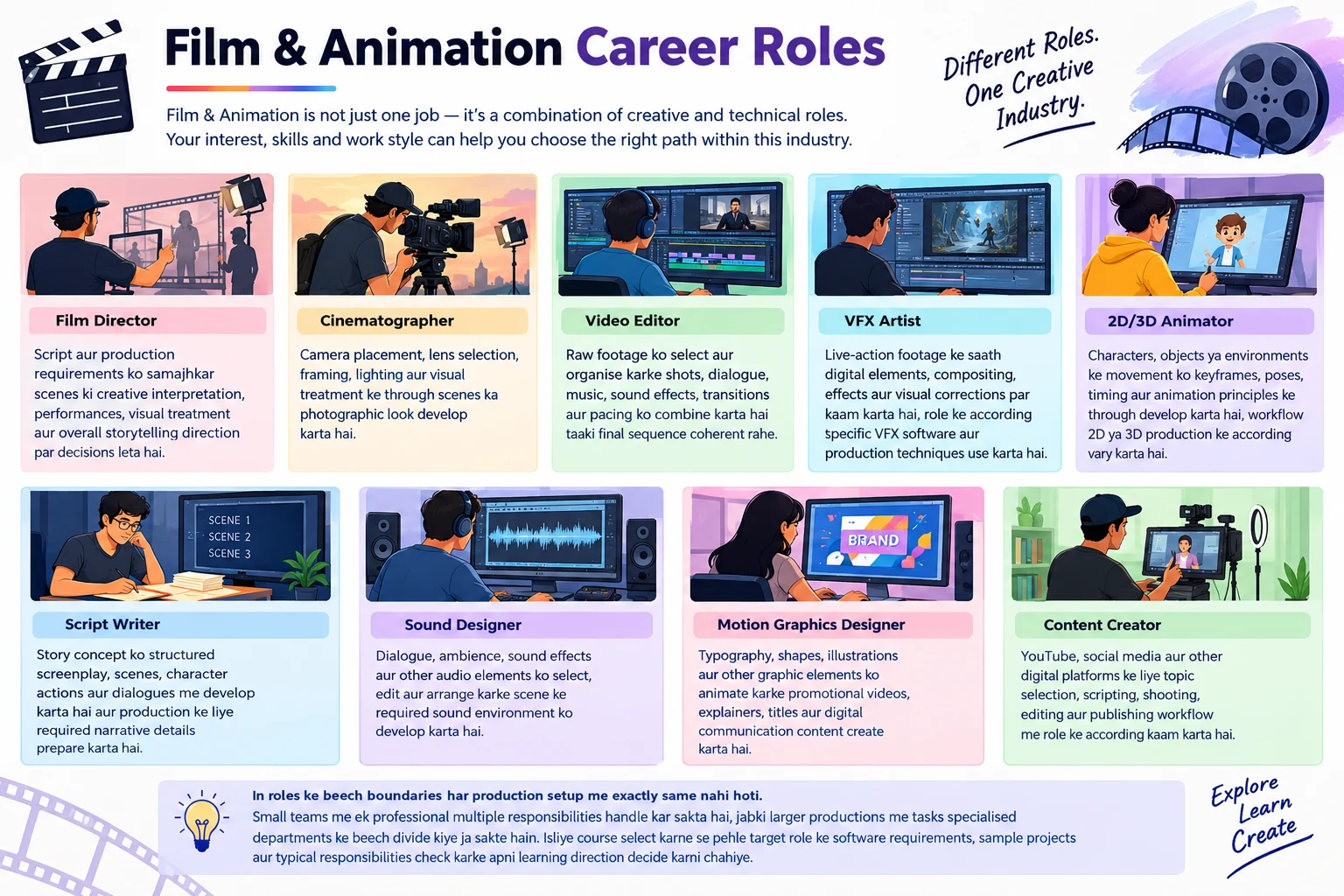
Film & Animation ko ek single job category ke roop me dekhna practical nahi hai, kyunki ek production me storytelling, camera, editing, animation, visual effects, sound aur digital content ke liye alag responsibilities hoti hain. Student ko specialization choose karte waqt apni interest ke saath daily work bhi compare karna chahiye. Story development aur creative decisions pasand hain to direction ya writing explore ki ja sakti hai; camera, framing aur lighting me interest hai to cinematography relevant ho sakti hai; footage ko sequence aur rhythm dena pasand hai to editing suitable direction ho sakti hai. Drawing, 3D modelling, movement aur digital effects me interest rakhne wale students animation ya VFX roles investigate kar sakte hain.
- Film Director: Script aur production requirements ko samajhkar scenes ki creative interpretation, performances, visual treatment aur overall storytelling direction par decisions leta hai.
- Cinematographer: Camera placement, lens selection, framing, lighting aur visual treatment ke through scenes ka photographic look develop karta hai.
- Video Editor: Raw footage ko select aur organise karke shots, dialogue, music, sound effects, transitions aur pacing ko combine karta hai taaki final sequence coherent rahe.
- VFX Artist: Live-action footage ke saath digital elements, compositing, effects aur visual corrections par kaam karta hai, role ke according specific VFX software aur production techniques use karta hai.
- 2D/3D Animator: Characters, objects ya environments ke movement ko keyframes, poses, timing aur animation principles ke through develop karta hai, workflow 2D ya 3D production ke according vary karta hai.
- Script Writer: Story concept ko structured screenplay, scenes, character actions aur dialogues me develop karta hai aur production ke liye required narrative details prepare karta hai.
- Sound Designer: Dialogue, ambience, sound effects aur other audio elements ko select, edit aur arrange karke scene ke required sound environment ko develop karta hai.
- Motion Graphics Designer: Typography, shapes, illustrations aur other graphic elements ko animate karke promotional videos, explainers, titles aur digital communication content create karta hai.
- Content Creator: YouTube, social media aur other digital platforms ke liye topic selection, scripting, shooting, editing aur publishing workflow me role ke according kaam karta hai.
In roles ke beech boundaries har production setup me exactly same nahi hoti. Small teams me ek professional multiple responsibilities handle kar sakta hai, jabki larger productions me tasks specialised departments ke beech divide kiye ja sakte hain. Isliye course select karne se pehle student ko target role ke software requirements, sample projects aur typical responsibilities check karke apni learning direction decide karni chahiye.
Detailed Salary Growth in Film & Animation Industry
Film & Animation me income ko sirf degree ke basis par estimate karna difficult hai. Same qualification wale do candidates ki earning alag ho sakti hai, kyunki role, location, employer, software proficiency, portfolio, project experience aur freelance work sab income ko affect karte hain. Isliye salary table ko fixed promise ke roop me nahi, balki career planning ke liye indicative range ke roop me dekhna chahiye.
| Career Role | Fresher | 3-5 Years | Senior Level | Growth Potential |
|---|---|---|---|---|
| Video Editor | ₹3–5 LPA | ₹6–10 LPA | ₹12–20 LPA+ | High demand in OTT, YouTube and Digital Media |
| Motion Graphics Designer | ₹3–6 LPA | ₹7–12 LPA | ₹15–25 LPA+ | Strong demand in advertising industry |
| 2D / 3D Animator | ₹3–7 LPA | ₹8–15 LPA | ₹18–30 LPA+ | Gaming and entertainment sector growth |
| VFX Artist | ₹4–7 LPA | ₹8–15 LPA | ₹18–30 LPA+ | One of the fastest growing fields |
| Cinematographer | ₹4–8 LPA | ₹10–18 LPA | ₹25 LPA+ / Project Based | Portfolio-based career growth |
| Sound Designer | ₹3–6 LPA | ₹7–12 LPA | ₹15–25 LPA+ | Growing OTT and gaming demand |
| Film Director | Project Based | ₹10–25 LPA | Unlimited Potential | Depends on project success and reputation |
What Increases Salary Faster?
- Strong portfolio and demo reel
- Advanced software expertise
- Internships and real-world projects
- Specialization in VFX, Animation or Cinematography
- Freelancing experience and client network
- Industry certifications and continuous learning
Skills Required to Build a Successful Career in Film & Animation
Film & Animation me software chalana basic requirement ho sakta hai, lekin professional work sirf tools operate karne se complete nahi hota. Ek editor ko footage ke beech story aur pacing samajhni hoti hai, animator ko movement aur timing par control chahiye, aur filmmaker ko camera, sound, actors aur production team ke saath coordinate karna padta hai. Isliye student ko technical skills ke saath visual storytelling, communication, teamwork, problem-solving aur deadline handling ko bhi practice karna chahiye.
Creative Thinking & Imagination
Creative thinking ka practical meaning sirf drawing ya artistic talent nahi hai. Film aur animation projects me creator ko limited budget, available locations, technical restrictions ya client requirements ke andar workable visual solution nikalna pad sakta hai. Student is skill ko short scenes, alternative story endings, visual experiments aur self-made projects ke through gradually develop kar sakta hai.
Visual Storytelling Ability
Visual storytelling ka matlab information ko sirf dialogue se explain karna nahi, balki framing, movement, expressions, sound aur editing ke combination se communicate karna hai. Ek beginner kisi short scene ko mute karke bhi practice kar sakta hai: agar basic action bina dialogue ke samajh aa raha hai, to framing aur visual sequence effectively kaam kar rahe hain.
Observation Skills
Observation skill ko improve karne ke liye student daily surroundings ko reference material ki tarah use kar sakta hai. Market, classroom, street ya public place me lighting, body language, movement aur background details observe karke unhe sketches, photographs, shot lists ya animation references me convert kiya ja sakta hai. Ye exercise visual accuracy ko theory padhne se zyada practical tareeke se develop karti hai.
Video Editing & Post-Production Knowledge
Editing me sirf clips ko sequence me rakhna enough nahi hota. Editor ko decide karna padta hai ki scene kitni der chale, kis point par cut ho, dialogue ke saath reaction shot kab aaye aur music ya sound effect ka use kahan appropriate rahega. Beginner apne ek hi video ke do different edits banakar pacing aur audience response ka difference compare kar sakta hai.
Animation & VFX Fundamentals
Animation aur VFX fundamentals un students ke liye useful hain jo visual production ke technical side ko explore karna chahte hain. Basic level par timing, keyframes, movement, masking, compositing, lighting aur rendering jaise concepts samajhna important hai. Filmmaking student bhi in concepts ki basic knowledge se production aur post-production teams ke workflow ko better understand kar sakta hai.
Communication Skills
Film production me communication ka practical test tab hota hai jab ek idea ko director, editor, designer, client ya production team ke saamne clearly explain karna ho. Student apne projects ke liye short creative briefs, shot lists aur revision notes likhne ki habit develop kar sakta hai. Isse feedback ko samajhna aur changes ko accurately implement karna easier hota hai.
Teamwork & Collaboration
Ek short film bhi aksar ek se zyada logon ka coordinated effort hoti hai. Camera, direction, editing, sound aur production responsibilities ko clearly divide karna padta hai, warna ek department ki delay poore project ko affect kar sakti hai. Students ko group projects me role assignment, file sharing aur deadline tracking ka basic workflow practice karna chahiye.
Time Management & Deadline Handling
Creative project me quality ke saath delivery time bhi important hota hai. Student kisi 60-second video ke liye planning, shooting, editing aur final export ki separate deadlines set karke practice kar sakta hai. Is process se ye samajh aata hai ki perfect result ka wait karne ke bajay workable version ko time par complete karke revisions ke liye space rakhna zyada practical hai.
Problem-Solving Mindset
Production problems har level par aa sakte hain—footage missing ho sakti hai, audio noisy ho sakta hai, render fail ho sakta hai ya client kisi scene ko revise karne ko keh sakta hai. Problem-solving skill ka matlab har situation ka instant answer jaanna nahi, balki issue ko identify karke alternatives test karna hai. Students apne projects me backup files, alternate shots aur revision plans maintain karke is habit ko develop kar sakte hain.
Attention to Detail
Post-production me chhoti inconsistencies bhi final output ko affect kar sakti hain. Misaligned audio, inconsistent colour, unnecessary transitions, continuity errors ya poorly timed animation jaise issues final export se pehle review karne chahiye. Ek simple checklist bana kar student har project ko publish karne se pehle technical aur creative errors separately check kar sakta hai.
Continuous Learning Attitude
Film & Animation tools regularly update hote hain, isliye student ko har software ka latest feature chase karne ke bajay apni core skill ko strong rakhna chahiye. Har semester ek focused skill choose karna—jaise colour grading, 3D modelling, motion graphics ya sound editing—aur us skill par ek complete project banana random tutorials dekhne se zyada measurable progress deta hai.
Agar aap Film & Animation career me enter karna chahte hain, to sirf software mastery ko goal mat banaiye. Creativity, communication, storytelling aur practical experience ke saath balanced skill set develop karna long-term success ke liye zyada effective strategy ho sakti hai.
Important Software
Film & Animation workflow me software ka selection role ke according change hota hai. Editor ko timeline editing aur colour tools ki zarurat hoti hai, motion designer ko compositing aur animation features ki, jabki 3D artist ko modelling, rigging, animation aur rendering workflow samajhna padta hai. Beginner ko ek primary tool se start karke project complete karna chahiye, phir requirement ke according second tool add karna practical approach hai.
| Software | Main Use | Who Uses It? | Difficulty Level |
|---|---|---|---|
| Adobe Premiere Pro | Video Editing & Post Production | Editors, Content Creators | Beginner to Intermediate |
| Adobe After Effects | Motion Graphics & Visual Effects | Motion Designers, VFX Artists | Intermediate |
| Autodesk Maya | 3D Modeling & Character Animation | Animators, VFX Professionals | Advanced |
| Blender | 3D Animation, Rendering & Modeling | Students, Freelancers, Studios | Beginner to Advanced |
| DaVinci Resolve | Editing & Professional Color Grading | Editors, Filmmakers | Intermediate |
| Final Cut Pro | Professional Video Editing | Mac Users & Filmmakers | Intermediate |
| Adobe Audition | Audio Editing & Sound Enhancement | Sound Designers | Intermediate |
| Cinema 4D | Motion Graphics & 3D Design | Motion Graphic Artists | Intermediate to Advanced |
Film & Animation industry me software selection specialization par depend karta hai. Video editors usually Premiere Pro aur DaVinci Resolve use karte hain, jabki animators Maya aur Blender par focus karte hain. VFX professionals After Effects aur advanced compositing tools ke saath kaam karte hain.
Software choose karte waqt student ko apne target role ko starting point banana chahiye. Video editing ke liye Premiere Pro ya DaVinci Resolve jaise tools relevant ho sakte hain, jabki 3D learning ke liye Blender ek accessible option hai. Ek beginner ke liye 6–8 software simultaneously seekhne ke bajay ek tool par basic projects complete karna zyada useful learning path hai.
Step-by-Step Study Plan for Film & Animation Students
Film & Animation me course ke saath independent practice ka bhi regular schedule banana useful hai. Agar student har semester sirf classroom assignments complete karta hai, to portfolio limited reh sakta hai; isliye academic work ke alawa personal projects, collaborations aur small experiments bhi maintain karne chahiye. Neeche ka roadmap ek flexible framework hai jise course duration aur chosen specialization ke according adjust kiya ja sakta hai.
Step 1: Understand the Industry Before Choosing a Specialization
Specialization choose karne se pehle kam se kam 3–4 roles ko practically explore karein. Ek short video edit karein, basic animation try karein, ek simple storyboard banayein aur kisi short film ke camera shots analyse karein. In small experiments ke baad student ko clearer idea milta hai ki usse storytelling, editing, visual design, animation ya production me kis type ka work naturally interesting lagta hai.
- Research different career options
- Watch behind-the-scenes documentaries
- Understand production workflow
- Explore filmmaking and animation fundamentals
Step 2: Learn Visual Storytelling and Camera Language
Visual storytelling seekhne ke liye sirf films dekhna enough nahi hai; scenes ko break down karna bhi zaruri hai. Kisi 2–3 minute sequence ko pause karke shot size, camera angle, movement, lighting, background sound aur cut points note karein. Phir same scene ko apne phone ya available camera se simple resources ke saath recreate karne ki koshish karein.
- Learn shot composition
- Understand camera angles
- Study scene construction
- Analyze successful films and animated projects
Step 3: Master Industry Software Step by Step
Software learning ko project-based rakhein. Pehle basic editing workflow complete karein, uske baad motion graphics ya animation ka small assignment banayein aur phir advanced features add karein. Har new software ke liye ek finished project rakhna student ko ye verify karne me help karta hai ki usne tool ko sirf tutorial level par nahi, actual workflow me use kiya hai.
- Start with video editing basics
- Learn motion graphics fundamentals
- Practice 2D and 3D animation workflows
- Understand rendering and export settings
Step 4: Create Real Projects Instead of Only Watching Tutorials
Tutorial dekhne ke turant baad us concept ko apne original project me apply karna better practice hai. Example ke liye, editing me pacing seekhne ke baad 60–90 second ka short sequence banayein; animation me timing seekhne ke baad ek simple character movement create karein. Har month ek finished project maintain karne se portfolio ke saath practical problem-solving experience bhi build hota hai.
- Create short films
- Edit travel or educational videos
- Design motion graphics
- Build mini animation projects
- Create social media content samples
Step 5: Build a Professional Portfolio
Portfolio ko certificate collection ki jagah practical evidence ki tarah treat karein. Har project ke saath final output, aapka role, software used aur problem solved ka short description rakhein. Agar group project hai to clearly batayein ki editing, animation, camera ya sound me aapki individual responsibility kya thi.
- Show your best projects only
- Maintain project quality
- Organize work professionally
- Update portfolio regularly
- Create an online portfolio website
Step 6: Gain Industry Exposure
Industry exposure ka purpose sirf certificate lena nahi hona chahiye. Internship ya freelance assignment choose karte waqt dekhein ki aapko real production workflow, client communication, revisions, deadlines ya team collaboration ka experience mil raha hai ya nahi. College projects ke saath ek genuine external assignment bhi portfolio ko practical context de sakta hai.
- Apply for internships
- Participate in creative competitions
- Network with professionals
- Collaborate on student projects
- Take freelance assignments
Job Opportunities in Film & Animation Industry
Film & Animation graduates ke opportunities sirf feature films aur television production tak restricted nahi hain. Video production agencies, advertising teams, gaming studios, e-learning companies, creator-led businesses, OTT production teams aur corporate communication departments bhi visual content ke liye creative professionals hire kar sakte hain. Role ki requirement company ke content format aur production workflow ke according change hoti hai.
Film Production Houses
Production houses me entry-level candidates assistant editor, production assistant, junior writer, assistant director, camera department ya post-production roles se start kar sakte hain. Student ko internship search karte waqt company ka actual work portfolio, project type aur assigned responsibilities check karni chahiye, kyunki sirf company ka naam practical exposure ki guarantee nahi deta.
Animation Studios
Animation studios me work profile project ke according modelling, texturing, rigging, character animation, background design, compositing ya production coordination se related ho sakti hai. Agar student 3D pathway choose karta hai, to demo reel me process aur final result dono dikhana useful hota hai, especially jab role technical skill par based ho.
OTT & Digital Streaming Platforms
OTT production me writers, editors, assistant directors, cinematographers, sound teams, VFX artists aur post-production professionals alag stages par contribute karte hain. Student ko is sector ko sirf “web series jobs” ke roop me nahi dekhna chahiye; production pipeline ke kis stage par uski skill fit hoti hai, ye identify karna zyada practical approach hai.
Advertising & Creative Agencies
Advertising agencies me visual professionals ko short-form videos, product films, branded content, motion graphics aur social media campaigns par kaam karna pad sakta hai. Is type ke work ke liye portfolio me different formats dikhana useful hota hai—jaise 15–30 second social video, product animation aur short promotional edit—taaki employer ko actual execution range samajh aaye.
Gaming Industry
Gaming sector me animation aur visual production roles game development pipeline ke specific stages se connected hote hain. Character animation, environment art, cinematic sequences aur VFX jaise areas me alag technical workflows use hote hain. Gaming me jaana chahne wale students ko portfolio project banate waqt game-engine workflow aur real-time asset requirements ko bhi gradually explore karna chahiye.
E-Learning & Educational Media
E-learning companies animated explainers, instructional videos, screen-based lessons aur visual presentations ke liye editors, motion designers aur animators use kar sakti hain. Is pathway me creative ability ke saath information ko clear sequence me present karna important hota hai, isliye student educational topic par ek 60–120 second explainer bana kar apni skill demonstrate kar sakta hai.
Freelancing & Independent Content Creation
Freelancing me client acquisition ke saath brief samajhna, quotation dena, revisions handle karna, files deliver karna aur payment terms manage karna bhi part of the work hota hai. Beginner ko pehle small fixed-scope assignments se start karna chahiye aur har completed project ka permission-based sample portfolio me maintain karna chahiye.
Film & Animation Career Roadmap After 12th
Film & Animation me career build karne ke liye shuruaat me expensive camera, high-end computer ya professional studio hona compulsory nahi hai. Student basic equipment aur accessible software ke saath editing, storytelling, animation, sound ya visual production ke fundamentals practice kar sakta hai. Jaise-jaise skills improve hoti hain, personal projects ko structured portfolio me convert karke internships, freelance assignments aur entry-level industry work ke liye use kiya ja sakta hai.
12th ke baad pehle stage par student ko different creative roles explore karke apni suitable direction identify karni chahiye. Course ke initial period me software fundamentals aur small projects par focus rakhein, uske baad selected specialization se related portfolio pieces aur internship experience build karein. Course ke later stage me portfolio ko target role ke according refine karna, real project workflow samajhna aur professional requirements ke liye preparation karna useful rahega.
f- Foundation Learning: Storytelling, visual language, basic production concepts aur industry workflow samjhein.
- Software Skills: Apne chosen role ke according editing, animation, VFX, sound ya design software par practical command develop karein.
- Practical Projects: Short films, edited videos, animation clips, motion graphics ya other role-specific projects complete karein.
- Portfolio Development: Completed work me se relevant projects select karke apna role, software aur contribution clearly show karein.
- Internship & Freelance Work: Real briefs, deadlines, revisions aur team/client communication ka experience gain karein.
- Specialization: Portfolio aur practical experience ke basis par editing, cinematography, animation, VFX, sound, direction ya production me focused pathway choose karein.
- Professional Development: Advanced projects, industry networking aur role-specific skills ke through apni professional profile ko gradually strengthen karein.
- Career Progression: Experience ke saath junior responsibilities se larger projects, specialised roles aur greater production responsibilities ki taraf move karein.
Emerging Trends Shaping the Film & Animation Industry in 2027
Film & Animation industry pichhle kuch saalon me rapid transformation se guzri hai. Jahan pehle content production sirf traditional studios aur television networks tak limited tha, wahi aaj digital platforms, gaming ecosystems, immersive technologies aur AI-powered tools industry ko naye direction me le ja rahe hain.
Students jo 2027 aur uske baad is field me entry karenge, unhe sirf traditional filmmaking ya animation techniques hi nahi, balki modern production technologies aur changing audience behavior ko bhi samajhna hoga. Industry ab speed, creativity aur technology ke combination par kaam kar rahi hai.
AI-Assisted Animation & Content Production
AI tools ko creative decision-maker ke replacement ke bajay production assistance ke roop me samajhna practical hai. Student concept references, rough ideas, repetitive production tasks ya workflow experiments ke liye AI tools test kar sakta hai, lekin final story, visual direction, editing choices aur output quality ko khud review karna zaruri hai. Portfolio me AI-assisted project ho to student ko apni individual contribution bhi clearly explain karni chahiye.
Virtual Production Studios
Virtual production technology filmmaking ka landscape change kar rahi hai. Traditional green screen workflows ke saath-saath LED volume stages aur real-time rendering technologies ka use badh raha hai.
Is technology ki madad se filmmakers realistic digital environments create kar sakte hain, jisse production flexibility aur visual quality dono improve hoti hain. Students ke liye real-time production workflows ko samajhna future-ready skill ban sakta hai.
OTT Content Expansion
Streaming platforms ke growth ne content demand ko significantly increase kiya hai. Web series, documentaries, mini-series aur niche audience content ke liye production opportunities pehle se zyada available hain.
Audience preferences bhi evolve ho rahi hain. Viewers high-quality storytelling, realistic characters aur engaging visual experiences ki expectation rakhte hain. Isi wajah se skilled writers, editors, animators aur directors ki demand lagatar bani hui hai.
Short-Form Storytelling Revolution
Short-form content platforms ne storytelling ke format ko completely transform kar diya hai. Aaj creators ko kuch seconds ke andar audience attention capture karna hota hai.
Is trend ne video editors, motion graphic designers aur content creators ke liye naye opportunities create kiye hain. Short-form storytelling future me bhi digital media ecosystem ka important part bani rahegi.
Gaming & Cinematic Animation Convergence
Gaming aur animation industries ke beech ka gap lagatar kam ho raha hai. Modern games cinematic storytelling, realistic character animation aur movie-quality visual experiences provide kar rahe hain.
Isi wajah se 3D artists, environment designers, character animators aur cinematic editors ke liye gaming sector me bhi strong career opportunities develop ho rahi hain.
3D Visualization & Virtual Worlds
3D visualization ka use sirf entertainment tak limited nahi hai. Architecture, education, healthcare, product design aur digital marketing sectors bhi 3D content ka extensive use kar rahe hain.
Future me immersive digital experiences aur virtual environments ki demand badhne ki sambhavna hai, jisse 3D professionals ke liye additional career paths create honge.
Interactive Media Experiences
Traditional passive content ke saath-saath interactive storytelling bhi popularity gain kar rahi hai. Viewers aur users ab sirf content dekhna nahi, balki uske saath interact karna bhi pasand karte hain.
Interactive media projects creative storytelling aur technology ka combination hote hain. Is area me kaam karne wale professionals ko design, animation aur user experience ki understanding develop karni padti hai.
A Day in the Life of a Film & Animation Professional
Bahut se students Film & Animation careers ko glamorous perspective se dekhte hain. Kuch log sochte hain ki animator ka kaam sirf characters draw karna hota hai ya filmmaker ka kaam sirf camera operate karna hota hai. Reality me industry ka daily workflow kaafi dynamic aur collaborative hota hai.
Har project ke piche multiple professionals milkar kaam karte hain. Directors, editors, writers, animators, VFX artists, sound designers aur production teams ek shared vision ko final visual experience me convert karne ke liye continuously collaborate karte hain.
Morning: Planning & Coordination
Film aur animation projects me din ki shuruaat usually current production status samajhne se hoti hai. Team apne assigned tasks, pending revisions, delivery requirements aur project schedule ko review karti hai, jisse editor, animator, designer, cinematographer ya production staff ko apne next steps clear rahein. Student ke liye bhi project start karte waqt shot list, asset list, file structure aur daily targets prepare karna professional workflow ki useful practice hai.
Mid-Day: Creative Production Work
Production ka main working period role ke according different activities me divide hota hai. Video editor footage select karke sequence aur audio ko refine kar sakta hai, animator movement aur timing par kaam kar sakta hai, VFX artist compositing ya effects elements adjust kar sakta hai, aur cinematography team planned shots ko lighting aur framing requirements ke according execute kar sakti hai. Is stage par creative decisions ke saath technical accuracy bhi maintain karni padti hai, kyunki ek small change final output ke overall look ko affect kar sakta hai.
Project ka initial version complete hone ke baad review aur revision cycle shuru ho sakti hai. Editor ko unwanted frames remove karne pad sakte hain, animator ko movement timing adjust karni pad sakti hai, ya production team ko approved brief ke according kisi scene me changes karne pad sakte hain. Har revision ko track karna important hota hai taaki latest file, feedback aur approved version ke beech confusion na ho.
Afternoon: Problem Solving & Creative Decisions
Production ke dauran unexpected issues aa sakte hain, jaise footage me continuity problem, recording me unwanted noise, animation me unnatural movement, render-related technical error ya client ke brief me last-minute change. Aise situation me professional ko pehle problem identify karni hoti hai aur phir available time, resources aur project requirements ke according practical solution choose karna hota hai. Kabhi alternate shot use karna, kisi sequence ko restructure karna ya effect ko simpler approach se create karna workable option ho sakta hai.
Day ke end me completed work ko review karke pending tasks aur next-stage requirements note ki ja sakti hain. Files ko proper folders me save karna, project versions maintain karna, important assets ka backup rakhna aur unfinished revisions ko clearly mark karna production workflow ko organised rakhta hai. Ye routine student projects me bhi follow kiya ja sakta hai aur gradually professional work habits develop karne me help karta hai.
Evening: Revisions & Feedback
Project ke working version ko review karne ke baad editor, animator ya production team ko received feedback ke according specific changes karne pad sakte hain. Review me pacing, audio levels, visual consistency, animation timing, colour treatment ya scene arrangement jaise points identify ho sakte hain. Har change ko directly apply karne ke bajay feedback ko priority ke according organise karna useful hota hai, especially jab delivery deadline close ho.
Revision complete hone ke baad updated version ko dobara check karna zaruri hai, kyunki ek change kabhi-kabhi kisi related element ko bhi affect kar sakta hai. Final export se pehle audio-video synchronisation, missing assets, spelling, transitions, resolution aur file format jaise technical points verify karke approved version ko clearly label karna professional workflow ka important part hai.
Continuous Learning Through Projects
Film & Animation me learning ka practical part regular projects ke saath naturally continue hota hai. New software feature ya production technique seekhne ke liye student ko sirf tutorial complete karne ke bajay us concept ko kisi small project me apply karna chahiye. For example, editing student ek new colour-grading technique ko short scene par test kar sakta hai, jabki animation student new movement principle ko ek short character exercise me apply kar sakta hai.
Is workflow ka benefit ye hai ki learning alag activity bankar nahi reh jaati, balki portfolio projects ke saath connected rehti hai. Course ke dauran students apne selected work, revision history aur project learnings ko organise karke graduation ke time apni practical capabilities ko clearly demonstrate kar sakte hain.
Why Some Students Succeed Faster Than Others in Film & Animation
Film & Animation industry me ek interesting cheez dekhi jati hai. Kai baar do students same institute se padhte hain, same software seekhte hain aur similar courses complete karte hain, lekin kuch saalon baad unki career growth completely different hoti hai. Ek student industry me quickly establish ho jata hai, jabki dusra struggle karta rehta hai.
Iska reason aksar talent ya luck nahi hota. Industry professionals ke according long-term success zyada tar habits, consistency aur practical execution par depend karti hai. Creative fields me knowledge collect karne se zyada important hota hai knowledge ko real projects me apply karna.
Successful Students Focus on Creating, Not Just Consuming
Beginners kaafi time tutorials dekhne me spend kar dete hain. Learning important hai, lekin industry me growth tab hoti hai jab aap apne projects create karna start karte hain. Ek simple short film, animation clip ya edited video bhi practical experience provide karti hai jo theory se nahi mil sakti.
They Build Their Portfolio From Day One
Kai students graduation complete hone ke baad portfolio banana start karte hain. Successful students pehle semester se hi apne best projects collect karna shuru kar dete hain. Time ke saath ye portfolio unki professional identity ban jata hai.
They Study Professional Work
Industry standards samajhne ke liye successful creators regularly movies, advertisements, animated films, documentaries aur commercial projects analyze karte hain. Wo sirf content consume nahi karte, balki ye observe karte hain ki scenes kaise design kiye gaye, editing ka flow kaisa hai aur storytelling audience ko kaise engage karti hai.
They Keep Learning New Skills
Film & Animation industry continuously evolve ho rahi hai. Naye software updates, AI-powered tools, virtual production workflows aur digital content trends regularly introduce hote rehte hain. Successful professionals learning ko kabhi stop nahi karte.
They Accept Feedback Professionally
Creative fields me revisions aur feedback normal process ka hissa hote hain. Jo students criticism ko personal attack ki tarah dekhte hain, unki growth slow ho sakti hai. Jo students feedback ko improvement opportunity ke roop me dekhte hain, wo generally faster progress karte hain.
Isi wajah se kai employers interviews ke dauran degree se pehle portfolio dekhna prefer karte hain. Ek strong portfolio kabhi-kabhi un opportunities ko create kar sakta hai jo sirf academic qualifications se possible nahi hoti.
Detailed Salary Growth by Career Role
| Career Role | Fresher Salary | 3-5 Years Experience | Senior Level | Growth Potential | Major Employers |
|---|---|---|---|---|---|
| Video Editor | ₹3–5 LPA | ₹6–10 LPA | ₹12–20 LPA+ | High due to OTT, YouTube and digital marketing demand | Production Houses, OTT Platforms, Agencies, Creators |
| Motion Graphics Designer | ₹3–6 LPA | ₹7–12 LPA | ₹15–25 LPA+ | Very High in advertising and branding industry | Advertising Agencies, Startups, Media Companies |
| 2D Animator | ₹3–5 LPA | ₹6–10 LPA | ₹12–18 LPA+ | Steady demand in educational and entertainment content | Animation Studios, E-learning Companies |
| 3D Animator | ₹4–7 LPA | ₹8–15 LPA | ₹18–30 LPA+ | Strong growth due to gaming and cinematic animation | Gaming Studios, Animation Studios, OTT Content Producers |
| VFX Artist | ₹4–7 LPA | ₹8–15 LPA | ₹18–30 LPA+ | One of the fastest-growing specializations | Film Studios, VFX Companies, Streaming Platforms |
| Compositor | ₹4–6 LPA | ₹8–14 LPA | ₹18–28 LPA+ | High demand in advanced post-production workflows | VFX Studios, Film Production Companies |
| Cinematographer | ₹4–8 LPA | ₹10–18 LPA | ₹25 LPA+ / Project Based | Excellent growth with strong portfolio | Films, OTT Productions, Advertising Industry |
| Sound Designer | ₹3–6 LPA | ₹7–12 LPA | ₹15–25 LPA+ | Growing demand in gaming and streaming content | Studios, Production Houses, Gaming Companies |
| Script Writer | ₹2–5 LPA | ₹6–12 LPA | ₹20 LPA+ / Project Based | Strong potential through original content creation | Film Industry, OTT Platforms, Agencies |
| Film Director | Project Based | ₹10–25 LPA | Unlimited Potential | Depends on reputation and project success | Film Studios, OTT Production Houses |
| Creative Director | Usually after experience | ₹12–25 LPA | ₹30–60 LPA+ | Leadership role with excellent long-term growth | Media Networks, Advertising Companies |
| Game Animator | ₹4–8 LPA | ₹10–18 LPA | ₹20–35 LPA+ | Very High because gaming industry is expanding rapidly | Game Development Studios |
Salary Growth Timeline
- 0–2 Years: Learning stage + portfolio building + internships
- 3–5 Years: Professional specialization and salary jump
- 5–10 Years: Senior artist, lead editor, lead animator, VFX supervisor roles
- 10+ Years: Creative director, independent filmmaker, studio owner or consultant level opportunities
Freelancing Income Potential (Additional Earnings)
| Freelance Service | Beginner Project | Experienced Professional |
|---|---|---|
| Video Editing | ₹2,000–10,000 | ₹20,000–1,00,000+ |
| Motion Graphics | ₹5,000–15,000 | ₹30,000–2,00,000+ |
| Animation Projects | ₹5,000–20,000 | ₹50,000–3,00,000+ |
| YouTube Editing | ₹3,000–15,000 | ₹25,000–1,50,000+ |
| Commercial Advertisements | ₹10,000–50,000 | ₹1 Lakh–10 Lakh+ |
Freelancing Film & Animation skills ko different types ke client projects me apply karne ka ek practical option hai. Video editors, animators aur motion graphic designers YouTube videos, advertisements, social media content, explainers aur other digital projects ke liye remote assignments le sakte hain. Beginner ko small, clearly defined projects se start karke deadlines, revisions, file delivery aur client communication ka workflow samajhna chahiye.
Freelance income fixed monthly salary ki tarah predictable nahi hoti; project ka scope, client budget, skill level, workload aur repeat assignments ke according amount change ho sakta hai. Specialization develop karne wale professionals apne portfolio me relevant work collect karke gradually higher-complexity projects target kar sakte hain. Isliye earning ko sirf ek salary figure se compare karne ke bajay project quality, repeat clients, workload aur skill development ke context me evaluate karna zyada practical hai.
How to Choose the Right Specialization
Film & Animation ke andar multiple roles hone ki wajah se specialization ko gradually narrow karna practical hota hai. Pehle 2–3 areas try karke dekhein ki kis type ke projects me aap consistently better work produce kar pa rahe hain. Uske baad ek primary specialization choose karke related software, projects, internships aur portfolio pieces ko us direction me align karein.
Script Writing, Screenplay Development, Direction
Love Cameras & Visual Composition?
Cinematography, Film Production, Visual Direction
Love Editing & Content Creation?
Video Editing, Post Production, Motion Graphics
Love Character Design?
2D Animation, 3D Animation, Character Development
Love Technology & Visual Effects?
VFX, CGI, Compositing, Virtual Production
Love Sound & Music?
Sound Design, Audio Engineering, Music Production
Questions to Ask Yourself Before Choosing
- Which type of creative work excites me the most?
- Do I enjoy visual design or storytelling more?
- Can I spend long hours refining creative work?
- Do I prefer technical workflows or artistic creation?
- Which projects make me curious enough to learn more?
The best specialization is usually not the one that promises the highest salary today. It is the one that matches your interests, strengths and long-term motivation. Students who genuinely enjoy their chosen specialization often stay consistent, improve faster and achieve better results over time.
Future Opportunities Beyond Movies
Film & Animation skills ka use entertainment ke alawa digital marketing, education, gaming, corporate communication aur creator-led content me bhi ho sakta hai. Iska practical benefit ye hai ki student apne core skill ko different industries me apply kar sakta hai—for example, an editor film production ke saath educational videos ya branded content bhi edit kar sakta hai. Career planning ke liye target industry ke bajay transferable skill ko identify karna useful starting point hai.
Digital Marketing & Brand Communication
Digital marketing teams ko campaign videos, product demonstrations, short social videos, animated explainers aur branded visual assets ki requirement ho sakti hai. Is pathway me editor ya motion designer ko fast turnaround aur brand guidelines ke according content prepare karna padta hai. Student apne portfolio me different aspect ratios aur short-form formats add karke is type ke work ke liye readiness demonstrate kar sakta hai.
YouTube & Creator Economy
Creator economy me editing aur visual production ka workflow traditional studio se different ho sakta hai. Ek creator ko weekly long-form videos ke saath Shorts, Reels, thumbnails, captions aur promotional clips bhi chahiye ho sakte hain. Students is field ko explore karne ke liye kisi ek topic par 3 long videos aur unke short-form versions create karke complete content workflow practice kar sakte hain.
Corporate Video Production
Corporate video production me training modules, product demonstrations, employee communication, presentations aur promotional films jaise projects aa sakte hain. Yahan creative work ke saath information accuracy aur brand consistency bhi important hoti hai. Student ek fictional company ke liye 60–90 second ka product explainer bana kar scripting, shooting, editing aur presentation skills ek hi project me demonstrate kar sakta hai.
E-Learning & Educational Media
Educational media me animator ya editor ko complex information ko visually understandable sequence me convert karna padta hai. Isliye portfolio me sirf attractive animation dikhane ke bajay ek concept ko introduction, explanation, example aur conclusion ke sequence me present karna useful hai. Ye project storytelling ke saath information-design ability bhi demonstrate karta hai.
Gaming Industry
Gaming industry cinematic storytelling aur high-quality animation ka extensive use karti hai. Character artists, environment designers, animators aur visual effects professionals ke liye gaming sector future ke strongest growth areas me se ek mana ja raha hai.
Virtual Reality & Immersive Experiences
Virtual reality aur immersive media projects entertainment ke saath-saath education, healthcare aur training industries me bhi use ho rahe hain. Future me interactive visual experiences ki demand aur increase hone ki sambhavna hai.
Educational Animation Companies
Animated educational content complex concepts ko easy aur engaging banane me help karta hai. Isliye educational animation companies regularly animators, illustrators aur motion graphic professionals hire karti hain.
The Skill Combination That Employers Actually Look For
Film & Animation me kisi role ke liye prepare karte waqt student ko sirf software ke features ya certificates collect karne par focus nahi karna chahiye. Practical work me employer ko ye dekhna hota hai ki candidate brief ko samajh sakta hai, required software ka use karke output create kar sakta hai, feedback ke according changes kar sakta hai aur assigned work ko agreed deadline ke andar complete kar sakta hai. Isliye employability ko ek single skill ke bajay connected abilities ke combination ke roop me develop karna useful hai.
Is combination ko portfolio projects ke through demonstrate kiya ja sakta hai. For example, ek editor apne portfolio me raw footage se final cut tak ka project dikha sakta hai, animator movement aur final render present kar sakta hai, aur motion designer ek brief ko finished visual me convert karke apni process explain kar sakta hai. Project ke saath role, software used, individual contribution aur final output clearly mention karne se practical capability ko samajhna easier hota hai.
Creativity
Creative ability ka practical use tab दिखाई deta hai jab student ek given brief ko apne visual decisions ke through effective output me convert karta hai. Same software use karne wale candidates ke projects alag ho sakte hain because framing, pacing, colour, movement, typography ya visual storytelling ke choices different hote hain. Portfolio me sirf finished work rakhne ke bajay selected creative decisions ka short explanation bhi useful ho sakta hai.
Communication Skills
Production work me instructions ko accurately samajhna aur apne progress ko clearly communicate karna important hota hai. Student ko project brief se key requirements note karne, unclear points par relevant questions poochne aur feedback receive hone par required changes confirm karne ki habit develop karni chahiye. Ye skill practical assignments aur group projects ke through naturally practice ki ja sakti hai.
Teamwork
Film aur animation projects me different people ek hi final output par contribute kar sakte hain, isliye individual work ko team ke workflow ke saath coordinate karna padta hai. Student group project me apni responsibility clearly define karke files organised format me share kar sakta hai aur agreed deadlines follow kar sakta hai. Isse collaboration ka practical experience portfolio project ke process me bhi demonstrate kiya ja sakta hai.
Problem Solving Ability
Production ke dauran technical ya creative problem aane par available options ko compare karke workable solution choose karna padta hai. Agar footage incomplete ho, animation timing incorrect ho ya client revision ke liye limited time ho, to student ko priority identify karke alternative approach test karni chahiye. Apne projects me aayi problems aur unke solutions ko note karna future assignments ke liye practical troubleshooting experience create karta hai.
Time Management
Creative project ko deadline ke andar complete karne ke liye task ko smaller stages me divide karna useful hota hai. Student planning, production, first review, revisions aur final export ke liye separate time blocks set kar sakta hai. Is workflow se last-minute changes ke liye bhi kuch time reserve kiya ja sakta hai aur project completion sirf final day par dependent nahi rehti.
Time Management
Creative projects me deadline ko manage karne ke liye complete task ko smaller stages me divide karna practical approach hai. Student ek project ke liye planning, shooting or asset collection, editing or animation, review, revisions aur final export ke separate deadlines set kar sakta hai. Isse project ke end me technical problems ya feedback ke liye kuch working time available rehta hai.
Small Projects You Can Start as a Student
Film & Animation seekhne wale students ko practical work start karne ke liye large production setup ka wait karna zaruri nahi hai. Smartphone footage, basic recording equipment aur accessible editing or animation software se short projects create kiye ja sakte hain. Project ka purpose sirf final video banana nahi hona chahiye; har assignment me ek specific skill test karein, jaise editing pace, camera framing, character movement, sound design ya motion graphics.
Beginner projects ko short aur clearly defined scope me rakhna easier hota hai. Ek project complete karne ke baad final output ko review karke technical mistakes, creative decisions aur next improvement points note karein. Selected finished projects ko later portfolio me include kiya ja sakta hai, provided they represent the student's actual contribution and target role.
Create a Short Documentary
Apne city, village, local business, craft, community activity ya cultural topic par 2–5 minute ki documentary banayein. Pehle subject research karke basic questions prepare karein, phir interviews, location shots aur supporting visuals collect karein. Editing ke dauran narration, natural sound aur B-roll ko combine karke ek clear beginning, middle aur ending create karein.
Build a 60-Second Animated Story
Ek simple 60-second story choose karke uska short script aur storyboard prepare karein. Uske baad character poses, background elements, movement timing aur sound ko sequence me develop karein. Short duration rakhne se beginner ek complete animation workflow—planning se final render tak—practice kar sakta hai.
Edit Educational or Travel Videos
Educational ya travel footage ko edit karte waqt unnecessary clips remove karke information ko logical sequence me arrange karein. Voice-over, background music, captions, B-roll aur transitions ko purpose ke according use karein, na ki sirf visual effect add karne ke liye. Final video ko dekhkar check karein ki viewer bina extra explanation ke main information follow kar sakta hai ya nahi.
Create Motion Graphics for Social Media
Ek fictional product, event ya educational topic choose karke 15–30 second ka motion graphic video create karein. Text hierarchy, typography, simple shapes, transitions aur timing ko use karke limited information ko quickly communicate karne ki practice karein. Different aspect ratios me export karke dekhein ki design vertical aur horizontal formats me properly readable rehta hai ya nahi.
Design Movie Title Sequences
Ek fictional film ke liye 15–30 second ka opening title sequence design karein. Film ke genre ke according typography, background visuals, movement, sound aur transition style choose karein, phir elements ko ek consistent visual sequence me animate karein. Portfolio me final sequence ke saath storyboard ya selected design frames rakhne se project ke creative process ko bhi demonstrate kiya ja sakta hai.
Develop a Mini Portfolio
Completed projects ko ek organised folder ya portfolio page me collect karein aur har project ke saath title, project type, software used, aapki responsibility aur final output ka short description add karein. Editing, animation, VFX, motion graphics ya filmmaking me alag roles target karne wale students ko apne chosen area se directly related work ko priority deni chahiye. Portfolio ko time ke saath update karte hue weaker samples ko better completed projects se replace kiya ja sakta hai.
Produce an Interview-Based Project
Local entrepreneurs, artists, teachers ya other professionals ke saath ek short interview project plan kiya ja sakta hai. Student interview questions prepare karke audio-video record kare, supporting B-roll collect kare aur final footage ko structured story ke form me edit kare. Is project me framing, audio recording, interview handling, footage selection aur editing jaise multiple production stages ko ek hi assignment me practice kiya ja sakta hai.
Is Film & Animation the Right Career for You?
Film & Animation choose karne se pehle student ko sirf movies, animation ya online content ke final result ke baare me nahi, balki us output ke peeche hone wale daily work ko bhi samajhna chahiye. Different roles me footage review, editing, drawing or keyframing, sound adjustment, rendering, revisions, file management, team coordination aur deadline-based delivery jaise tasks aa sakte hain. Aap jis role ko target kar rahe hain, uske actual work pattern se apni interest compare karna useful rahega.
Career fit check karne ke liye apne current interests ko practical activities ke saath compare karein. Agar aapko storytelling pasand hai to short video ya documentary edit karke dekhein; animation me interest hai to ek simple character exercise complete karein; aur visual design pasand hai to short title sequence ya motion graphic banayein. Sirf final result pasand aana enough nahi hai—project ko plan karna, mistakes correct karna aur revisions complete karna bhi aapko reasonably comfortable lagna chahiye.
Questions to Ask Yourself
- Creative Work: Kya aap storytelling, visual design, editing ya animation jaise activities me genuine interest feel karte hain?
- Practice: Kya aap ek project ko improve karne ke liye multiple attempts aur revisions kar sakte hain?
- Software Learning: Kya aap role-specific software ko regularly practice karne ke liye comfortable hain?
- Feedback: Kya aap apne work par milne wale specific feedback ko analyse karke changes kar sakte hain?
- Technical Problems: Kya aap creative work ke saath file errors, rendering issues, audio problems ya other technical tasks handle karne ke liye ready hain?
- Team Projects: Kya aap apne assigned work ko doosre team members ke tasks aur deadlines ke saath coordinate kar sakte hain?
- Work Process: Kya aapko ek idea se final output tak planning, production, review aur revision ka complete process interesting lagta hai?
Agar in questions ke answers mostly positive hain, to next step directly course choose karna nahi, balki ek small project complete karke apni interest ko test karna ho sakta hai. Project ke baad note karein ki kaunsa part enjoyable tha, kis task me difficulty aayi aur kis skill ko improve karne ki zarurat hai. Ye self-check aapko Film & Animation ke andar suitable specialization identify karne ke liye zyada specific information dega.
Ek aur important baat ye hai ki is field me start karne ke liye perfect background ya perfect age ki zarurat nahi hoti. Kai successful professionals ne apni journey simple devices, free software aur personal projects ke saath start ki thi.
Common Mistakes That Delay Career Growth
Film & Animation industry me opportunities kaafi hain, lekin beginners kuch common mistakes ki wajah se apni growth unnecessarily slow kar dete hain. Agar aap in mistakes ko early stage par avoid kar lete hain, to learning journey kaafi smooth ho sakti hai.
1.) Learning Software Without Understanding Storytelling
Kai students software shortcuts aur effects seekhne me bahut time invest kar dete hain, lekin storytelling aur visual communication par focus nahi karte. Industry me software ek tool hai, jabki storytelling actual value create karti hai.
2.) Copying Projects Instead of Creating Original Work
Tutorials useful hote hain, lekin sirf copied projects portfolio ko strong nahi banate. Employers aur clients original thinking aur creative problem-solving dekhna pasand karte hain.
3.) Ignoring Portfolio Development
Bahut se students certificates collect karte rehte hain lekin portfolio build nahi karte. Reality me recruiters aksar portfolio ko certificates se zyada importance dete hain.
4.) Waiting for Expensive Equipment
Ye beginners ki sabse common mistakes me se ek hai. Kai log camera, laptop ya expensive software purchase karne ka wait karte rehte hain. Lekin practical learning simple tools aur free resources ke saath bhi start ki ja sakti hai.
5.) Focusing Only on Certificates
Certificates knowledge ko validate kar sakte hain, lekin opportunities usually practical skills aur project quality ke basis par milti hain.
6.) Not Building Professional Connections
Networking creative industries ka important part hai. Industry professionals, mentors aur fellow creators ke saath connections future opportunities create kar sakte hain.
7.) Skipping Internships and Real Projects
Practical exposure industry expectations ko samajhne ka fastest way hota hai. Internships aur collaborative projects valuable real-world experience provide karte hain.
Portfolio Checklist for Students
Film & Animation industry me portfolio aapka digital identity card hota hai. Kai situations me portfolio hi pehla impression create karta hai. Isi liye students ko early stage se hi apne best work ko organize karna start kar dena chahiye.
- One Short Film Project
A simple but complete storytelling project jo planning, execution aur editing skills demonstrate kare. - A.) Two Professionally Edited Videos
Different editing styles aur pacing showcase karne ke liye. - B.) Animation Demo Reel
Best animation work ka short compilation jo technical and creative skills highlight kare. - C.) Storyboard Samples
Visual planning aur storytelling approach demonstrate karne ke liye. - D.) Behind-the-Scenes Documentation
Project process aur problem-solving ability dikhane ke liye. - E.) Professional Resume
Skills, projects, certifications aur achievements clearly present karne ke liye. - F.) LinkedIn Profile
Professional networking aur visibility improve karne ke liye. - G.) Personal Portfolio Website
All projects ko organized format me showcase karne ke liye.
Portfolio ka objective quantity nahi, quality hota hai. 50 average projects se better hai ki aapke paas 5 high-quality projects hon jo aapki creativity aur practical skills ko effectively showcase kar sakein.
Recommended Learning Resources for Film & Animation Students
Books, documentaries aur filmmaking breakdowns ko passive reading ya watching ke bajay analysis practice ke liye use karein. Kisi film scene ko dekhte waqt shot composition, editing rhythm, sound design aur visual transitions note karein, aur animation project me character movement, timing aur background design observe karein. Is tarah learning resource directly aapke next practical project ke liye reference ban sakta hai.
Industry knowledge continuously build karna long-term career growth me help karta hai. Jo students learning ko regular habit bana lete hain, wo changing trends aur opportunities ke saath zyada easily adapt kar pate hain.
How to Choose the Right Film & Animation Institute?
Film & Animation field me sirf college ka naam dekhkar admission lena sahi strategy nahi hoti. Kai students high fees wale institute join kar lete hain, lekin graduation ke baad unke paas strong portfolio ya practical experience nahi hota.
| Evaluation Factor | Why It Matters | Student Should Check |
|---|---|---|
| Industry Exposure | Real-world experience milta hai | Workshops, Guest Lectures, Live Projects |
| Portfolio Development | Job selection me important role | Final Year Projects & Demo Reels |
| Software Training | Industry-ready skills develop hoti hain | Maya, Blender, After Effects, Premiere Pro |
| Faculty Experience | Practical guidance milti hai | Industry background of trainers |
| Internship Support | Professional experience milta hai | Studio tie-ups and placement cell |
| Placement Record | Career start karne me help | Previous placement statistics |
| Equipment & Labs | Hands-on learning improve hoti hai | Editing Lab, Studio Setup, Cameras |
How Film & Animation Skills Can Create Additional Income Opportunities
Film & Animation ke different skills ko part-time creative assignments me apply kiya ja sakta hai, especially jab student kisi ek service ko clearly define karke small projects accept karta hai. Editing, motion graphics, animation aur short-form video production jaise skills ko clients, creators, local businesses, educators aur digital content teams ke requirements ke according use kiya ja sakta hai. Har assignment ka scope, deadline aur required output pehle clarify karna important hai.
Side projects ka type aapki existing skill aur available working time ke according choose kiya ja sakta hai. Kisi student ke liye short-form video editing manageable ho sakti hai, jabki animation ya motion graphics project ko complete karne me zyada production time lag sakta hai. Isliye starting stage par ek service choose karke uske workflow, pricing structure, revisions aur delivery process ko samajhna multiple services ek saath offer karne se easier ho sakta hai.
Possible Side Income Opportunities
- Video Editing Services: YouTube videos, interviews, educational videos ya short-form content ko edit karna.
- YouTube Content Production: Creators ke liye footage organisation, editing, captions, thumbnails ya basic post-production support provide karna.
- Motion Graphics Projects: Promotional videos, animated titles, explainers ya social media graphics ke short motion pieces create karna.
- Social Media Video Creation: Reels, Shorts aur other vertical content ke liye clips ko edit, caption aur format karna.
- Educational Content Development: Teachers, educators ya learning platforms ke liye visual lessons, presentations ya instructional videos prepare karna.
- Animation Services: Simple 2D animation, logo animation, character exercises ya short animated sequences create karna.
- Freelance Creative Projects: Clearly defined editing, design, animation ya post-production assignments ko project basis par complete karna.
Beginner ke liye practical starting point ek aisi service choose karna hai jise woh consistently deliver kar sake. Us service ke 2–3 relevant sample projects prepare karke scope, turnaround time, number of revisions aur final file format clearly define karein. Pehle assignments se actual workflow samajhne ke baad student apne work process ko improve kar sakta hai aur gradually more specific creative services offer kar sakta hai.
Creating Online Course with AIFrequently Asked Questions (FAQs)
Can Arts students join Film & Animation after 12th?
Yes. Film & Animation industry generally welcomes students from different educational backgrounds. Arts students can explore filmmaking, animation, editing, script writing, media production, content creation and several other creative career paths without stream restrictions.
Is coding required for animation careers?
For most animation roles, coding is not mandatory. Creative skills, storytelling ability, software knowledge and artistic understanding are usually more important. However, learning basic technical concepts can sometimes be beneficial for advanced specializations.
Can students start freelancing while studying?
Yes. Many students begin with small projects such as video editing, social media content creation, motion graphics and animation assignments while continuing their education. Freelancing can provide practical experience along with portfolio development.
Which specialization offers the highest earning potential?
Long-term earning potential depends on skills, experience and reputation rather than job title alone. However, advanced areas such as film direction, cinematography, VFX supervision, high-end animation, creative production leadership and specialized visual storytelling often provide strong growth opportunities.
Do I need expensive equipment to start learning?
Not necessarily. Many beginners start with basic devices, free software and personal projects. As skills improve and requirements increase, equipment can be upgraded gradually. Consistent practice is usually more important than having expensive tools in the beginning.
How long does it take to become job-ready?
Job-ready hone ka fixed timeline nahi hota, kyunki editing, animation, VFX, cinematography aur production roles ki skill requirements alag hoti hain. Apni readiness check karne ke liye student ko kam se kam kuch completed projects, role-specific software practice, portfolio samples aur basic project workflow independently handle karne ki ability dekhni chahiye.
Is Film & Animation a stable long-term career?
The industry continues to evolve with digital media, streaming platforms, gaming, advertising and online content creation. Professionals who keep updating their skills and adapt to new technologies generally have access to a wide range of career opportunities.
What is more important: degree or portfolio?
Degree aur portfolio ka role alag hota hai. Degree structured education, academic training aur eligibility provide kar sakti hai, jabki portfolio aapke actual projects, technical execution aur creative approach ka evidence deta hai. Admission aur job planning ke waqt dono ko alag criteria ke roop me evaluate karna practical rahega.
Recommended Books (Amazon)
YouTube Content Creation for Beginners Animation & VFX Learning BooksRelated Career Guides
About the Author

This guide has been reviewed and updated by the After12thArtsCareer Editorial Team to keep the course information, career pathways, skill requirements and practical guidance clear and relevant for students exploring Film & Animation after Class 12.
This career guide has been researched, written and regularly updated by the After12thArtsCareer Editorial Team, a platform dedicated to helping students explore educational opportunities, career paths, skill development options and emerging industries after Class 12.
Our content creation process focuses on collecting information from educational resources, industry trends, professional career insights and publicly available academic references. Every article is prepared with the objective of providing practical, easy-to-understand and student-friendly guidance.
For this Film & Animation career guide, our team reviewed current industry developments, creative career pathways, portfolio requirements, skill expectations, freelancing opportunities and future growth trends to help students make informed decisions.
We continuously review and update our articles to improve accuracy, usefulness and relevance for students exploring career opportunities in India and globally.
Our Research & Content Review Process
- Content is prepared after reviewing multiple educational and career-related sources.
- Industry trends and career opportunities are regularly reviewed and updated.
- Information is written in simple language to help students understand complex career topics.
- Articles are designed for educational and informational purposes.
- Content quality, readability and usefulness are reviewed before publication.
- Regular updates are made whenever significant industry changes occur.
Why Readers Trust This Guide
- Student-focused educational content.
- Detailed explanations instead of short summaries.
- Balanced discussion of opportunities, challenges and career growth.
- Practical guidance for course selection and skill development.
- Regular content review and updates.
- Clear and easy-to-understand language.
- Focus on helping students make informed career decisions.