What is Geography? Complete Career Guide After 12th
Geography ko sirf maps, rivers aur countries ke study tak limited samajhna sahi nahi hoga. Is subject me students climate, landforms, population, migration, natural resources aur human activities ke spatial patterns ko samajhte hain. Isi wajah se Geography padhne wale students ko environment aur society dono ko ek saath analyse karne ki foundation milti hai, jo aage chal kar GIS, planning, research aur environmental studies jaise areas me kaam aa sakti hai.
Geography ki practical use ab digital mapping aur location-based technology tak bhi pahunch chuki hai. GIS me maps ke saath spatial data analyse kiya jata hai, jabki Remote Sensing me satellite ya aerial imagery ka use Earth ke surface ko study karne ke liye hota hai. In skills ka application urban planning, transportation, agriculture, environmental monitoring aur disaster-related projects me dekhne ko milta hai.
Geography un students ke liye especially relevant ho sakti hai jinko environment ke saath maps, cities, field studies ya technology-based analysis me interest hai. Is subject ki padhai ke baad career direction ek hi type ki nahi hoti; student teaching aur research se lekar GIS, environmental work, urban planning ya competitive examinations tak apni skills ke according path choose kar sakta hai.
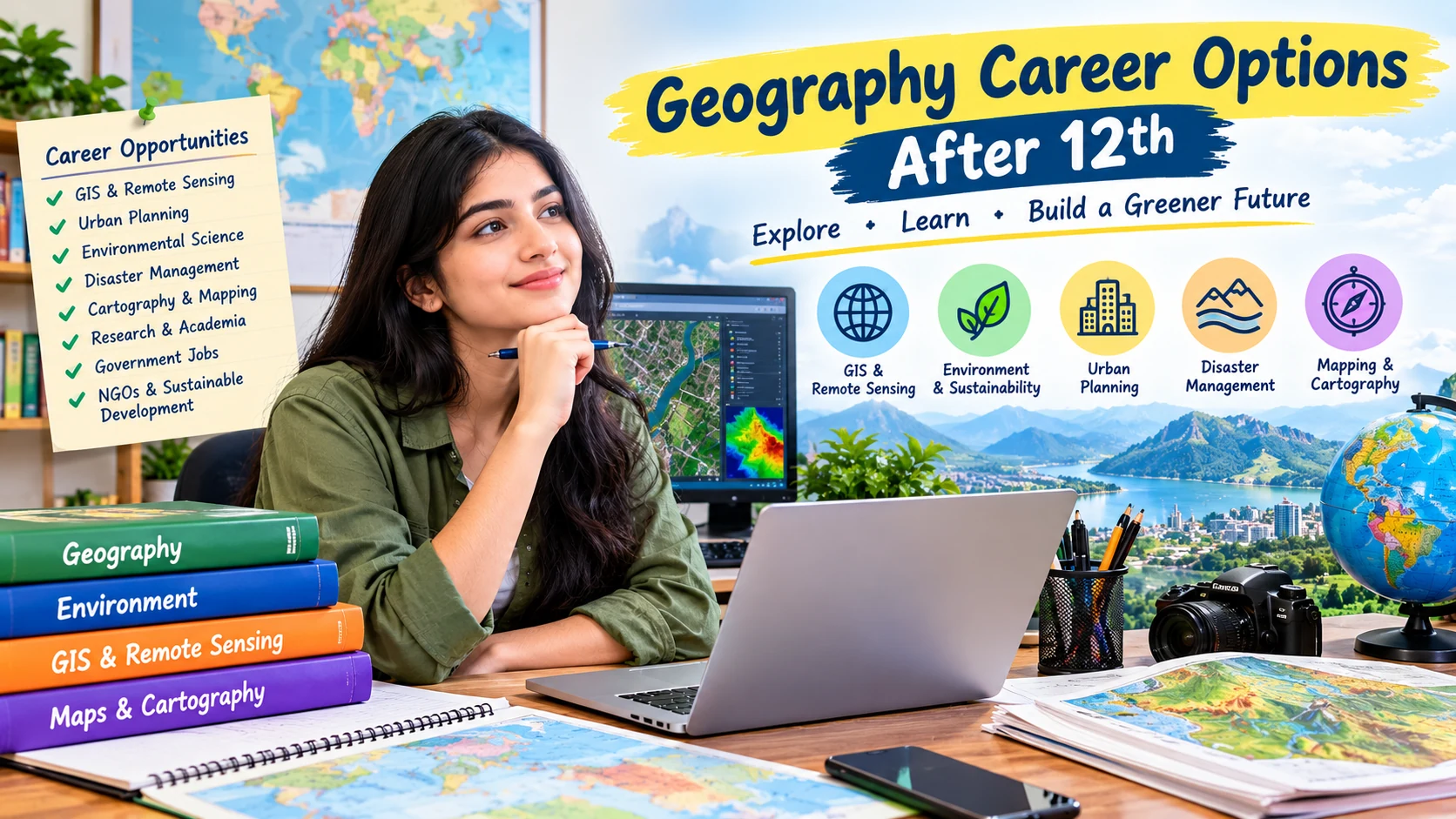
Geography after 12th can lead to different study and career directions, including GIS, mapping, environmental studies, research and planning.
Why Choose Geography After 12th?
12th ke baad Geography choose karne ka decision tab zyada clear hota hai jab student pehle ye samjhe ki subject me theory ke saath practical areas bhi jude hue hain. Physical geography aur human geography ke concepts ke saath GIS, mapping, environmental analysis aur urban studies jaise areas explore kiye ja sakte hain. Isliye course select karte waqt apni interest ko future skill requirements ke saath compare karna useful rahega.
Geography ka academic structure un students ko suit kar sakta hai jo society aur environment ko alag-alag nahi, balki connected systems ke roop me samajhna chahte hain. Population movement, climate, settlements, resources aur regional development jaise topics is connection ko clearly dikhate hain. Agar student ko reading ke saath maps, data interpretation aur field-based learning bhi pasand hai, to graduation ke dauran kai specialization options explore kiye ja sakte hain.
Climate change, water availability, population growth aur expanding cities jaise issues geography ke core study areas se directly connected hain. In topics ko samajhne ke liye location, land use, population distribution aur environmental conditions ko ek saath analyse karna padta hai. Isi type ki understanding ka use research, planning, environmental assessment aur disaster-risk related work me kiya ja sakta hai.
1. Environment Aur Sustainability Careers Ki Growing Demand
Environmental projects me kaam karne wale organizations ko pollution, land use, natural resources aur sustainability se judi information ko assess karna padta hai. Geography background wala student environmental assessment, resource planning aur field-based studies ki taraf ja sakta hai, although specific roles ke liye additional qualification ya technical training ki requirement institution aur job profile ke according alag ho sakti hai.
Environmental direction choose karne wale Geography students ko resource planning, environmental research, sustainability projects aur ecological assessment jaise areas samajhne padte hain. College ke dauran environmental studies ke saath data handling, report writing aur basic research methods seekhna useful rahega. Renewable energy ya sustainability projects me entry ke liye student ko relevant specialization aur organization ki eligibility requirements bhi check karni chahiye.
2. GIS Aur Remote Sensing Jaise Modern Technology Fields
Geography ka technical side GIS aur Remote Sensing ke through clearly samne aata hai. GIS me location-based information ko layers aur spatial data ke form me analyse kiya jata hai, jabki Remote Sensing satellite ya aerial imagery se information collect karne par focus karta hai. In techniques ka use infrastructure mapping, transport planning, agriculture, disaster studies aur logistics-related analysis me kiya ja sakta hai.
GIS work me sirf map banana hi nahi hota; data ko organise karna, different geographic layers compare karna aur location-based patterns identify karna bhi important hota hai. Aise projects me road networks, land use, population distribution ya service locations jaise datasets analyse kiye ja sakte hain. Isliye GIS-related roles ke liye Geography degree ke saath software practice aur spatial-data handling ka hands-on experience bhi valuable hota hai.
GIS aur geospatial work Geography ko technology-based tasks ke saath connect karta hai. Student ek taraf geographical concepts samajhta hai aur doosri taraf mapping software, spatial datasets aur digital visualisation ke saath practice karta hai. Agar aap technical work me interest rakhte hain, to graduation ke saath GIS projects aur portfolio work karna aapko apni practical ability clearly demonstrate karne me help kar sakta hai.
3. Smart Cities Aur Urban Development Me Important Role
Cities ke expand hone ke saath roads, housing, transport networks, public facilities aur land use ko systematically plan karna padta hai. Geography students population distribution, settlement patterns aur land-use changes jaise factors ko study karte hain, jo urban studies me relevant hote hain. Urban planning ke specialised roles ke liye aksar dedicated planning qualification ki requirement hoti hai, isliye Geography graduates ko course eligibility pehle check karni chahiye.
Urban planning me population growth ke saath available land, transport routes, housing requirements aur public infrastructure ko ek saath study kiya jata hai. Geography background student ko in spatial relationships ko samajhne ki foundation deta hai. Agar urban planning ko career banana hai, to graduation ke baad planning ya urban-development related specialised programme ki eligibility aur curriculum ko carefully compare karna practical step hoga.
Cities, transport networks aur land-use planning me interest rakhne wale students Geography ke through spatial analysis ki basic understanding develop kar sakte hain. Is interest ko career skill me convert karne ke liye maps ke saath data interpretation, GIS software aur urban-development concepts par practice karna useful rahega. Aage ka exact career path student ki qualification aur chosen specialisation par depend karega.
4. Climate Change Aur Global Challenges Ko Samajhne Ka Mauka
Climate studies me temperature patterns, rainfall, landforms, water availability aur human settlement jaise factors ko ek geographical context me analyse kiya jata hai. Floods, droughts aur other extreme events ka impact har region me alag ho sakta hai, isliye location-based analysis important hota hai. Geography students in concepts ko aage environmental research, climate studies ya disaster-management related learning me apply kar sakte hain.
Climate-related work me geographical data ko samajhna aur different regions ke environmental conditions compare karna important hota hai. Graduation ke dauran students climatology, environmental studies, GIS aur research methods jaise areas par focus karke apni foundation build kar sakte hain. Research ya policy-oriented roles ke liye higher studies aur role-specific qualifications ki requirement ho sakti hai, isliye career plan ke saath education pathway bhi dekhna zaroori hai.
5. Data-Driven Careers Ki Nayi Duniya
Geography me data ka ek important part location hota hai. Kisi area ki population, roads, land use, customers ya natural resources ko map ke saath analyse karne par patterns zyada clearly samajh aa sakte hain. Isi approach ko spatial analysis ya location intelligence ke context me use kiya jata hai. Students ke liye iska practical benefit tab badhta hai jab woh GIS software ke saath actual datasets par practice karte hain.
Transportation aur logistics projects me routes, service areas aur locations ko analyse karne ke liye spatial data ka use kiya ja sakta hai. E-commerce aur telecom jaise sectors me bhi geographic information planning aur network analysis me relevant ho sakti hai. Geography graduate ko in roles ke liye basic GIS ke saath Excel, data interpretation aur project-based practice develop karni chahiye, kyunki degree ke alawa technical requirements job ke according change hoti hain.
6. Competitive Exams Ke Liye Strong Foundation
Geography ki preparation competitive examinations me useful ho sakti hai, especially un areas me jahan physical geography, human geography, environment aur India-related geographical topics syllabus ka part hote hain. Students ko ye bhi check karna chahiye ki jis examination ko target kiya ja raha hai uske latest syllabus me Geography ka exact role kya hai. Graduation aur exam preparation ko parallel manage karne ke liye topic-wise notes aur regular revision schedule practical approach ho sakta hai.
Agar student competitive examination ki preparation bhi kar raha hai, to graduation me padhe Geography concepts ko exam syllabus ke relevant topics ke saath map kiya ja sakta hai. Isse alag se har concept ko zero se prepare karne ki zarurat kam ho sakti hai, lekin exam-specific current affairs, previous-year questions aur test practice phir bhi separately karni padti hai. Isliye Geography degree ko automatic exam advantage samajhne ke bajay preparation plan ke ek part ke roop me dekhna better hai.
7. Research Aur Higher Education Opportunities
Research ya specialised academic work ki taraf jaana chahne wale students graduation ke baad apne interest ke according higher studies choose kar sakte hain. MA Geography me human aur regional studies par focus ho sakta hai, jabki MSc Geography, Geoinformatics, Remote Sensing ya Environmental Management jaise programmes technical ya environmental direction provide kar sakte hain. Admission se pehle eligibility, subject requirements, practical training aur programme curriculum ko university ke official details se compare karna zaroori hai.
Research-oriented roles me geographical information ko collect karna, datasets ko analyse karna, field observations record karna aur findings ko report ke form me present karna pad sakta hai. Universities, research projects aur policy studies me kaam karne ke liye subject knowledge ke saath research methodology, statistics, GIS ya specialised domain training useful ho sakti hai. Higher academic roles ke liye required qualification position aur institution ke according alag hoti hai.
Geography Sirf Subject Nahi, Ek Perspective Hai
Geography ka main strength different factors ko location ke context me ek saath dekhna hai. Kisi region ko samajhte waqt population, economy, environment, transport aur available resources ko separately nahi dekha ja sakta, kyunki inke beech direct relationships ho sakte hain. Isi analytical approach ki practice students ko maps, data, field observations aur written research ke through develop karni padti hai.
Geography graduates ke career options unki additional skills aur specialisation ke saath kaafi change ho sakte hain. Ek student teaching ya research ki taraf ja sakta hai, jabki doosra GIS, environmental analysis, planning ya data-related work explore kar sakta hai. Is flexibility ka practical benefit tab milta hai jab academic Geography ke saath student ek clear skill set, internship experience aur relevant project portfolio bhi develop karta hai.
Major Branches of Geography
| Branch | Focus Area | Career Relevance |
|---|---|---|
| Physical Geography | Climate, landforms, rivers, ecosystems | Environmental Science, Research |
| Human Geography | Population, migration, settlements | Policy Making, Urban Planning |
| Economic Geography | Resources and industries | Development Planning |
| GIS & Geospatial Science | Mapping and spatial analytics | GIS Analyst, Geospatial Expert |
| Remote Sensing | Satellite data interpretation | Space & Earth Observation Sector |
Courses After 12th (Geography): Complete Study Path & Career Roadmap
12th ke baad Geography se related course choose karte waqt sabse pehle ye dekhna useful hai ki aapko subject ka kaunsa part genuinely interesting lagta hai. BA Geography me human aur social aspects zyada relevant ho sakte hain, jabki BSc Geography, GIS, Remote Sensing ya Environmental Science me scientific aur technical components alag level par mil sakte hain. Course ka final decision lene se pehle eligibility, syllabus, practical work aur higher-study options ko compare kijiye.
Geography ki padhai ko student apni preferred direction ke according aage develop kar sakta hai. Agar interest human geography aur society me hai to academic aur policy-oriented subjects relevant ho sakte hain; technology pasand hai to GIS aur geospatial learning add ki ja sakti hai; environment me interest ho to environmental studies aur resource-related subjects explore kiye ja sakte hain. Isi liye course ke naam se zyada uske actual syllabus aur practical components ko dekhna important hai.
Undergraduate Courses (Bachelor Degree Programs)
Bachelor's degree ke dauran students Geography ke basic concepts ke saath apni preferred area identify kar sakte hain. Is stage par fieldwork, map reading, research assignments, data handling aur basic GIS practice jaise activities future specialisation ko samajhne me help kar sakti hain. Graduation ke final years me internship, project work aur higher-study requirements ko explore karna bhi useful rahega.
1. BA Geography
BA Geography me human aur social dimensions of Geography par substantial attention mil sakta hai, jisme population, settlements, economic activities, regional development aur political geography jaise topics shamil ho sakte hain. Course structure university ke according change hota hai, isliye admission se pehle actual syllabus check karna zaroori hai. Reading, writing, current-affairs analysis aur research-oriented students is academic direction ko apne interests ke saath compare kar sakte hain.
BA Geography ka coursework geographical topics ko social, economic aur regional perspectives ke saath connect karta hai. Is background ka use teaching, research aur competitive-examination preparation me kiya ja sakta hai, lekin har career ke liye alag eligibility aur further qualification ho sakti hai. Agar aap government examinations target kar rahe hain, to degree ke saath respective examination ka latest syllabus aur eligibility separately check karna important hai.
Major Subjects:- Human Geography
- Economic Geography
- Population Geography
- Regional Planning
- Political Geography
- Indian Geography
- Civil Services Aspirants
- Researchers
- Teachers & Academicians
- Policy Analysis Careers
2. BSc Geography
BSc Geography ka structure university ke according vary karta hai, lekin is type ke programme me physical geography, climate, environmental systems, geomorphology aur geographical techniques jaise areas par scientific approach mil sakti hai. Kuch programmes me practical work, mapping aur geospatial techniques bhi curriculum ka part hote hain. Admission se pehle students ko laboratory or fieldwork requirements aur actual subject structure zaroor dekhna chahiye.
GIS, environmental studies ya geographical research ki taraf jaana chahne wale students BSc Geography ke scientific subjects ko apni foundation ke roop me use kar sakte hain. Is direction ko stronger banane ke liye graduation ke saath GIS software, data analysis, research methods ya field-study projects me practical exposure lena useful ho sakta hai. Higher studies choose karte waqt programme ki eligibility aur required undergraduate subjects ko pehle verify karein.
Major Subjects:- Physical Geography
- Geomorphology
- Climatology
- Hydrology
- Cartography
- Geospatial Techniques
- GIS Professionals
- Environmental Researchers
- Climate Analysts
- Urban Development Experts
3. BSc Geology
Earth ke rocks, minerals, groundwater aur geological processes me interest rakhne wale students Geography ke saath Geology ko bhi compare kar sakte hain. Geology ka academic focus Earth materials aur processes par hota hai, isliye iska syllabus Geography se alag direction leta hai. Admission se pehle eligibility subjects, practical training aur future career areas ko university ke programme details ke saath compare karna useful rahega.
Geology graduates ke liye mining, groundwater studies, geological surveys, natural-resource projects aur environmental consulting jaise areas relevant ho sakte hain. In roles ki exact eligibility organisation aur position ke according change hoti hai, isliye sirf sector ka naam dekhkar career assume nahi karna chahiye. Student ko course ke practical components, required technical knowledge aur recruitment criteria ko pehle compare karna chahiye.
Career Areas:- Mining Industry
- Oil & Gas Sector
- Groundwater Analysis
- Geological Survey Projects
4. BSc Environmental Science
BSc Environmental Science me environment ko biological, chemical, social aur management perspectives se study kiya ja sakta hai. Programme me biodiversity, pollution, conservation, sustainability aur environmental management jaise topics mil sakte hain, although exact subjects university ke syllabus par depend karte hain. Environment-related career plan karne wale students ko course select karte waqt fieldwork, laboratory exposure, research projects aur internship opportunities ko bhi compare karna chahiye.
Environmental sector me kaam karne ke liye subject knowledge ke saath regulations, reporting, data handling aur practical project experience ka role ho sakta hai. Climate studies, sustainability, pollution monitoring aur environmental assessment jaise areas me alag-alag qualifications ki requirement hoti hai. Isliye students ko career role ke naam ke saath uski eligibility aur required skills bhi check karni chahiye, especially higher-level technical positions ke liye.
Career Areas:- Environmental Consultant
- Sustainability Officer
- Pollution Control Expert
- Environmental Researcher
5. BSc GIS & Geoinformatics
GIS skills ka use transportation, logistics, telecom, infrastructure mapping, environmental projects aur urban studies jaise areas me ho sakta hai. Career preparation ke liye student ko kisi ek software ka naam yaad karne ke bajay mapping workflow, spatial-data cleaning, basic analysis aur map presentation par practice karni chahiye. Internship ya college project me banaye gaye maps aur analyses ko portfolio me organise karna bhi practical step ho sakta hai, Aaj transportation, logistics, telecom, defense aur smart city projects me GIS professionals ki demand steadily increase ho rahi hai.
Key Skills Learned:- GIS Software Handling
- Spatial Data Analysis
- Digital Cartography
- Location Intelligence
- Database Management
- GIS Analyst
- Geospatial Specialist
- Mapping Engineer
- Spatial Data Analyst
6. BSc Remote Sensing Technology
Remote Sensing ka application agriculture monitoring, land-use studies, disaster assessment, weather-related observation aur natural-resource mapping jaise projects me ho sakta hai. Is field me interest rakhne wale students ko satellite imagery ke basic concepts ke saath GIS aur spatial analysis bhi seekhna useful rahega. Advanced roles ke liye programming, image processing ya specialised postgraduate training ki requirement position ke according ho sakti hai, Agriculture, weather forecasting, disaster management, defense aur natural resource monitoring me remote sensing technology ka extensive use hota hai.
Future Opportunities:- Satellite Data Analyst
- Remote Sensing Specialist
- Earth Observation Expert
- Geospatial Consultant
Which Geography Course Should You Choose After 12th?
12th ke baad Geography-related course choose karte waqt ek simple approach ye hai ki pehle apni preferred work style identify karein. Agar aap reading, society aur current affairs me comfortable hain to BA Geography ke subjects compare kijiye; scientific and environmental topics pasand hain to BSc Geography ya Environmental Science dekhiye; aur agar software, mapping aur data ke saath kaam karna interesting lagta hai to GIS, Geoinformatics ya Remote Sensing programmes ke curriculum ko dekhiye.
Neeche ka comparison course ke academic focus aur possible career directions ko ek jagah rakhta hai. Is table ko final recommendation ki tarah na dekhein; admission se pehle university ka current syllabus, eligibility, practical training, fees aur higher-study requirements bhi verify karna chahiye. Same course ka structure alag institutions me kaafi different ho sakta hai.
| Course | Best For Students Who Like | Main Focus Area | Popular Career Paths | Who Should Choose This Course? |
|---|---|---|---|---|
| BA Geography | Current Affairs, Society, Human Development, Government Exams | Human Geography, Regional Development, Population Studies | UPSC, State PCS, Teaching, Research, Policy Analysis | Students preparing for government exams, teaching careers or social science-related fields. |
| BSc Geography | Science, Environment, Climate, Natural Systems | Physical Geography, Climatology, Environmental Analysis | Research, Environmental Sector, Higher Studies | Students interested in scientific study of the Earth, environment and climate systems. |
| BSc GIS & Geoinformatics | Technology, Mapping, Data Analysis | GIS Software, Spatial Analytics, Digital Mapping | GIS Analyst, Geospatial Expert, Mapping Engineer | Students who enjoy technology, digital mapping, software tools and location-based data. |
| BSc Environmental Science | Environment Protection, Sustainability, Ecology | Pollution Control, Sustainability Management | Environmental Consultant, Sustainability Officer | Students passionate about environmental conservation, sustainability and climate-related issues. |
| BSc Geology | Earth Science, Minerals, Natural Resources | Geology, Resource Exploration, Earth Processes | Mining, Oil & Gas, Geological Surveys | Students interested in rocks, minerals, natural resources and Earth's physical structure. |
| BSc Remote Sensing Technology | Satellites, Space Technology, Data Interpretation | Satellite Imaging, Earth Observation | Remote Sensing Specialist, Geospatial Consultant | Students fascinated by satellite technology, aerial imaging and advanced geospatial applications. |
A Simple Way To Decide
Geography ke baad course choose karte waqt ek hi option sabhi students ke liye suitable nahi hota. Apne decision ko clear karne ke liye pehle ye dekhiye ki aapko theory aur social studies me zyada interest hai, science aur environment me, ya technology aur location-based data me. Iske baad selected courses ki eligibility, syllabus, practical subjects, software training aur higher-study requirements ko compare kijiye. Is process se course ka naam dekhkar decision lene ke bajay aap apni interest aur career direction ke according options ko shortlist kar sakte hain.
- Government examinations ya Geography-based academic study me interest hai? BA Geography ke syllabus me human geography, physical geography, regional studies aur related topics par focus ho sakta hai. Admission se pehle university ka current syllabus aur eligibility criteria check kijiye.
- Physical Geography, environment aur scientific topics pasand hain? BSc Geography ya Environmental Science jaise courses consider kiye ja sakte hain. Dono programmes ka syllabus university ke according different ho sakta hai, isliye practical work aur core subjects ko compare karna useful rahega.
- Technology, digital maps aur location-based data me interest hai? GIS & Geoinformatics ya Remote Sensing se related programmes explore kiye ja sakte hain. Course select karte waqt GIS software, spatial data, mapping projects aur practical training available hai ya nahi, ye zaroor check karein.
- Earth materials, natural resources aur geological processes samajhna pasand hai? Geology ek alag academic direction provide karta hai jisme rocks, minerals, Earth processes aur natural resources jaise areas study kiye ja sakte hain. Is field ko choose karne se pehle course eligibility, laboratory work aur field-based training ko dekhein.
- Climate, pollution, conservation aur sustainability me interest hai? Environmental Science aur related programmes ko shortlist kiya ja sakta hai. In courses me environmental systems ke saath research, data collection, regulations aur practical project work ka exposure mil sakta hai, lekin exact subjects university ke curriculum par depend karte hain.
Current Industry Perspective
Geography se related career paths ab traditional roles tak limited nahi hain. GIS, Geospatial Technology, Remote Sensing aur Environmental Management jaise areas mein students ko technology aur subject knowledge ko combine karne ka opportunity milta hai. In fields mein kaam karne ke liye employers ki requirements role ke according alag ho sakti hain, isliye students ko course ke saath relevant software, data handling, research ya fieldwork skills par bhi focus karna chahiye.
Iska matlab ye nahi hai ki BA Geography ya traditional Geography degrees ki relevance khatam ho gayi hai. Government examinations, teaching, research, policy-related work aur higher education jaise pathways ab bhi Geography graduates ke liye available hain. Student ke liye practical approach ye hai ki graduation ke dauran apne preferred career direction ko identify karke uske according internship, certification, competitive-exam preparation ya postgraduate study plan kiya jaye.
Postgraduate Courses After Geography: Advanced Specializations & Career Opportunities
Graduation complete karne ke baad kai students ke mind me ek common question aata hai – "Kya Master's degree karni chahiye ya directly job start karni chahiye?" Iska answer largely aapke career direction par depend karta hai. Agar aap research, teaching, specialized technical roles ya leadership positions tak pahunchna chahte hain, to postgraduate studies aapke liye ek strong investment ho sakti hain.
Master's degree ka purpose sirf qualification badhana nahi hota. Ye aapko kisi specific area me deeper expertise develop karne, advanced tools seekhne aur complex real-world problems ko solve karne ki capability build karne me help karti hai.
MA Geography
MA Geography un students ke liye suitable mana jata hai jo Human Geography, Regional Development, Population Studies, Public Policy aur Social Research me interest rakhte hain.
Is course me geographical issues ko social, economic aur developmental perspective se samjha jata hai. Students ko regional planning, resource distribution, urban growth aur policy-related challenges ka analytical understanding develop karne ka mauka milta hai.
Key Areas of Study:- Human Geography
- Population Studies
- Regional Planning
- Development Geography
- Political & Economic Geography
- Research Associate
- Policy Analyst
- Academic Researcher
- Development Sector Professional
- Teaching & Education
MSc Geography
MSc Geography geography ke scientific aur analytical aspects par focus karta hai. Ye course students ko physical geography, environmental systems aur advanced geographical research methods me expertise provide karta hai, Agar aap climate science, environmental studies, resource management ya geographical research me career banana chahte hain, to MSc Geography ek strong option ho sakta hai.
Key Areas of Study:- Physical Geography
- Climatology
- Geomorphology
- Environmental Modeling
- Advanced Geospatial Techniques
- Environmental Researcher
- Climate Analyst
- Geography Lecturer
- Research Scientist
- Project Coordinator
MSc GIS & Remote Sensing
Ye Geography ke sabse career-oriented aur industry-focused postgraduate programs me se ek mana jata hai. Aaj infrastructure planning, transportation, agriculture, disaster management aur urban development sectors me GIS aur Remote Sensing technologies ka extensive use ho raha hai, Is course me students digital mapping, satellite imagery interpretation, spatial database management aur advanced geospatial analysis techniques seekhte hain.
Key Areas of Study:- GIS Applications
- Remote Sensing Technologies
- Spatial Data Analysis
- Satellite Image Processing
- Geospatial Database Management
- GIS Specialist
- Geospatial Analyst
- Remote Sensing Expert
- Mapping Consultant
- Spatial Data Scientist
MSc Environmental Management
MSc Environmental Management un students ke liye useful postgraduate option ho sakta hai jo environment se related problems ko scientific, administrative aur practical perspective se samajhna chahte hain. Course me environmental planning, resource management, sustainability, pollution control, environmental assessment aur applicable regulations jaise topics cover kiye ja sakte hain. Exact subjects aur practical components university ke curriculum ke according different ho sakte hain, isliye admission se pehle syllabus aur eligibility requirements check karna important hai.
Is specialization ke through students environmental projects ke planning, monitoring, reporting aur management aspects ko samajhne ki preparation kar sakte hain. Government departments, consulting organisations, research projects aur other environment-related workplaces me roles ke liye additional skills aur qualification requirements alag ho sakti hain. Agar aap is field ko career direction ke roop me consider kar rahe hain, to course ke practical training, fieldwork, research opportunities aur target job ki eligibility ko saath me compare karna useful rahega.
Key Areas of Study:- Environmental Planning
- Sustainability Management
- Natural Resource Management
- Environmental Impact Assessment
- Environmental Policy
- Environmental Consultant
- Sustainability Manager
- Resource Management Specialist
- Environmental Auditor
- Project Manager
MSc Geoinformatics
MSc Geoinformatics un students ke liye suitable postgraduate direction ho sakta hai jo Geography ke concepts ko GIS, Remote Sensing, digital mapping aur spatial data ke technical applications ke saath combine karna chahte hain. Is programme me geographic information ko collect, organise, analyse aur visualise karne ke methods par kaam kiya ja sakta hai. Course structure university ke according alag ho sakta hai, isliye admission se pehle syllabus, eligibility criteria, practical training aur project requirements ko check karna important hai.
Is field ki study classroom theory ke saath practical computer-based work par bhi focus kar sakti hai. Students digital maps prepare karna, spatial datasets ko manage karna, different geographic layers ko compare karna aur location-based patterns ko interpret karna seekh sakte hain. Kuch programmes me programming, spatial databases ya Remote Sensing jaise additional components bhi include ho sakte hain. Agar aap technical geospatial career ki taraf jaana chahte hain, to course choose karte waqt available software training aur hands-on projects ko bhi syllabus ke saath compare karein.
Key Areas of Study:- Geospatial Technologies: Geographic information ko digital format me collect, manage aur process karne wali technologies ka basic understanding.
- Advanced GIS Systems: GIS platforms ke through spatial layers, geographic datasets aur digital maps ke saath more detailed analysis karna.
- Spatial Analytics: Location-based data ko analyse karke geographic patterns, relationships aur distribution ko understand karna.
- Programming for Geospatial Applications: Geospatial data ke processing, automation ya application-based tasks ke liye programming concepts ka use.
- Location Intelligence: Geographic information ko business, infrastructure, planning ya operational decisions ke context me interpret karna.
- Geoinformatics Specialist: Geospatial datasets, mapping workflows aur GIS-based projects par technical work karne wale roles.
- Location Intelligence Analyst: Location-based information ko analyse karke organisations ke planning aur operational requirements ke liye insights prepare karna.
- GIS Developer: GIS applications, mapping tools ya geospatial systems ke development aur technical implementation se related work.
- Spatial Data Consultant: Spatial datasets, GIS workflows aur location-based analysis se related projects me technical guidance provide karna.
- Geospatial Project Manager: Geospatial projects ke planning, coordination, timelines aur project deliverables ko manage karna; is type ke role ke liye relevant experience bhi important ho sakta hai.
MSc Geoinformatics ke baad exact job title aur eligibility employer, role aur candidate ke technical experience ke according change ho sakti hai. Isliye degree complete karne ke saath GIS software, spatial data handling, basic programming aur project documentation jaise skills par practical work karna useful rahega. Students apne coursework ke projects ko portfolio me organise karke future internships ya job applications ke liye bhi use kar sakte hain.
Comparison of Popular Postgraduate Geography Courses
| Course | Main Focus | Best For | Popular Career Areas |
|---|---|---|---|
| MA Geography | Human & Regional Geography | Research, Policy & Government Sector | Teaching, Research, Public Policy |
| MSc Geography | Scientific & Environmental Studies | Research & Higher Education | Climate Science, Environment, Academia |
| MSc GIS & Remote Sensing | Mapping & Geospatial Technology | Technology-Oriented Students | GIS, Remote Sensing, Analytics |
| MSc Environmental Management | Sustainability & Resource Planning | Environment-Focused Students | Consulting, Sustainability, Environment |
| MSc Geoinformatics | Advanced Geospatial Technology | Technical & Data-Oriented Students | Geospatial Analytics, GIS Development |
Should You Pursue a Master's Degree?
Master's degree ka decision aapke target career par depend karta hai. Agar aap research, academia, specialised GIS, environmental consulting, geospatial analysis ya kisi subject-specific role mein jaana chahte hain, to relevant postgraduate qualification aapki academic preparation ko deepen kar sakti hai. Agar aap graduation ke baad work experience lena chahte hain, to entry-level job ke saath practical projects aur role-specific certifications bhi consider kiye ja sakte hain.
Specialisation select karne se pehle course syllabus, practical training, software exposure, project requirements aur us qualification ke baad available career paths check karein. Is comparison se student ko ye samajhne mein help milegi ki Master's degree uske planned career ke liye genuinely relevant hai ya graduation ke baad practical experience pehle lena zyada suitable rahega.
Professional Certifications and Training for Geography Careers
Geography degree ke saath additional technical training students ko specific career areas ke liye practical skills develop karne me help kar sakti hai. GIS, Remote Sensing, digital mapping, spatial data aur environmental assessment jaise areas me short-term courses ya professional training available hoti hai. Certification ko degree ka replacement nahi samajhna chahiye; iska value mainly is baat par depend karta hai ki training me kya skills cover ki gayi hain, practical assignments milte hain ya nahi, aur woh skills target job ke requirements se kitni closely match karti hain.
Course choose karte waqt sirf certificate ke naam par decision lene ke bajay syllabus, software covered, practical exercises, assessment method aur training provider ki credibility ko compare karein. Agar aap GIS-based career target kar rahe hain, to mapping aur spatial-data projects wali training useful ho sakti hai. Remote Sensing me interest hone par image interpretation aur satellite-data related practice dekhein, jabki environmental direction me relevant assessment, reporting aur regulatory concepts ka exposure zyada useful ho sakta hai.
Training and Certification Areas to Explore:- GIS Software Training: Digital mapping, spatial layers, coordinate systems and basic GIS workflows par hands-on practice.
- ArcGIS Training or Certification: ArcGIS-based mapping, spatial analysis aur software workflows ki structured learning; exact certification requirements provider ke according check karein.
- QGIS Training: Open-source GIS software ke through map creation, data management aur spatial analysis ki practical practice.
- Remote Sensing and Image Interpretation: Satellite imagery ko understand karna, image-based information interpret karna aur land-use related analysis ki practice.
- Spatial Data Analytics: Geographic datasets ko organise, analyse aur visualise karne ke liye data-handling aur spatial-analysis concepts.
- GPS Survey and Mapping: Location data collection, field measurements aur geographic coordinates ko mapping workflows ke saath use karne ki basic training.
- Cartography and Digital Mapping: Readable maps design karna, geographic information present karna aur digital cartographic principles ko apply karna.
- Environmental Assessment Training: Environmental assessment, documentation, monitoring aur relevant regulatory concepts ki introductory ya specialised training.
Final Advice Before Choosing a Course
Course choose karte waqt sirf popularity ya kisi aur student ki advice ko decision ka base na banayein. Pehle apne interest areas, preferred type of work, academic strengths aur long-term career plan ko identify karein. Technology aur mapping mein interest ho to GIS ya Geoinformatics ke syllabus ko compare karein; environment aur sustainability mein interest ho to Geography, Environmental Science ya related programmes ke subjects aur practical components dekhein.
Geography ki padhai ke baad career direction choose karne ke kai possible routes ho sakte hain, including government examinations, teaching, research, environmental work, GIS, planning aur geospatial technology. Final decision lene se pehle course eligibility, duration, fees, practical training, internship opportunities aur required additional skills ko compare karna students ke liye zyada useful rahega.
Geography Career Roadmap (Visual Guide)
12th Pass
     │
     ▼
BA/BSc Geography
     │
     ├─────────────► Government Exam Preparation
     │                    │
     │                    ▼
     │               UPSC / SSC / PCS
     │
     ▼
GIS / Remote Sensing Skills
     │
     ▼
Internship + Projects
     │
     ▼
GIS Analyst / Research Associate
     │
     ▼
Senior GIS Specialist
     │
     ▼
Project Manager / Geospatial Consultant
Top Career Options in Geography
1. GIS Analyst
GIS Analyst ka kaam location-based datasets ko organise, clean aur analyse karna ho sakta hai. Project ke according roads, land use, population, infrastructure ya environmental information ko different map layers me work kiya ja sakta hai. Is role ke liye GIS software, spatial analysis, cartography aur basic database handling useful skills hain, aur students college projects ke through in skills ka practical portfolio bana sakte hain.
Key Skills
- ArcGIS
- QGIS
- Spatial Data Analysis
- Cartography
- Database Management
2. Environmental Consultant
Environmental consultants organisations ko environmental assessment, compliance, pollution-related studies aur sustainability projects me support kar sakte hain. Work profile me documentation ke saath site visits, data collection ya reports ka analysis bhi ho sakta hai. Is field me entry requirements role ke according vary karti hain, isliye Geography graduate ko environmental studies, regulations, report writing aur relevant internship experience ko apni career preparation ka part banana chahiye.
3. Urban Planner
Urban planners cities aur towns ke land use, transport, housing, public facilities aur infrastructure se jude planning projects par kaam karte hain. Geography background se population distribution, settlement patterns aur spatial relationships ko samajhne me foundation mil sakti hai. Lekin professional urban-planning roles ke liye specialised planning qualification ki requirement ho sakti hai, isliye student ko target role ki eligibility admission se pehle verify karni chahiye.
4. Disaster Management Specialist
Disaster-management work me floods, earthquakes, cyclones aur other hazards ke risk ko identify karna, vulnerable areas ko map karna aur preparedness ya mitigation planning me support dena shamil ho sakta hai. Geography students GIS, remote sensing, physical geography aur field-data collection jaise skills ke through relevant foundation bana sakte hain. Specific specialist positions ke liye disaster management ya related higher qualification ki requirement institution ke according alag ho sakti hai.
5. Cartographer
Cartographers geographic information ko readable maps aur digital visualisations me convert karte hain. Traditional map-making ke saath modern cartography me GIS software, spatial databases, coordinate systems aur digital map design ka knowledge bhi useful ho sakta hai. Geography students map interpretation aur GIS practice ko college assignments me apply karke apne portfolio ke liye sample maps prepare kar sakte hain.
6. Climate Change Researcher
Climate research roles me temperature, rainfall, land-use change, environmental indicators aur other datasets ko study karke regional patterns samjhe ja sakte hain. Geography students climatology, environmental studies, statistics, GIS aur research methods ki foundation develop karke is direction ko explore kar sakte hain. Research-focused positions ke liye higher studies aur specialised research experience ki requirement role aur institution ke according ho sakti hai.
Detailed Salary Structure in Geography Careers
| Job Role | Entry Level | Mid-Level | Experienced |
|---|---|---|---|
| GIS Analyst | ₹4–7 LPA | ₹8–14 LPA | ₹15–30+ LPA |
| Environmental Consultant | ₹4–8 LPA | ₹8–16 LPA | ₹18–35+ LPA |
| Urban Planner | ₹5–9 LPA | ₹10–18 LPA | ₹20–40+ LPA |
| Research Scientist | ₹5–10 LPA | ₹12–20 LPA | ₹25–50+ LPA |
| Disaster Management Expert | ₹4–8 LPA | ₹8–15 LPA | ₹18–30+ LPA |
Note: Table me diye gaye salary ranges ko indicative figures ke roop me dekhein, guaranteed pay ke roop me nahi. Geography-related roles me salary qualification, technical skills, employer, work location, experience aur role ki responsibility ke according kaafi change ho sakti hai. Job offer compare karte waqt fixed pay, variable component, experience requirement aur required skills ko separately check karna practical rahega.
Future Scope of Geography (2027–2035)
2027–2035 ke period ko dekhte hue Geography se jude career areas ko samajhne ke liye location-based data, environmental monitoring, urban development, infrastructure mapping aur disaster-risk studies jaise applications par focus karna useful hai. In areas me technology ka role badhne ke saath students ke liye sirf Geography theory par depend rehna enough nahi ho sakta; GIS, data interpretation, research methods aur relevant project experience jaise practical skills ko bhi apne learning plan me include karna chahiye.
Future Growth Drivers
- Smart Cities Mission
- Climate Change Monitoring
- Renewable Energy Planning
- Satellite Data Analytics
- Disaster Risk Assessment
- Urban Infrastructure Development
- Agricultural Mapping Technologies
- Transportation & Logistics Optimization
Frequently Asked Questions (FAQ)
Is Geography a good career option after 12th?
Geography after 12th ek single career path tak limited nahi hai. Graduation ke baad students teaching, research, government examinations, GIS, environmental studies, urban development, mapping aur other location-based fields ki taraf move kar sakte hain. Career direction largely is baat par depend karti hai ki student theoretical Geography ke saath fieldwork, data analysis, GIS software ya environmental studies me kis area ko develop karta hai. Course select karne se pehle eligibility, university syllabus, practical work aur future role requirements ko compare karna useful rahega.
Can Geography students work in the IT sector?
Haan, Geography students technology-related roles ke liye prepare kar sakte hain, particularly jab woh GIS, geospatial data, digital mapping aur spatial analysis jaise skills develop karte hain. GIS-based work me maps create karna, location data ko organise karna, different geographic layers ko analyse karna aur project ke according visual information prepare karna shamil ho sakta hai. Agar aap is direction me jana chahte hain, to graduation ke saath GIS software practice, basic data handling aur 2–3 practical mapping projects ka portfolio banana helpful rahega.
Which skills are useful for building a career in Geography?
Geography me useful skills career direction ke according change hoti hain. GIS aur digital mapping geospatial roles ke liye important ho sakte hain, jabki Remote Sensing satellite imagery aur land-use analysis se related work me useful hai. Research-oriented students ko data interpretation, report writing, fieldwork aur basic statistics par focus karna chahiye. Environmental ya planning-related roles ke liye subject knowledge ke saath relevant software, research methods aur practical project experience develop karna bhi important ho sakta hai.
Is Geography useful for UPSC preparation?
Geography ka academic content UPSC Civil Services Examination ki preparation me relevant ho sakta hai, kyunki is subject me physical geography, human geography, resources, environment aur regional patterns jaise areas cover hote hain. Lekin Geography degree ko UPSC preparation ka substitute nahi samajhna chahiye. Aspirants ko current affairs, previous-year questions, answer writing aur examination ke latest official syllabus ke according preparation karni hoti hai. Agar Geography ko optional subject ke roop me choose karna ho, to current UPSC syllabus aur recent question papers ko pehle check karna practical approach rahega.
What courses can students choose after 12th with Geography?
12th ke baad Geography me interest rakhne wale students BA Geography aur BSc Geography jaise undergraduate programmes consider kar sakte hain. Interest ke according GIS, Geoinformatics, Environmental Science aur related areas bhi explore kiye ja sakte hain. Har university ka eligibility criteria, subject combination aur practical structure alag ho sakta hai, isliye admission lene se pehle official course details ko carefully check karna better rahega. Agar student technology-based career ki taraf jana chahta hai, to course me GIS, mapping ya data-related practical exposure ko bhi compare karna useful hoga.
What jobs are available after studying Geography?
Geography ke baad job options student ki qualification aur developed skills par depend karte hain. GIS aur mapping ke interest wale students geospatial roles explore kar sakte hain, jabki environmental studies, research, teaching, urban development aur disaster management bhi possible directions hain. Kuch specialised positions ke liye postgraduate qualification ya additional professional training ki requirement ho sakti hai. Isliye kisi particular job ko target karne se pehle uski eligibility, required skills, experience aur employer ki current requirements ko check karna important hai.
Can Geography students build a career in GIS and Remote Sensing?
Geography students GIS aur Remote Sensing ko additional technical skills ke roop me develop karke geospatial field ki taraf move kar sakte hain. GIS me digital maps, spatial layers aur location-based datasets ke saath kaam kiya jata hai, jabki Remote Sensing me satellite ya aerial imagery se geographic information analyse ki ja sakti hai. Is field me interest rakhne wale students software practice ke saath real datasets par small projects bana sakte hain. Aise projects classroom concepts ko practical work se connect karne me help karte hain.
Is higher education necessary for a Geography career?
Har Geography-related career ke liye postgraduate degree compulsory nahi hoti, lekin specialised roles me higher education useful ya required ho sakti hai. MA or MSc Geography, Geoinformatics, Remote Sensing, Environmental Management aur related programmes students ko advanced subject knowledge aur practical exposure de sakte hain. Research aur academic careers me qualification requirements generally alag hoti hain, jabki technical roles me software skills aur project experience bhi important ho sakte hain. Isliye higher studies ka decision target career ki actual eligibility requirements dekhkar lena chahiye.
Disclosure: Some links on this page may be affiliate links. We may earn a small commission at no extra cost to you.
Recommended Resources
- NCERT Geography Books (Class 11 & 12)
- Oxford School Atlas
- GIS Software Practice Platforms
- Remote Sensing Learning Resources
- Environmental Research Journals
Geography Students Ki 7 Common Mistakes Jo Career Growth Ko Slow Kar Deti Hain
Har saal hazaron students Geography me graduation complete karte hain, lekin sabko expected career growth nahi mil pati. Iska reason subject nahi, balki planning aur skill development ki kami hoti hai.
1. Sirf Degree Par Depend Rehna
Aaj ke competitive market me sirf BA ya BSc Geography sufficient nahi mana jata. Employers practical skills aur software knowledge ko bhi importance dete hain.
2. GIS Tools Na Seekhna
Kai students graduation complete kar lete hain lekin ArcGIS, QGIS ya Google Earth Pro jaise tools ka use nahi jante. Result ye hota hai ki unke paas theoretical knowledge hoti hai lekin industry-ready skills nahi hoti.
3. Internship Ignore Karna
College ke dauran ki gayi internship future job opportunities ko kaafi impact karti hai. Field surveys, mapping projects aur research internships resume ko strong banati hain.
4. Government Jobs Par Hi Focus Karna
UPSC ya State PCS prepare karna achhi baat hai, lekin backup career plan bhi hona chahiye. Geography students ke liye private sector me bhi bahut opportunities available hain.
5. Current Environmental Issues Follow Na Karna
Climate change, water scarcity, urban expansion aur renewable energy jaise topics geography careers me directly relevant hote hain. Updated knowledge candidate ko dusron se alag banati hai.
Final Thoughts
Geography ek aisa subject hai jo traditional academic knowledge ko modern technology ke saath connect karta hai. Ye field sirf maps aur locations tak limited nahi hai, balki climate science, environmental sustainability, urban development, geospatial technology aur data analytics jaise fast-growing sectors ka foundation bhi hai.
Agar aap future-ready career, government exam support aur technology-driven opportunities ka combination chahte hain, to Geography after 12th ek strong aur stable career direction choice ho sakti hai.